

Published Oct 28, 2026 | 10:38 AM ⚊ Updated Oct 28, 2026 | 10:38 AM

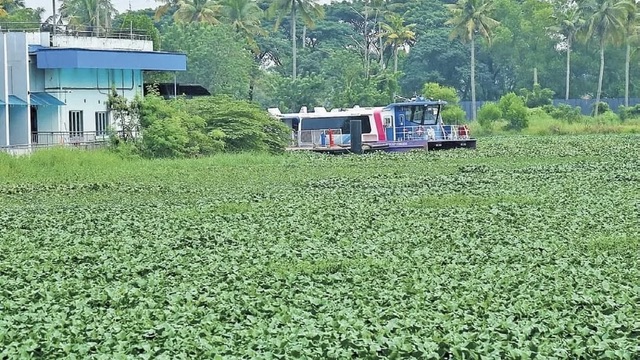
A water hyacinth waterbody in Keralam (Courtesy: Director General of Shipping)

Synopsis: Could the weed choking Keralam’s water bodies become a source of jobs? The State is exploring scientific methods to control water hyacinth and turn the invasive plant into biodegradable products and other marketable goods. The Thrissur-Ponnani Kole wetlands could serve as a testing ground for the approach, which aims to contain the weed’s damage to waterways, fisheries and agriculture while creating livelihoods from the biomass removed from water bodies.
Keralam’s 55,734 water bodies face the threat of water hyacinth, an invasive weed that chokes waterways, threatens aquatic life and disrupts farming. After years of efforts to contain its spread, the State government is considering a scientific approach to controlling the weed and finding uses for the vegetation removed from water bodies.
The proposed approach combines scientific methods to control the weed with its conversion into compost and other marketable products, creating scope for employment. The Thrissur-Ponnani Kole wetlands could serve as the testing ground for this strategy.
The weed continues to spread despite measures taken over the years. Its rapid growth and reproduction make it difficult to control, while periodic removal alone has failed to resolve the problem. The government is now considering a broader approach that would address both its spread and the disposal and reuse of the harvested vegetation.
The issue came up in the Assembly on 26 October, when C Raveendranath, MLA, raised a calling attention motion on the unchecked proliferation of water hyacinth and its damaging effects on water bodies and agriculture.
In his response, Water Resources Minister Mons Joseph outlined a plan combining scientific control measures with the removal of the weed and the conversion of the harvested vegetation into compost and other marketable goods.
Also Read: A case of rotten apples? Vigilance to probe unused iPhones worth Rs 7.16 crore in Keralam hospitals
Native to the Amazon basin in Brazil and tropical South America, water hyacinth is a highly invasive aquatic plant.
It’s said that it was introduced to India as an ornamental plant in 1896 at the Botanical Garden in Shibpur, West Bengal. It subsequently spread across the country, infesting freshwater bodies under widely varying agro-climatic conditions.
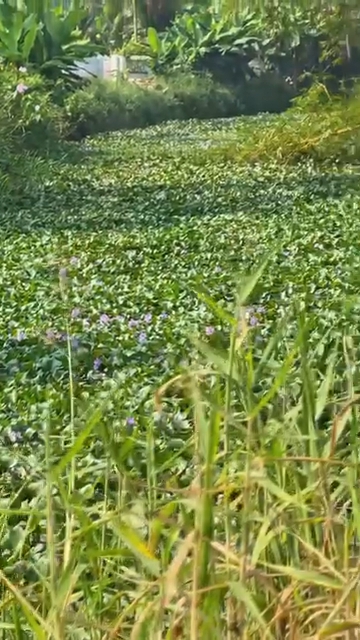
A water hyacinth filled waterbody
The International Union for Conservation of Nature (IUCN) has identified water hyacinth as one of the world’s most dangerous invasive species, given the difficulty of eradicating it and its far-reaching socioeconomic consequences.
In Keralam, its unchecked growth obstructs the natural flow of water in rivers, backwaters, streams and canals, affecting inland navigation, fishing and agricultural operations. The accumulation of the weed also reduces dissolved oxygen levels, degrades water quality and threatens aquatic biodiversity.
The problem becomes more acute during the monsoon, when mats of vegetation obstruct water flow, contributing to waterlogging and increasing the risk of flooding.
The proliferation of water hyacinth and other aquatic weeds, including pola and various forms of moss and algae, is also linked to the entry of organic waste and residues from chemical fertilisers into water bodies.
The minister said regulating the discharge of such waste and fertiliser residues into backwaters and other water sources could help curb weed growth to some extent.
The State government proposes to constitute an expert committee with specialists from Kerala Agricultural University, the Centre for Water Resources Development and Management (CWRDM), the Kerala State Council for Science, Technology and Environment (KSCSTE) and fisheries research institutions.
The committee will examine long-term scientific methods to control water hyacinth, including technologies used successfully elsewhere that could be adapted to Keralam’s conditions. The Thrissur-Ponnani Kole wetlands have been identified as a possible pilot site to test these interventions.
Existing canal and pond cleaning operations involve removing water hyacinth, algae and other aquatic vegetation. The Irrigation Department’s mechanical wing has dredgers and silt pushers to remove accumulated silt and mud from backwaters and rivers, as well as weed harvesters to clear aquatic vegetation.
The government has acknowledged the need for scientific studies to develop more effective and lasting methods of controlling the weed.
Water Resources Minister Mons Joseph said the government would examine the feasibility of a practical, research-based project that combines water hyacinth control with the production of value-added goods.
The Water Resources, Local Self-Government and Animal Husbandry departments would be involved in the project. The government would also coordinate with the Fisheries and Industries departments and seek technical support from research institutions.
Also Read: Child seen steering moving car in Thiruvananthapuram two days after Cheranallur crash
The State government is also exploring ways to put water hyacinth removed from water bodies to productive use rather than treating it as waste.
Several countries have developed methods to convert the weed into organic compost, decorative items and other value-added products. Keralam will assess whether similar methods can be adopted in the State. The Industries Department will help prepare projects that could generate self-employment opportunities.
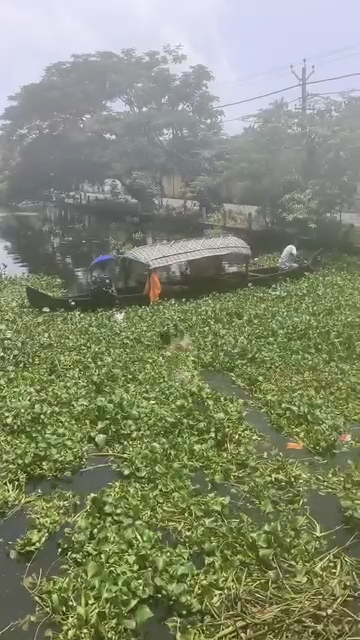
A boat operating in a water hyacinth filled water body
The proposal envisages a chain of activities, from collecting the weed during water-body cleaning to drying it along the banks and transporting it to processing units or manufacturers.
Workers employed under the rural employment guarantee scheme could take part in collection, drying and transportation. Local Self-Government Institutions would play an active role in organising these activities.
The Agriculture and Animal Husbandry departments are expected to examine the possible use of the harvested vegetation as organic fertiliser and cattle feed. These efforts would require awareness programmes and appropriate technical guidance.
The Industries Department could also encourage enterprises to process the weed and manufacture products from it.
The government’s proposal seeks to combine the removal of water hyacinth with local processing, addressing the burden the weed places on water bodies while creating employment opportunities in affected areas.
Water Resources Minister Mons Joseph stressed that complete eradication of the weed would require sustained, coordinated action.
Water hyacinth could become a source of income through products such as bio-fertilisers, fuel briquettes and biodegradable sanitary pads. The idea is to turn the invasive plant, which damages water bodies and disrupts livelihoods, into an economic resource.
An official with the National Bank for Agriculture and Rural Development (NABARD) said the ‘Weed to Wealth’ eco-livelihood initiative, already implemented in States such as Karnataka and Assam, seeks to achieve this by finding productive uses for the weed.
“For years, water hyacinth has been viewed primarily as an environmental menace. But there are opportunities to turn it into a source of livelihood,” the official said.
Models developed in India and elsewhere have demonstrated how harvested water hyacinth can be processed into value-added products through small-scale, community-based biorefining. The approach calls for moving beyond simply removing and disposing of the weed to exploring value addition, innovation and enterprise, the official said.
Apart from bio-fertilisers, fuel briquettes and biodegradable sanitary pads, the harvested biomass can be used to produce biogas, bioethanol, biohydrogen, biobutanol, biopolymers, fish feed, high-calorific-value fuel, composites and superabsorbent polymers.
Other potential products include enzymes, cellulose xanthogenate, levulinic acid, shikimic acid and xylitol. Water hyacinth residue can also serve as a substrate for mushroom cultivation. The plant could also be used to treat industrial effluents, particularly to remove heavy metals.
However, making commercial use of the weed requires tackling the damage it causes to water bodies and the difficulties of removing it on a large scale.
An official with the Water Resources Department said the plant’s rapid spread, vigorous growth and reproductive capacity made it particularly difficult to control. Its proliferation affects aquatic ecosystems and communities that depend on water bodies.
Dense mats of water hyacinth reduce dissolved oxygen in water, affecting fish populations. They also obstruct fishing by making it difficult to cast nets and damaging boats, which increases fuel consumption.
The weed can spread across the surface of small channels, rivers and canals, obstructing transport and reducing water flow. Infestations can also block irrigation channels and affect hydropower infrastructure, reducing power generation or damaging facilities.
The official said the weed could compromise the potability of drinking water, raising potential health concerns. Stagnant water and dense vegetation could also create conditions favourable for disease vectors such as mosquitoes.
Physical removal remains one of the main methods of controlling water hyacinth. The process involves harvesting plants manually or cutting them within affected water bodies. Surface screens and barriers can contain floating mats, making them easier to cut and collect.
However, these methods are labour-intensive and often inadequate or impractical when the weed spreads across large catchment areas, a Water Resources Department official said.
Water Resources Minister Mons Joseph also told the Assembly that this labour-intensive method had not proved effective in tackling the menace.
The plant’s ability to absorb pollutants offers another avenue for research and practical application. Studies on its phytoremediation potential have examined its capacity to accumulate heavy metals, including chromium, cadmium, copper, zinc, lead, iron and arsenic.
The challenge is to contain the weed’s damage to aquatic ecosystems while finding safe and economically viable ways to use the biomass collected during removal.
(Edited by Dese Gowda)



