

Published Nov 12, 2026 | 12:31 PM ⚊ Updated Nov 12, 2026 | 12:31 PM

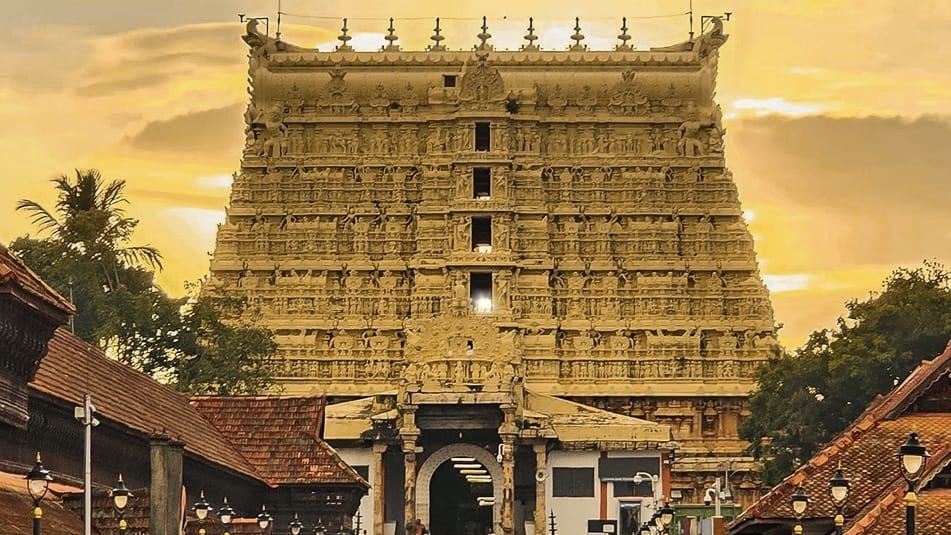
The Padmanabha Swamy Temple.

Synopsis: On the 90th anniversary of the Temple Entry Proclamation, a look back at a little-known 1934 report that helped shape the historic social reform. Based on 3,122 responses, 112 sittings and evidence gathered across Travancore, the Temple Entry Enquiry Committee documented growing support for opening temples to Avarnas, even as orthodox opposition persisted. The report offers a fascinating insight into the social debate, caste barriers and political deliberations that preceded Maharaja Chithira Thirunal Balarama Varma’s landmark proclamation on 12 November 1936, which opened Travancore’s temples to all Hindus irrespective of caste.
As Keralam observes the 90th anniversary of the Temple Entry Proclamation on 12 November, attention turns to a little-known document that helped pave the way for one of the most significant social reforms in the history of the erstwhile Travancore State.
Two years before Maharaja Chithira Thirunal Balarama Varma signed the historic proclamation in 1936, a committee report submitted in 1934 had brought the contentious question of temple entry into official debate.
The document titled ‘Report of the Temple Entry Enquiry Committee’ recorded a significant shift in public opinion, noting that a considerable section of Savarnas, including Brahmins and Nairs, favoured allowing temple entry. It also found that the Avarna communities, who had long been denied access to temples on the basis of caste, overwhelmingly supported the demand.
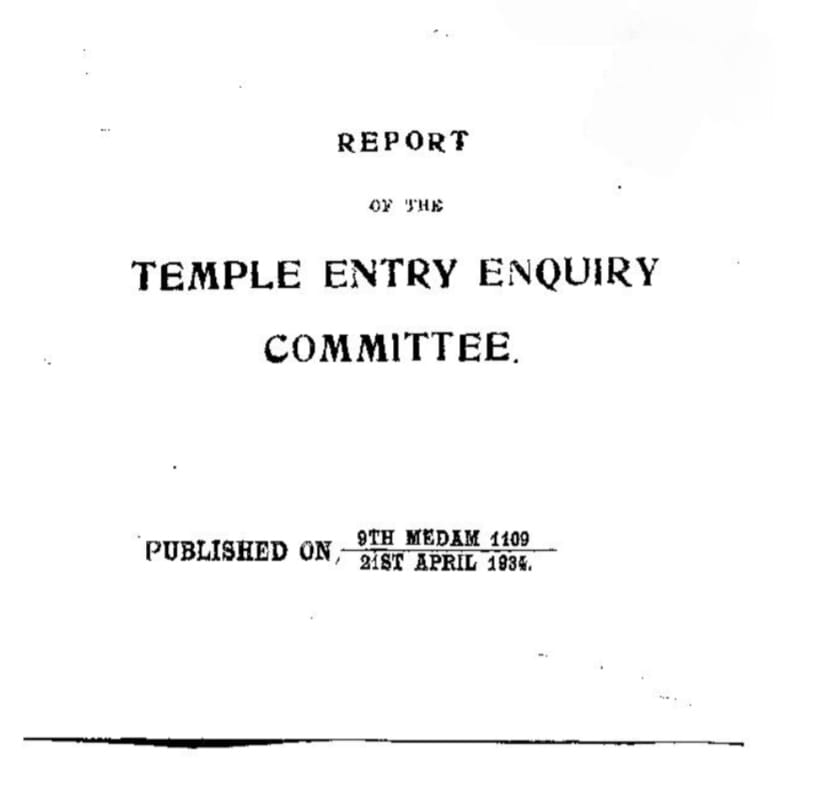
The Report
The findings were particularly significant as they brought a deeply entrenched religious and social practice under official scrutiny at a time when caste-based exclusion remained an accepted feature of public life.
The report, which recommended greater access to places of worship while seeking to preserve the faith of orthodox Hindus, offers a revealing glimpse into the social climate and deliberations that preceded the historic decision.
The deliberations eventually formed part of the larger reform process that culminated on 12 November, 1936, when Chithira Thirunal signed the Temple Entry Proclamation, thus marking a defining moment in India’s social reform history.
The debate over temple entry in Travancore took a formal turn on 8 November 1932, when the princely state government announced the formation of a nine-member committee to examine the question and submit its recommendations. The move marked an important administrative step in the discussions surrounding caste-based restrictions on access to Hindu temples.
The committee was headed by Dewan Bahadur V S Subramonia Aiyar, a former Dewan of Travancore. Its first meeting was held on 17 December 1932, following which it prepared a detailed questionnaire to gather public opinion on the issue.
Copies of the questionnaire were circulated among 5,774 prominent individuals, including temple trustees and representatives of various associations. It was also published in the government Gazette in English, Malayalam and Tamil, inviting responses from all interested sections of society.
As many as 3,122 people, including eight women, submitted their views.
The committee conducted its proceedings across 24 locations and held a total of 112 sittings.
Of these, 14 were devoted to preparing the questionnaire, while 51 were spent recording oral evidence. Another 39 sittings were used to discuss the committee’s terms of reference, examine the evidence received and arrive at conclusions. The remaining meetings were devoted to finalising and passing the draft report.
Also Read: Keralam auto, taxi unions call off strike; government agrees in principle to fare revision
When the committee began its work, temple access in Travancore was governed by a rigid system of caste-based restrictions. The extent to which a Hindu could approach the sanctum varied according to caste and social standing.
Apart from those engaged in performing rituals and offering services to the deity, no one, irrespective of caste, was permitted to enter the inner shrine.
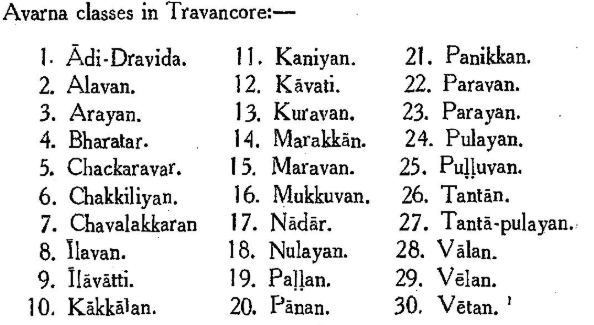
Number of Avarnas in Travancore as per the Report
Brahmins and Kshatriyas were allowed to approach the steps leading to the Garbhagriha and enter the Namaskara Mandapam in front of the sanctum for devotional purposes. Vaishyas and Sudras could go only up to the steps but were barred from entering the Namaskara Mandapam.
Certain communities placed below the Sudras in the social hierarchy, but not classified as ‘unapproachables’, were permitted to walk along the Pradakshina Vazhi outside the Nalambalam. They were not allowed to move any closer to the sanctum. The committee noted that these communities constituted only a small section of the population.
At the lowest rung of this discriminatory system were those subjected to the practice of theendal, or distance-based untouchability. They were required to remain outside the temple’s outer walls and offer worship from there. The report referred to these communities as Avarnas, or non-caste Hindus, and noted that they numbered around 30 communities.
The committee also recorded that discrimination was not confined to the distinction between Savarnas (caste Hindus) and Avarnas. Even among Savarnas, access and privileges differed considerably according to caste.
One of the committee’s key observations was that no Savarna temple in Travancore had a locally established custom permitting the entry of non-caste Hindus. In other words, the committee found no existing local practice in such temples that allowed Avarnas to enter.
The survey conducted by the committee examining the question of temple entry revealed overwhelming support for the demand among Avarnas, while opinion among Savarnas remained divided, with a sizeable section opposing the move on religious grounds.
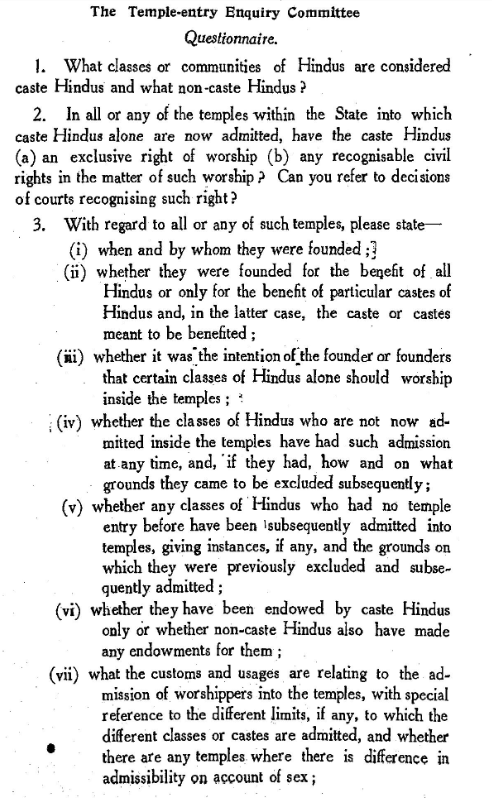
An excerpt of the questionnaire prepared by the Committee for documenting the general opinion on Temple Entry
The committee received 3,122 responses to its questionnaire, including 2,867 from Savarnas and 255 from Avarnas. All the Avarna respondents favoured opening caste-Hindu temples to them, a position that the committee said was hardly surprising given the changing social outlook among oppressed communities.
The report noted that the earlier apprehension among Avarnas that entering temples would amount to polluting the sacred premises and invite divine wrath had largely faded. All those who responded to the questionnaire, as well as the Avarna witnesses who gave oral evidence, believed that worship and religious rites performed inside temples would be more effective than those conducted from outside.
Almost all Avarna witnesses who appeared before the committee also supported the demand for entry into caste-Hindu temples. The only exception was an Ezhava advocate practising at Kottarakkara. He opposed the move, arguing that temple entry could eventually draw Avarnas deeper into the caste hierarchy of Savarna Hindus and expose their wealth to exploitation.
Among the Savarna respondents, however, there was no clear consensus. While 525 believed that the spiritual efficacy of worship would diminish if Avarnas were permitted to enter temples, 468 held the opposite view.
The committee also made a separate effort to ascertain the views of women, but found it difficult to secure responses from Savarna Hindu women, who generally stayed away from public appearances. Of the 10 women who received the questionnaire, only three responded, and all supported temple entry. Similarly, only two of the eight women invited to give oral evidence appeared before the committee. Both favoured opening temples to Avarnas.
The committee clarified that nearly 1,500 responses were excluded from its calculations as they came from people with no established connection or interest in Travancore, or lacked basic identification details such as house name and profession.
Drawing on the questionnaire and oral testimonies, the committee observed that there was considerable support for temple entry among Savarnas, even as strong opposition persisted within another section of the community.
Also Read: 80th anniversary special of Punnapra-Vayalar struggle turns contentious, reopens old wounds in Left
The committee in its report acknowledged the strong opposition among sections of orthodox Hindus but felt that the changing social climate called for greater access to temples.
In its assessment of the possible consequences of permitting temple entry, the committee flagged the possibility of protests and disturbances, noting that a sizeable section of Savarnas remained opposed to the entry of Avarnas into temples.
Such resistance, it feared, could lead to breaches of peace.
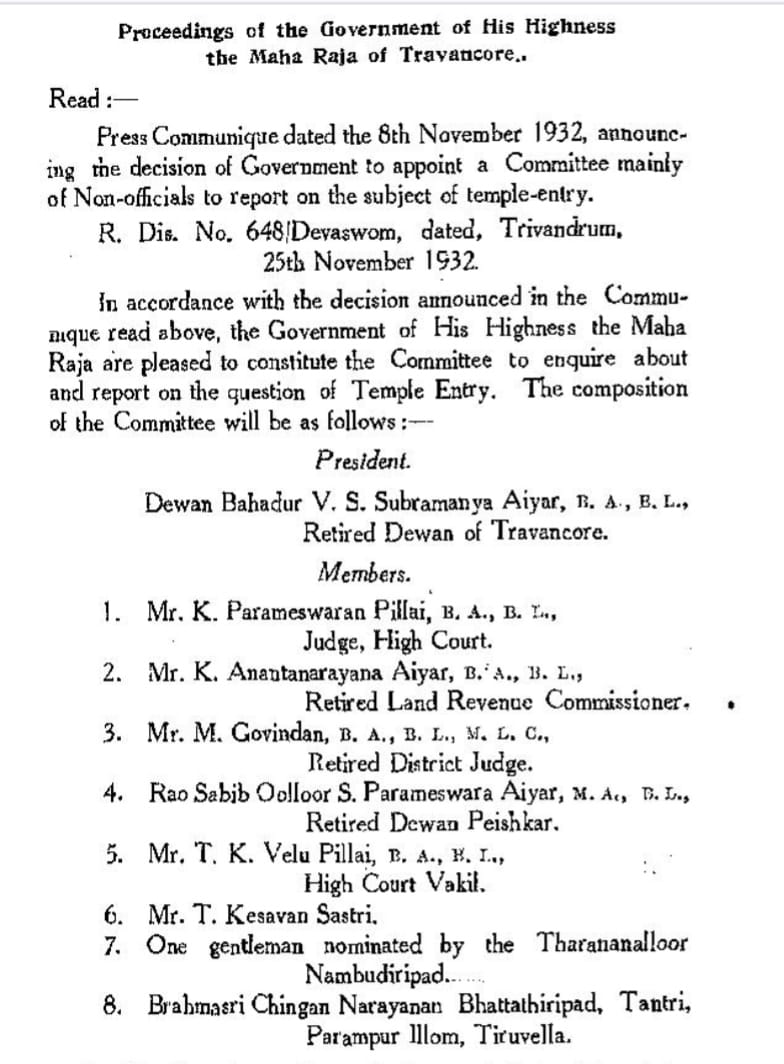
The royal order on the appointment of the committee
However, it maintained that the government should be able to prevent any law and order problems through appropriate precautionary measures.
The panel also considered the possibility of an initial boycott by Savarnas, with large numbers staying away from temples while Avarnas began visiting them for worship.
It felt, however, that this situation might not last. Some of those who initially kept away could eventually return, while the number of Avarnas visiting temples could decline once the initial enthusiasm and novelty wore off.
Another concern was the possible withdrawal of temple priests, including Tantris and Santhikars (poojaris), if entry restrictions were relaxed. Other temple employees, particularly Kazhakakkars, could also quit. Many among them received a share of the daily cooked rice offered to the deity as part of their remuneration.
Also Read: Abhirami, Abhirami! Los Angeles Mayor Nithya Raman’s link to Malayalam cinema
The committee also recorded the objections raised by orthodox Savarnas, who believed that admitting Avarnas would undermine the sanctity of temples. Some even predicted that temples would be deserted by both conservative and progressive Hindus — the former losing faith in the institutions and the latter, according to the orthodox argument, having little genuine religious attachment to them.
While recognising that temple entry alone could not establish social and religious equality, the committee observed that removing the restrictions would help reduce discrimination to some extent. It also pointed out that measures for the social advancement of Avarnas could be pursued independently of the temple-entry movement.
In its concluding observations, the committee said the changed circumstances of the time made it desirable to take steps to provide Avarnas with greater opportunities to worship at Savarna temples. At the same time, it stressed that such changes should not undermine the faith of orthodox Hindus or their belief in the sanctity of the installed deities.
The committee ultimately left the extent of any relaxation in the existing prohibition on temple entry to the decision of the Sovereign (the King), placing the responsibility for determining the way forward with the ruler.
Eventually, on the evening of 12 November 1936, Chithira Thirunal Balarama Varma issued the Temple Entry Proclamation.
(Edited by Dese Gowda)



