

Published Oct 15, 2026 | 1:00 PM ⚊ Updated Oct 15, 2026 | 1:03 PM

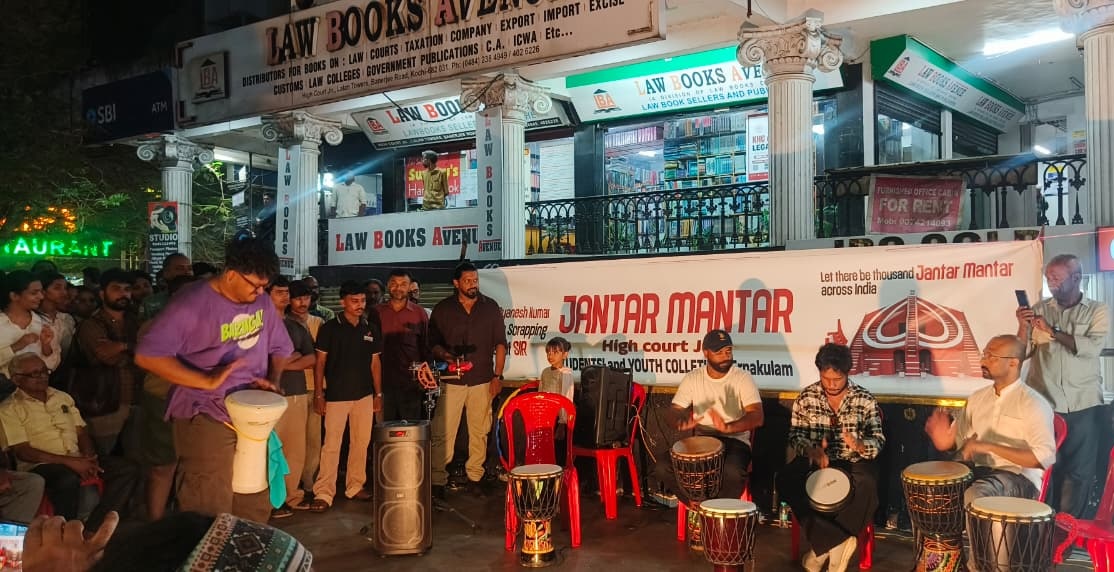
From 16 October, the group intends to continue its protest at Vanchi Square until Jantar Mantar in Delhi is restored as a designated protest site.

Synopsis: A day after the Delhi Police denotified Jantar Mantar as a designated protest site on 12 October, the Students and Youth Collective Forum organised a campaign in Kochi under the slogan ‘Let There Be a Thousand Jantar Mantars Across India’. Anjaly, an anthropology research fellow and organiser of the demonstration, told South First that the campaign was a political struggle against fascism.
At around 5.30 pm on Tuesday, as the October sun began to dip, people hurried past one another at Vanchi Square, opposite the Kochi Bench of the Kerala High Court, eager to get home after a long day at work. Nobody seemed to have time to stop.
Then a few people arrived, one after another, carrying posters. Within minutes, passers-by began to slow down and stop to watch. One by one, they joined the gathering.
Soon, the Square had turned into a sea of people.
A day after the Delhi Police denotified Jantar Mantar as a designated protest site on 12 October, the Students and Youth Collective Forum organised a campaign in Kochi under the slogan ‘Let There Be a Thousand Jantar Mantars Across India’.
From 16 October, the group intends to continue its protest at Vanchi Square until Jantar Mantar in Delhi is restored as a designated protest site.
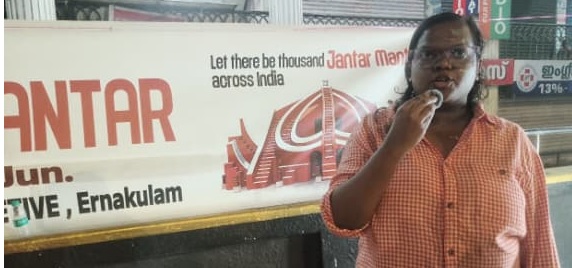
Anjaly
Anjaly, an anthropology research fellow and organiser of the demonstration, told South First that it was the collective’s third event in the city.
“On October 2, we organised a programme and held a protest against the Delhi Police brutality. Now, when the Delhi Police has denotified Jantar Mantar to prevent protests, we decided to stand up and create a Jantar Mantar in Kochi. We chose Vanchi Square because it is right in front of the Keralam High Court,” she said.
Anjaly said the campaign was a political struggle against fascism and called for the immediate cancellation of the SIR exercise and the resignation of Chief Election Commissioner Gyanesh Kumar.
Also Read: Peechi’s seismic puzzle: Three months on, tremors remain unexplained and homes unchecked
The collective had seen young people take to the streets in Kochi during the NEET controversy and the protests against the Citizenship (Amendment) Act (CAA). Anjaly said the fight against the Special Intensive Revision (SIR) of electoral rolls was even more fundamental because it concerned every citizen’s right to vote.
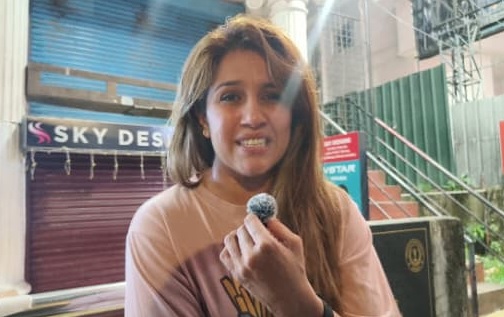
Ranjini Haridas
“When NEET became an issue, it affected a particular section, especially students. But voting rights belong to every citizen and concern our next generation, too. We have decided to stand up against fascism,” she said.
“Those who are educated may know how to get their names added to the electoral roll if they are left out. But not everyone has that awareness. India is also a country of poor people. What will they do? Even a passport is not being accepted as proof of citizenship.”
Anchor and activist Ranjini Haridas criticised the Delhi Police’s handling of protests, saying restrictions on demonstrations amounted to an assault on citizens’ democratic rights.
“The Delhi Police brutality was insane. I believe that when injustice becomes law, resistance becomes our duty. When we seek permission to protest, they refuse it and look for ways to prevent us from gathering,” she told South First.
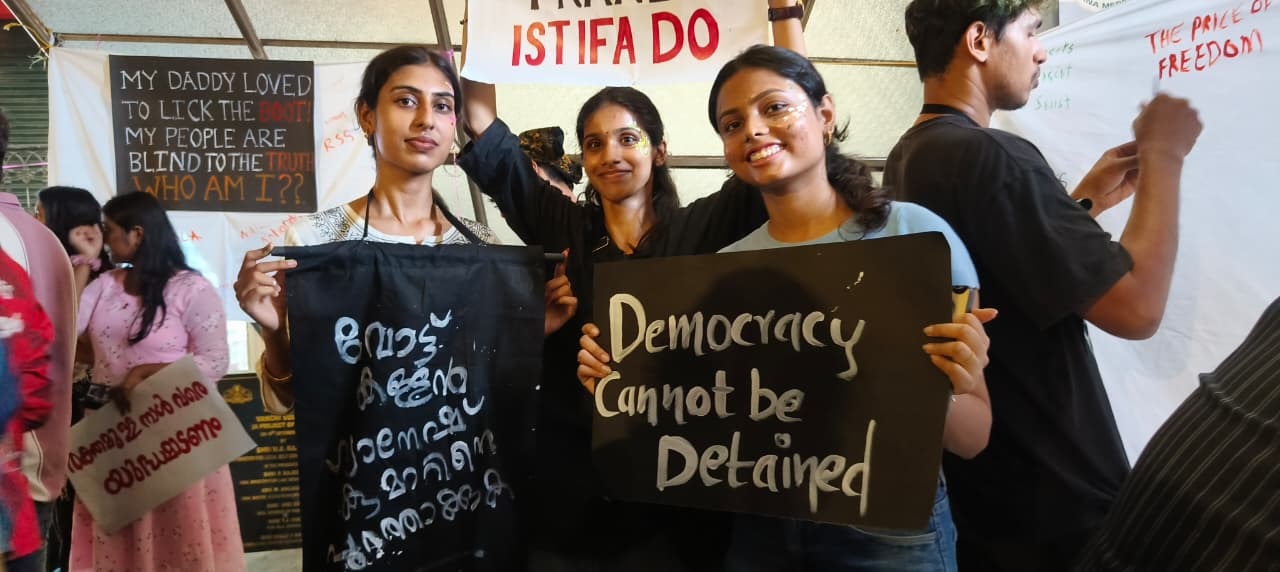
Students from various institutions held posters opposing Gyanesh Kumar
“By debarring Jantar Mantar, what kind of mockery are they making of our nation? Do they think millions of people are silent because we are stupid? No, it is because we have other things to worry about. But today’s generation is no longer willing to take this nonsense,” she said.
Haridas said the energy of young protesters had renewed her determination to stand up for democratic rights.
“We grew up in a democracy. We have the right to protest and the right to express ourselves, rights we fought so hard to win. Earlier, it was the British who suppressed us; now, it is our own people. It is sad to see those in power hiding behind the Delhi Police and goons,” she said.
“If you try to suppress citizens’ voices, they will only grow louder. If you shut Jantar Mantar, the whole country will become Jantar Mantar.”
Also Read: Keralam BJP councillor Sreelekha’s drug jibe at Rahul Gandhi sparks row; complaints filed
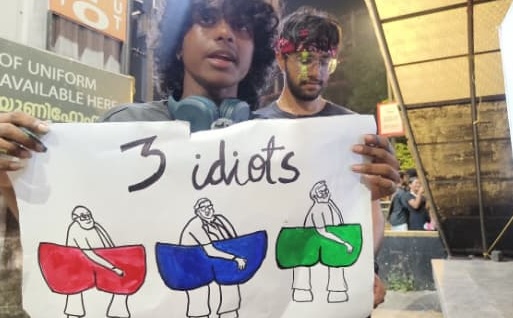
NIFT student Radeep, who is from Thrissur, designed several satirical posters for the gathering. One reimagined Three Idiots, featuring Prime Minister Narendra Modi, Chief Election Commissioner Gyanesh Kumar and Union Home Minister Amit Shah. It was among the artworks that drew the most appreciation from protesters.
Govardhan
“Every day, we hear that we have no right to protest. But we will continue to raise our voices. We need to express ourselves more. I call upon every artist in the country to speak through drawings, colours and every other medium available to us,” Radeep told South First.
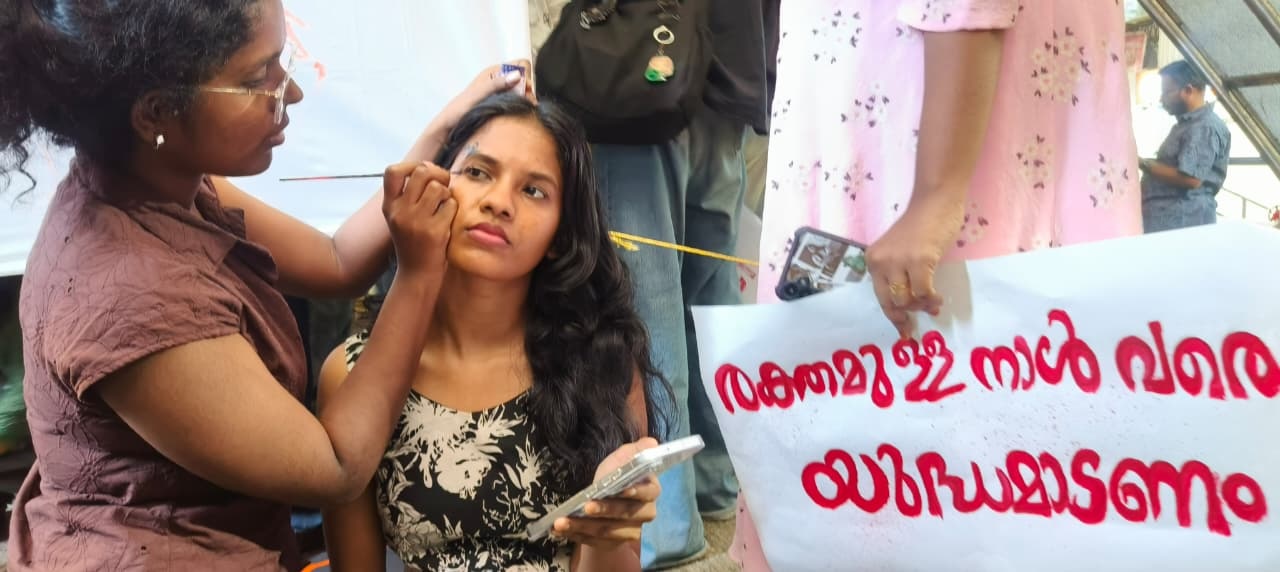
Artists face-painted protesters
Govardhan, a student from Ernakulam, painted protesters’ faces with images ranging from tea glasses and the Constitution to wilted lotus flowers. He also encouraged people to contribute at least one line to an art wall set up as part of the demonstration.
“We are not protesting for ourselves. There is a younger generation growing up, and they need to know that they have these rights in our country. This is for Gyanesh Kumar, bro. Just pack your bags and get lost, idiot,” Govardhan said.
Several students who spoke to South First were reluctant to identify themselves, fearing their parents might discover that they had attended the protest. Some had left their hostels without informing their families or teachers, expecting that they would not be allowed to participate if they sought permission.
One student said she felt compelled to attend despite the questions she might face at home.
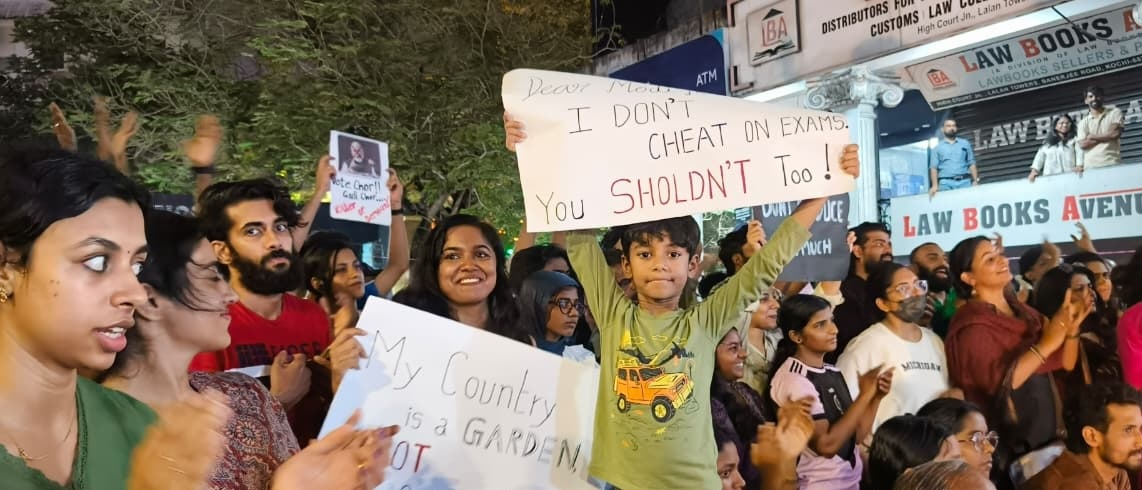
Children were also present at the protest with their parents
“If we tell our parents that we are going to protest, they will not allow us. I think they have not yet realised the extent of the violation of rights happening in our country. My father already suspects that I am a ‘cockroach’. I am neither a cockroach nor a comrade, but I have to be here because I plan to live in this country and build a secure future here,” she said.
“When our rights are curtailed, we have to speak up. I cannot go to Delhi, where people of my generation are facing lathi charges and detentions. This is the least we can do for them, when they are even sacrificing their health and future for us.”
The gathering also received a message from Thushar Gandhi, the great-grandson of Mahatma Gandhi.
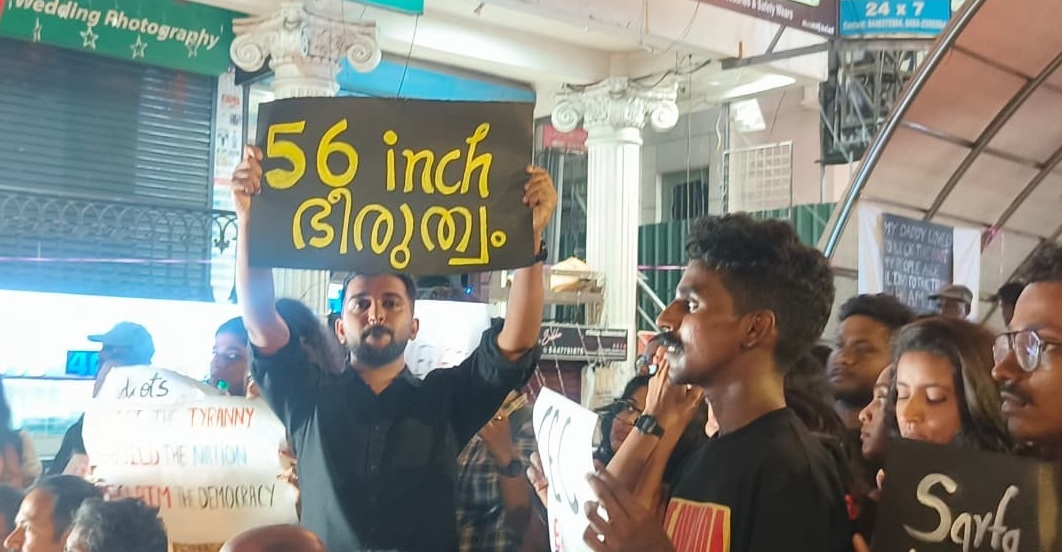
Posters mocking Modi
“I’m in solidarity with your protest and hope there will be a thousand Jantar Mantars across India,” Gandhi said in a voice message to Anjaly. The organisers played his message over the microphone.
The protest demanding the right to protest ended at around 9 pm, when the time permitted by the police ran out and officers approached the organisers to call an end to the gathering.
(Edited by Dese Gowda)



