

Published May 03, 2026 | 9:00 AM ⚊ Updated May 03, 2026 | 9:00 AM


CUSAT Campus.

Synopsis: Two students at the Cochin University of Science and Technology in Kerala were found dead within a span of seven days, reportedly due to academic pressure and emotional distress in both cases. The university has ordered an inquiry and a review of welfare systems after students said gaps in counselling access, weak grievance systems and rising costs have made it harder to cope with academic stress.
A pall of grief has hung over the Cochin University of Science and Technology (CUSAT) in Kalamassery, Kochi, after two students from the same institute died within seven days, triggering concern and unease across the campus community.
On 22 April, Dhanush D, a 21-year-old BTech Electrical and Electronics Engineering student at CUSAT, was found dead in his rented accommodation near Kalamassery.
Police said the body was found with a plastic wire tied around his neck.
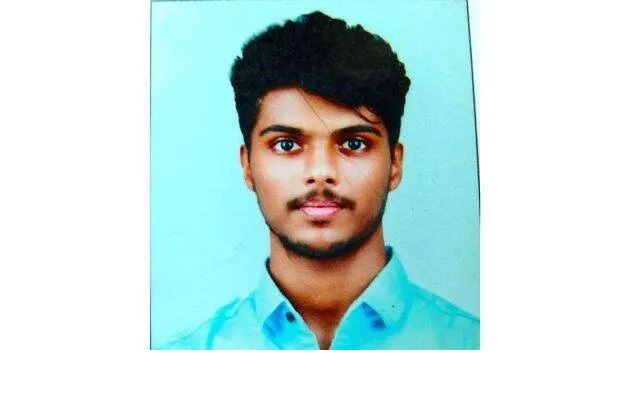
Dhanush
Days later, the campus was shaken again by the death of Darshana Sudharshan, a 21-year-old fourth-year Civil Engineering student.
She had missed her supplementary exam on the morning of Wednesday, 30 April. When her roommates returned to their shared rented accommodation at Hidayath Nagar in Kalamassery around 1 pm after finishing their examination, repeated knocks on the door went unanswered.
Neighbours then broke open the door and rushed her to hospital, but she was declared brought dead.
Also Read: A protest, not a strike — and that made all the difference
In both cases, Kalamassery Police Station has registered unnatural death cases under BNSS Section 194 and initiated standard procedures, including inquests and post-mortem examinations.
“We could not find any direct connection between the two deaths. Initial findings point to emotional distress and academic stress. The investigation is still ongoing and, in both cases, no suicide notes were found,” an officer from Kalamassery Police Station told South First.
Sources said Dhanush had been struggling with arrears and attendance issues, which had affected his academic progression.
Teachers had taken steps to help him re-enter the examination process. Police and faculty said delays in formal documentation and ongoing emotional difficulties held this up.

Darshana
Police also said he had been undergoing treatment for depression and had earlier expressed thoughts of discontinuing his course. They added that family circumstances, including his parents’ separation, may have affected his emotional well-being.
On the day of his death, teachers tried to reach him after he failed to respond to calls about attendance-related formalities.
Likewise, Darshana, daughter of Sudharshan from Puthuvype, was facing academic distress, according to preliminary assessments.
Sources said she had exam arrears and had been placed in a “year-out” academic status. This meant she was studying with a junior batch while clearing supplementary papers.
Police also said Darshana had not informed her family about her academic delays.
She had been preparing alongside junior students while her original batch had reached their final stage. In the same week, her original classmates had their farewell.
Friends and police said this gap between her academic position and her peers may have added to her distress. Missing exams, while her classmates graduated and marked their farewell, is being examined as part of the pressure she faced.
Also Read: Hartal call over Nithin Raj’s death draws Kerala High Court’s ire
Inside the CUSAT campus, the mood is one of confusion and fear. Students said academic pressure is part of university life, but the lack of consistent emotional support has made coping difficult.
A student representative, who did not wish to be named, told South First that a counselling system exists on paper, but access is limited.
“We have to wait weeks for appointments, and in urgent situations, immediate psychological support is often unavailable.”
Another student said the grievance redressal system is largely inactive in practice, despite existing regulations. Students said complaints about academic stress, faculty behaviour and internal marks often remain unresolved for long periods.
Concerns have also been raised about fee structures.
“Every year, the fee structure can be increased by 5 percent, and the rule permits it. But other fees have become unbearable. For instance, in the MBA course, there is a Department Development Fund. It was earlier ₹2,000, then raised to ₹5,000, and now it stands at ₹10,000,” Kerala Students Union (KSU) unit chief Mohammed Rashid told South First.
“The concern is that most of the university syndicate members are from the Left, and orders are often issued at the beginning of vacation or examination periods. The recent fee hike order came on 1 April, leaving student organisations with little room to protest as everyone is engaged in exam preparations. Apart from a few faculty members who are strict about attendance, it is generally considered a student-friendly campus.”
Students also raised access to recreational spaces. They said limited access to playgrounds and open spaces has reduced opportunities for physical activity and informal stress relief, which has led to greater dependence on mobile phones and isolation.
Also Read: Big four and beyond! Your guide to the snakes behind Kerala’s fatal bites
CUSAT Vice-Chancellor Junaid Bushiri has taken note of the incidents and directed the Registrar and Controller of Examinations to conduct detailed inquiries into both deaths. The Chief Security Officer has also been asked to submit a comprehensive report.
A special review meeting is scheduled for 5 May, with police officials, university administrators and municipal representatives set to take part. Officials said the aim is to assess campus welfare systems and institutional support.
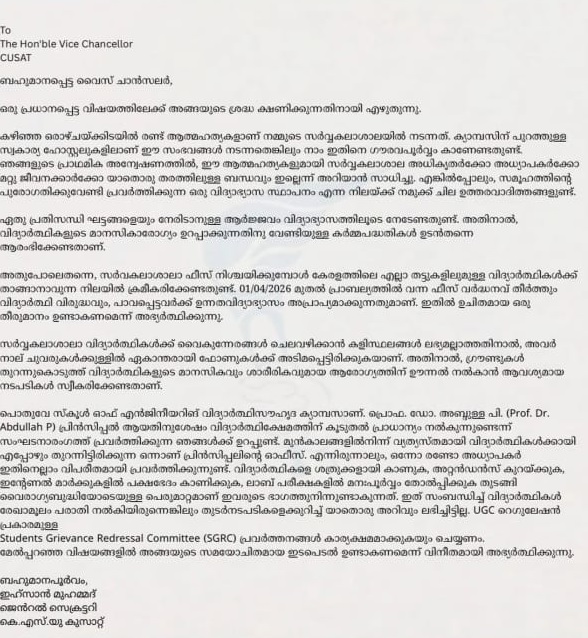
KSU has submitted a memorandum to the University VC
The KSU has submitted a memorandum to the Vice-Chancellor highlighting structural issues affecting student well-being, including:
The memorandum states that although the deaths did not occur on campus, the institution still carries responsibility for student welfare.
It calls for immediate steps to strengthen emotional support, improve counselling systems and make grievance mechanisms more transparent.
(Edited by Dese Gowda)



