

Published Jun 04, 2026 | 12:38 PM ⚊ Updated Jun 04, 2026 | 1:32 PM

The report identifies a mismatch between inflows and outflows as the core problem. Credit: x.com/vdsatheesan, x.com/pinarayivijayan

Synopsis: Kerala’s new UDF government has painted a grim picture of the state’s finances, revealing a debt burden of ₹5.07 lakh crore, massive unpaid liabilities and growing dependence on RBI support, while arguing that years of fiscal stress have eroded the government’s ability to fund welfare and development programmes. The white paper also alleges that the financial strain has disproportionately affected social sector spending and allocations for vulnerable communities, while calling for tough structural reforms to restore fiscal stability and revive long-term growth.
Painting a stark picture of Kerala’s public finances, the UDF government on Thursday, 4 June, tabled a white paper in the Assembly warning that the state faces mounting fiscal stress, with outstanding liabilities touching ₹5.07 lakh crore and accumulated payment arrears of not less than ₹48,733 crore,
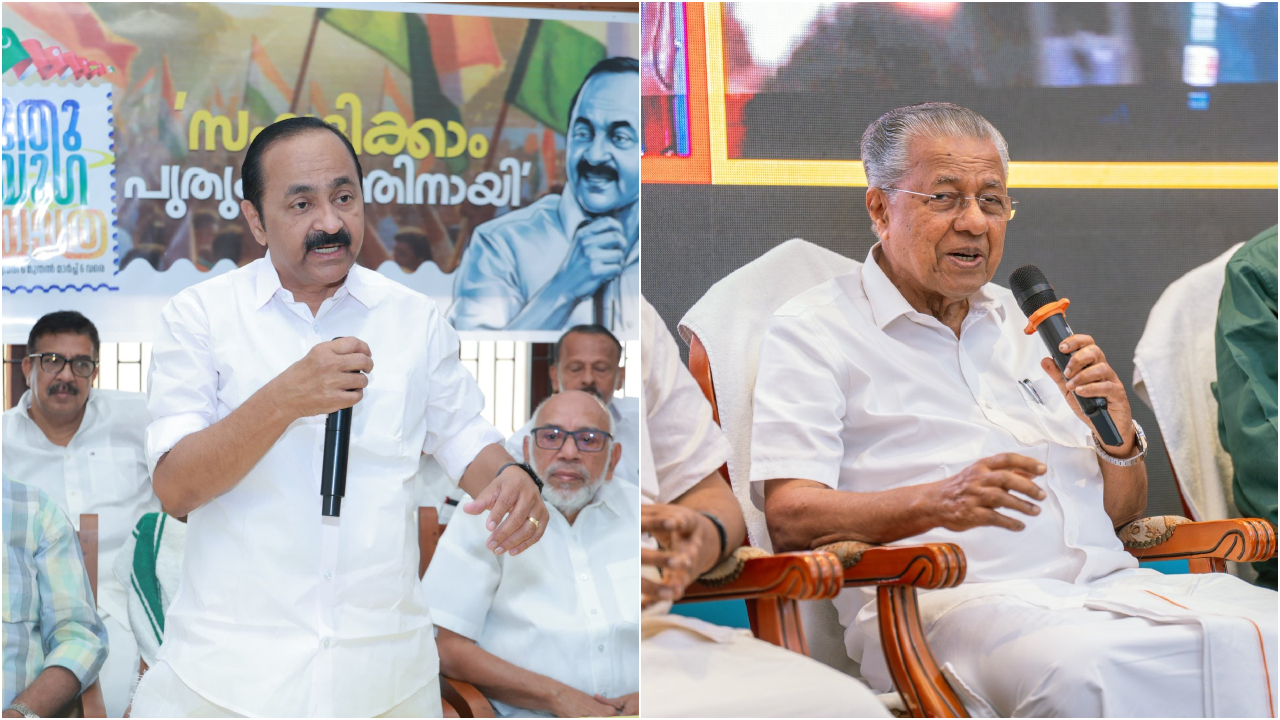
Presented by Chief Minister V.D. Satheesan, who also holds the Finance portfolio, the report argues that Kerala’s financial challenges demand an “honest diagnosis” and urgent corrective measures, including fiscal consolidation, stronger revenue mobilisation and institutional reforms.
It also calls for bringing KIIFB under stricter budgetary oversight and flags persistent inefficiencies in KSEBL, KWA and KSRTC as major sources of financial leakage.
The report titled ‘Kerala’s Fiscal Health: A Status Report’ highlighted that the UDF government has inherited a substantial backlog of legally due payments, including ₹21,670 crore in Dearness Allowance arrears and ₹14,387 crore in Dearness Relief arrears. Payments due to banks and contractors under bill discounting schemes account for another ₹3,431 crore, with the total outstanding commitments almost matching Kerala’s net annual borrowing.
The report analysed a decade of fiscal trends between 2016-17 to 2025-26, with 2025-26 as the base year for current position assessment.
Also Read: A ‘good’ Friday for ED? Kerala HC verdict on CMRL case, probe into convoy attack in focus
The report highlighted that the state’s fiscal position is under mounting pressure, with rising debt, persistent cash shortages and a growing pile of unpaid obligations pointing to a widening gap between the state’s revenues and expenditure commitments.
Indirectly mentioning the LDF government, which governed the state from 2016 to 2026, the report stated that a recent assessment of the state’s finances paints a picture of a government struggling to keep pace with its routine financial obligations.
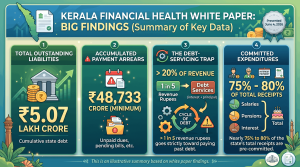
More than one rupee out of every five spent from the state’s revenue account now goes towards servicing past debt, leaving significantly less fiscal space for public services, welfare programmes and development spending.
The report warns that the debt burden has acquired a self-perpetuating character.
As interest payments consume a larger share of revenues, the government is left with limited flexibility to fund its commitments, often forcing it to borrow more merely to sustain existing expenditure. In effect, debt servicing itself is emerging as a driver of fresh indebtedness.
The fiscal strain is most visible in the state’s treasury operations.
Despite presenting fiscal deficit figures that remain within prescribed limits, Kerala has increasingly relied on emergency borrowing facilities offered by the Reserve Bank of India (RBI) to manage day-to-day cash requirements.
Treasury balances reportedly remained in the red for ten months of the year, while payment arrears accumulated across multiple sectors.
When treasury balances fall below the prescribed minimum level, the state is forced to access RBI support mechanisms such as the Special Drawing Facility (SDF), Ways and Means Advances (WMA) and, in more severe situations, overdraft facilities.
The trend over the past decade shows a steady deterioration.
Kerala has availed Ways and Means Advances every year since 2015. During the pandemic years, dependence on these facilities surged sharply. While there was some improvement in 2022 and 2023, the situation worsened again in 2024 and 2025.
In 2025 alone, Kerala reportedly remained on Ways and Means Advances for 262 days and on overdraft for 84 days, indicating sustained cash-flow stress throughout much of the year.
The report identifies a mismatch between inflows and outflows as the core problem.
Open Market Borrowings, through which the state raises funds by issuing securities, have become the principal source for bridging fiscal gaps. Yet these borrowings have consistently fallen short of meeting committed expenditure, particularly salaries, pensions and interest payments.
Compounding the problem is the relatively weak performance of Goods and Services Tax (GST) collections, a key component of the state’s own tax revenue. At the same time, central transfers, including tax devolution and revenue deficit grants that had provided some relief in earlier years, have declined sharply over the last two years.
On the expenditure side, committed spending continues to dominate the budget. Salaries, pensions and interest payments account for nearly three-fourths of the State’s receipts, leaving little room for discretionary spending.
One consequence has been the accumulation of large payment arrears.
According to Finance Department data cited in the report, unpaid Dearness Allowance (DA) arrears for government employees have reached ₹21,670 crore, while Dearness Relief (DR) arrears for pensioners stand at ₹14,387 crore.
In addition, payments due to banks and contractors under bill discounting arrangements amount to ₹3,431 crore. Together with other deferred liabilities, the total outstanding obligations are estimated at no less than ₹48,733 crore.
The scale of these arrears is striking.
The unpaid liabilities are now approaching the size of Kerala’s annual net borrowing programme, underlining the extent to which expenditure commitments have been pushed into the future.
The report highlighted that the state’s financial challenge is no longer confined to a high debt stock alone. Increasing dependence on short-term RBI support, shrinking fiscal flexibility, weakening revenue growth and a growing backlog of unpaid obligations together point to a structural fiscal stress that will require sustained corrective measures by the new government.
Also Read: After more than three decades, a woman returns to Kerala Assembly Deputy Speaker’s chair
The report further puts the former LDF government in the spotlight, as it noted that the fiscal stress appears to have come at a heavy social cost, with government spending increasingly moving away from sectors that traditionally formed the backbone of the state’s development model.
Upon analysing the budget data the report highlighted that while overall plan expenditure has continued to grow in recent years, the share earmarked for social development and the welfare of Scheduled Castes (SCs), Scheduled Tribes (STs) and other vulnerable communities has witnessed a sharp decline.
The findings are likely to put the previous LDF government under scrutiny, particularly over its claims of protecting Kerala’s social development legacy during a period of financial strain.
The report points out that fiscal adjustment during periods of financial stress often spares politically sensitive expenditures such as salaries, pensions and interest payments.
As these committed liabilities consume a growing share of public resources, the burden of adjustment falls disproportionately on development spending — the very expenditure intended to improve public services, expand opportunities and support long-term growth.
In Kerala, this trend has become increasingly visible in the post-pandemic years.
The share of resources allocated to the State Plan has generally declined, indicating that rising fiscal pressures have reduced the government’s ability to expand development spending. A larger portion of public funds has been absorbed by current expenditure, leaving less room for investments in education, healthcare, welfare and other long-term development initiatives.
The impact is most visible in the social sector. The share of social services in plan expenditure — covering education, health, water supply, welfare programmes for SCs, STs, minorities and other vulnerable groups — fell dramatically from 53.78 percent to 30.68 percent during the period under review.
The report describes this trend as particularly disturbing for a state that built its national reputation on prioritising planning and social development. It argues that social expenditure, once treated as the first claim on public resources, is increasingly becoming a casualty of fiscal constraints.
Even more alarming is the decline in allocations for historically disadvantaged communities. Spending on SCs, STs, OBCs and minorities has remained well below the 12.64 percent benchmark envisaged in 2016 and has steadily fallen over the last eight years. The share has now dropped to just 3.85 percent, only marginally above the 2.83 percent allocation that would correspond exclusively to the Tribal Sub Plan (TSP).
According to the report, the decline is so severe that the fiscal crisis has virtually pushed vulnerable communities to the margins of the state’s development expenditure framework. The shrinking allocations raise concerns about the government’s commitment to inclusive growth at a time when these communities continue to face significant socio-economic disadvantages.
What makes the trend more striking is that actual plan expenditure exceeded the approved plan outlay in most years, touching as high as 142 percent in one year. This suggests that while the government spent more than originally budgeted on development programmes overall, the additional resources were increasingly directed away from social sectors and targeted welfare schemes.
The report stated that Kerala’s fiscal crisis has not merely reduced development spending but has also altered its priorities. As resources became scarce, sectors central to social equity and human development appear to have borne a disproportionate share of the adjustment, raising questions about the long-term consequences for the state’s celebrated development model.
Also Read: Beyond anti-incumbency: What the report card of Kerala’s Left is beginning to reveal
According to recommendations submitted by the expert panel that examined the state’s financial position, the state must take a series of difficult political and economic decisions to restore fiscal stability.
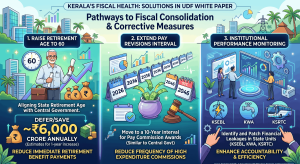
The report notes that nearly 80 percent of the state’s resources are consumed by salaries, pensions and interest payments, leaving limited fiscal space for development and capital investment.
Among the key suggestions is raising the retirement age of government employees to align with that of the Centre.
The panel estimates that every one-year increase in the retirement age could save the state around ₹6,000 crore in retirement benefits. It has also recommended extending the interval between pay revisions to ten years, similar to the Central government system, instead of more frequent pay commission awards.
The report stresses that fiscal reforms must go hand in hand with job creation, warning that Kerala cannot sustain growth without generating more employment opportunities for its youth.
Highlighting higher education as a potential growth engine, the panel has called for easier entry of private and foreign universities into the State. It suggests that defunct plantation estates and unused government buildings could be repurposed for educational institutions, helping Kerala position itself as a major higher education hub.
On the revenue front, the report recommends a comprehensive study to identify ways to improve tax collection, particularly under the Goods and Services Tax (GST) regime. Strengthening revenue mobilisation, it says, is essential to reducing fiscal stress.
The panel has also proposed the introduction of a performance management system in government to improve efficiency and accountability in public administration.
At the national level, the report expresses concern over the changing fiscal relationship between the centre and the states. It argues that the divisible pool of tax revenue available to States has shrunk due to the Centre’s growing reliance on cesses and surcharges. The report also points to difficulties faced by States in accessing Centrally Sponsored Schemes (CSS), particularly because of the requirement to provide a substantial matching share upfront.
Calling for a broader federal dialogue on fiscal issues, the panel says Kerala should join hands with other States facing similar challenges and take the lead in initiating serious discussions with the Centre on resource sharing, borrowing limits and fiscal flexibility.
However, the report makes it clear that without structural reforms, Kerala’s fiscal challenges will only deepen in the years ahead.



