

Published Jun 16, 2026 | 11:00 AM ⚊ Updated Jun 16, 2026 | 11:00 AM

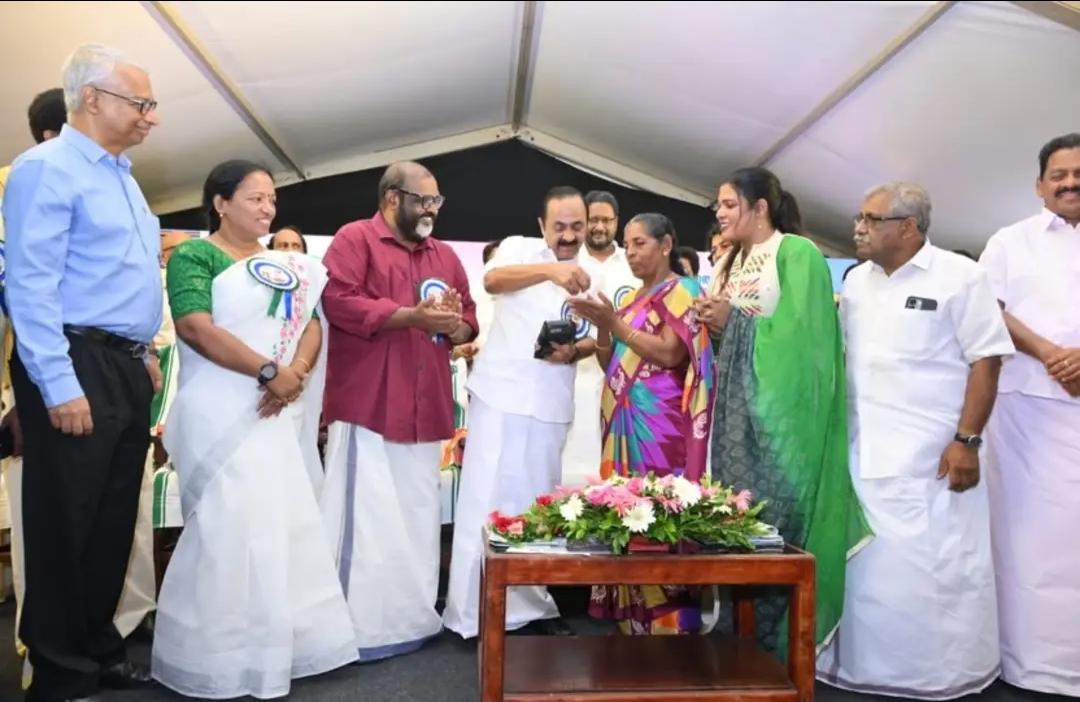
Chief Minister VD Satheesan handing over the first zero-value ticket while inaugurating the Priyadarshini scheme on 15 June.

Synopsis: Kerala has led the way in India on human development. But, the participation of women in the labour force has been stubbornly low despite the high literacy rates. Priyadarshini could be a possible game-changer.
At 9.00 am on Monday, 15 June 2026, at the Thampanoor bus terminal in Thiruvananthapuram, a familiar sound acquired a new meaning: the double bell of a Kerala State Road Transport Corporation (KSRTC) bus. Chief Minister VD Satheesan flagged off the Priyadarshini scheme, under which women and transgender persons can now travel free on ordinary-class KSRTC services across Kerala. The inaugural bus was operated entirely by women staff—driver, conductor, and crew—in a carefully choreographed signal of what the government wants this programme to represent: not charity, but mobility-led empowerment.
The scheme covers seven categories of ordinary services—Ordinary, City Ordinary, Limited Stop Ordinary, Fair-Stage Ordinary, Town-to-Town, Point-to-Point and Gramavandi—accounting for roughly 60 per cent of KSRTC operations, or about 3,125 buses. No income ceiling applies. No age restrictions apply. No special card is required. A zero-fare ticket and valid ID are sufficient.
While politically this marks the Congress-led UDF fulfilling a key welfare promise, the more consequential economic question is what happens when the cost of movement falls for millions and mobility itself becomes a gateway to opportunity. With this, Kerala joins Delhi—the first mover in 2019—along with Tamil Nadu, Karnataka, Punjab, and, more recently, West Bengal, in rightly connecting affordable mobility to transformative welfare.
Public debate in India often reduces welfare to a simplistic binary: either “freebies” or “reforms.” That distinction is often misleading. A subsidy that merely replaces private spending without improving productive capacity may deserve scrutiny. But a public intervention that lowers barriers to work, education, healthcare, and market participation belongs to a different category.
That is not a consumption subsidy, but economic infrastructure.
Transport economists have long recognised mobility as a foundational driver of labour participation: people cannot access opportunities they cannot physically reach. For affluent households, commuting is an inconvenience or a budget line item; for low-income households, it can become a barrier to economic participation itself.
Consider a domestic worker travelling from a rural village to the city centre, a retail employee commuting from their base to the town, or a fish vendor from the coastal part of a district heading to vibrant inland markets—daily bus expenses can easily range between ₹50 and ₹120, sometimes more, translating to roughly ₹1,250 to ₹3,000 a month over 25 working days. For a salaried professional earning ₹80,000 a month, this may be manageable; for workers earning ₹10,000–₹18,000, it is a substantial burden. In many low-income households, commuting alone can absorb 10–25 per cent of disposable income, effectively functioning as an invisible tax on work.
That burden matters in Kerala precisely because of the state’s economic paradox.
Kerala performs exceptionally well on human development.
It has among India’s highest literacy rates, life expectancy levels comparable to those of middle-income countries, and relatively strong social indicators. Yet female labour-force participation remains stubbornly low relative to women’s educational attainment.
According to trends from the Periodic Labour Force Survey (PLFS), women in Kerala are significantly more educated than the national average, yet this educational advantage has not translated proportionately into workforce participation. The reasons are layered: unpaid care burdens, occupational mismatch, social norms, safety concerns, and mobility constraints.
In fact, mobility is often the missing variable in discussions on women’s economic participation. A woman may possess education, skills, and a willingness to work. But if transport costs significantly erode earnings, employment becomes economically irrational. A job paying ₹12,000 per month becomes less attractive if ₹2,500 disappears in commuting expenses. That friction cost is what Priyadarshini attempts to reduce.
Chief Minister Satheesan explicitly framed the programme in these terms when announcing the Cabinet decision. “The first phase covers ordinary buses,” he said, adding that the government would evaluate outcomes before expansion. “The government will incur a liability of around ₹65–75 crore per month. KSRTC may lose around ₹800 crore annually in revenue. The government will bear that cost.” He also stressed that free travel was being provided “irrespective of age or income,” and described the scheme as an investment in women’s mobility rather than a narrow welfare transfer.
Transport Minister CP John reinforced that logic. “This is a historic decision to provide free bus travel for women,” he said before the launch. “No special cards or certificates are required.” He noted that exact fiscal liability would become clear only after ticket data was collected, but insisted the government viewed the scheme as a social investment rather than mere expenditure. This distinction matters.
What the state spends as subsidy may not vanish economically; it may re-enter the economy through household consumption, savings, and investments in small enterprises.
Low-income households generally have a high marginal propensity to consume. That means every rupee saved is more likely to be spent quickly rather than parked in savings instruments. A ₹2,000 monthly transport saving may become groceries, medicine, school supplies, mobile recharge, debt repayment or working capital for micro-businesses.
That circulation effect is especially important in Kerala’s consumption-driven economy.
Take a Kudumbashree entrepreneur making snacks or pickles from home. Her production capacity may not be the main constraint. Market access often is. If transport becomes cheaper, her catchment area expands. She can sell in more neighbourhoods, attend more markets, and improve price discovery. That improves revenue. The same logic applies to fish sellers, tailoring workers, home bakers, and informal service providers. Mobility expands markets.
Global evidence increasingly shows that reducing transport costs is less a welfare concession than an economic enabler, even when used to ease traffic congestion and climate change, as seen in Europe.
In 2020, Luxembourg became the first country to make public transport universally free, treating mobility as essential economic infrastructure rather than charity. Germany offered a similar lesson through its widely successful €9 transit pass and later the Deutschlandticket, both of which significantly increased ridership, especially among lower- and middle-income commuters.
In India, Karnataka’s Shakti scheme remains the clearest comparator: since free bus travel for women was introduced in 2023, state transport corporations have recorded hundreds of crores of women passenger journeys, alongside visible increases in independent travel for work, education, healthcare, and caregiving. Tamil Nadu reported similar behavioural shifts. The lesson across jurisdictions is consistent: demand for mobility among economically constrained populations is rarely absent—it is often merely suppressed by cost, and when that barrier falls, latent economic participation rapidly becomes visible.
Kerala’s economic geography makes this intervention particularly consequential.
Unlike states dominated by a single metropolitan centre, Kerala functions as a linear urban corridor from Thiruvananthapuram to Kasaragod, with jobs dispersed across towns and peri-urban clusters. Affordable bus connectivity therefore does more than reduce travel costs—it expands labour-market reach, allowing workers to access opportunities beyond walking distance while enabling employers to tap into larger labour pools, improving labour-market efficiency.
The gains could extend to welfare-linked employment as well.
Kerala has consistently led India in women’s participation under the Mahatma Gandhi National Rural Employment Guarantee Act, driven significantly by Kudumbashree. Studies have shown that participation has strengthened women’s bargaining power, financial inclusion, and spending autonomy. Lower mobility costs could further improve access to work sites, making participation more viable.
The savings effect is equally significant: ₹1,500–₹3,000 saved each month may appear modest to the middle class, but for poorer households it can mean medicine during illness, uninterrupted schooling, or avoiding predatory debt.
Also Read: Why free bus travel for women is good for Kerala
Critics are right to raise fiscal concerns.
The Kerala State Road Transport Corporation has long struggled with debt, salary stress, and structural inefficiencies, and the subsidy burden is substantial. But the fiscal debate ultimately depends on whether public transport is viewed as a commercial service or as social infrastructure.
Roads, schools, and public hospitals are subsidised because they expand capability and opportunity. Mobility for economically vulnerable citizens deserves to be viewed through the same lens. The inclusion of transgender persons is especially important, given how mobility barriers often compound economic exclusion and precarious livelihoods.
Kerala’s greatest developmental gains have historically come not from GDP growth alone but from sustained public investment in human capability—education, healthcare, decentralised governance, and community institutions. Priyadarshini belongs to that tradition.
Its success will not be measured just by the number of zero-fare tickets issued, but by outcomes: whether more women enter the workforce, more students stay in education, more micro-entrepreneurs reach markets, and more vulnerable households gain financial breathing room. The familiar double bell of a Kerala bus may now signal something more profound than movement—it may signal the expansion of access, agency, and economic freedom.
(Edited by R Rajesh Kumar.)
Also Read | Ground Report: Do women in Kerala need free travel in KSRTC buses?



