

Published Jun 16, 2026 | 9:35 AM ⚊ Updated Jun 16, 2026 | 9:35 AM

Priyadarshini scheme in Kerala.

Synopsis: The UDF government’s ambitious Priyadarshini scheme has opened free KSRTC travel for women and transgender persons across Kerala. But behind the celebratory launch lies a carefully calibrated financial gamble by a debt-ridden transport corporation already struggling under massive loan repayments. After intense Cabinet deliberations and stark revenue projections, the government opted for a limited rollout confined to ordinary services, balancing welfare politics with fears of pushing KSRTC deeper into crisis.
Amid the celebrations and slogans, the UDF government in Kerala rolled out the much-awaited ‘Priyadarshini’ scheme on Monday, 15 June, throwing open free KSRTC travel for women and transgender persons across the state.
Projected as a welfare intervention aimed at easing the daily burden of commuting, the scheme covers more than 3,100 ordinary-category buses in its first phase.
However, beyond the optics and political messaging lies a far more difficult question: How did the government decide to introduce a financially massive subsidy through a corporation already drowning in debt?
Before clearing the scheme on 10 June, the State Cabinet weighed multiple models adopted in other states, examined findings from a KSRTC pilot study and debated the financial safeguards needed to prevent further strain on the public transporter. The government also had to spell out what assurances it would offer KSRTC for losses arising from the project.
South First examines the calculations, concerns and compromises that shaped the rollout of one of Kerala’s biggest public transport welfare schemes in recent years.
Also Read: Kerala’s Nipah puzzle deepens with cats, bats, monsoon
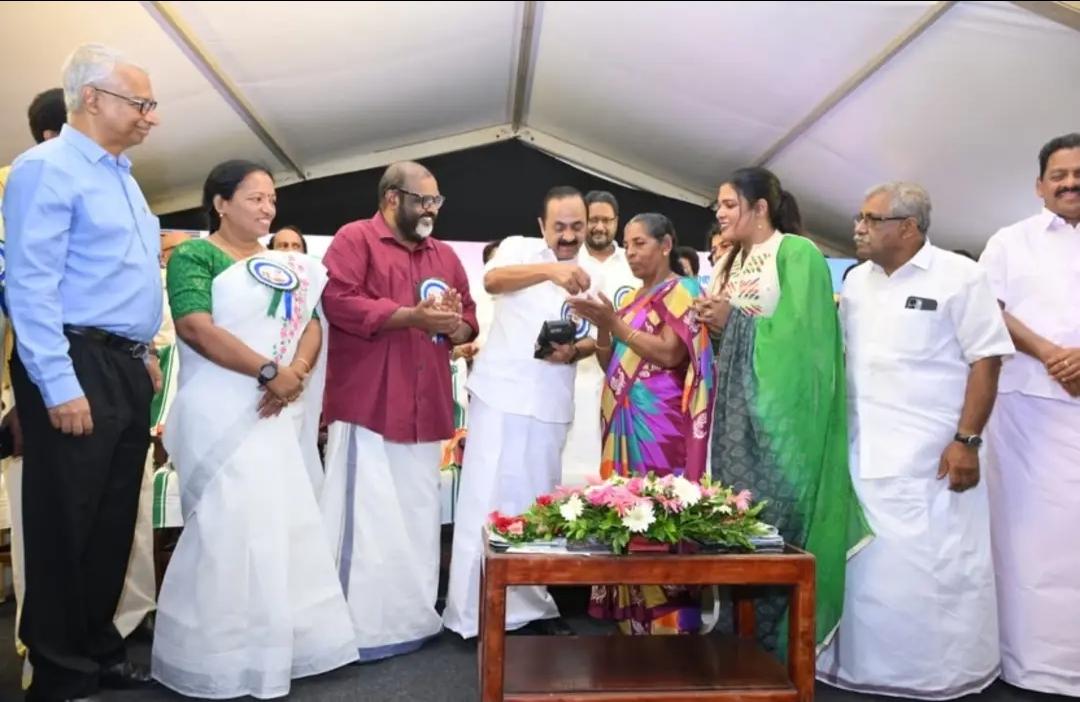
Chief Minister VD Satheesan handing over the first zero-value ticket while inaugurating the Priyadarshini scheme on 15 June.
Behind the government’s grand announcement of the new concession scheme lay tense discussions over cash flow, loan liabilities, and the corporation’s fragile financial position.
During the Cabinet meeting on 10 June, one of the most crucial debates centred on the reimbursement mechanism for the fare concession proposed in KSRTC buses.
Officials weighed two models — advance monthly payment with periodic settlement based on zero-value tickets issued for actual travel, and a daily reimbursement mechanism linked directly to the distance travelled by beneficiaries.
The discussion assumed significance in the backdrop of KSRTC’s mounting financial commitments.
According to official records, the daily collection from 59 depots is currently being remitted to an escrow account towards repayment of the consortium bank loan availed by the corporation. KSRTC is paying ₹1,19,13,000 every single day towards loan repayment.
The corporation had availed a loan of ₹3,100 crore on 1 April 2018, of which ₹2,597 crore remains outstanding as of 31 May 2026.
Given the precarious cash flow situation, officials noted that a daily reimbursement system, with one day’s payment retained as an advance, would be the preferred arrangement to ensure uninterrupted operations and timely debt servicing.
The issue had figured prominently in the high-level meeting convened by the chief minister on 8 June in the presence of the transport minister, Additional Chief Secretary (Finance), Secretary (Law), KSRTC Chairman and Managing Director (CMD) and senior transport department officials.
The meeting decided that the scheme would initially be implemented only in ordinary services as part of the first phase and that the government would review the impact after 100 days of implementation before considering expansion.
Another key decision was to extend the benefit to the transgender community as well.
Officials also agreed that the state government will bear the entire financial burden of the scheme through direct transfer of funds to KSRTC.
The Additional Chief Secretary (Finance) was directed to design an effective settlement mechanism to ensure seamless cash flow, so that KSRTC’s daily operational expenses and financial obligations are not disrupted.
Transport Secretary TV Anupama later clarified that the state government would fully shoulder the project cost and that a dedicated financial management system would be put in place to guarantee smooth fund transfer and operational stability.
She also said KSRTC CMD had been asked to identify additional non-fare revenue sources to offset the extra financial burden arising from the implementation of the scheme.
On 10 June, the State Cabinet, before arriving at the final framework, closely examined transport models operating in several other states and Union Territories, including Delhi, Tamil Nadu, Punjab, Karnataka, Telangana and Andhra Pradesh, while simultaneously studying financial simulations prepared by the KSRTC.
What emerged from both exercises was a clear warning: The wider the coverage, the steeper the fiscal burden.
According to officials familiar with the discussions, KSRTC’s internal trial calculations projected an exponential rise in financial liability if more categories of services were brought under the concession umbrella.
That assessment ultimately became the key factor that pushed the state toward a limited first-phase rollout confined to ordinary services.
The Cabinet noted that most states which introduced free or subsidised travel schemes had deliberately protected their revenue-generating premium services.
Delhi and Tamil Nadu restricted benefits to ordinary town and city services, keeping AC and premium segments outside the scheme. Punjab also excluded AC and Volvo operations despite implementing a broader concession model.
Karnataka’s much-publicised “Shakti” scheme permits women to travel free in almost all non-luxury categories, but limits the facility to intra-state travel.
Telangana opened nearly 81 percent of its RTC fleet under the programme, including Pallevelugu, Express and city ordinary services. Andhra Pradesh extends coverage to around 74 percent of its fleet across Pallevelugu, Ultra Pallevelugu, city ordinary, Express, and Metro Express services.
However, KSRTC’s projections painted a stark picture for Kerala.
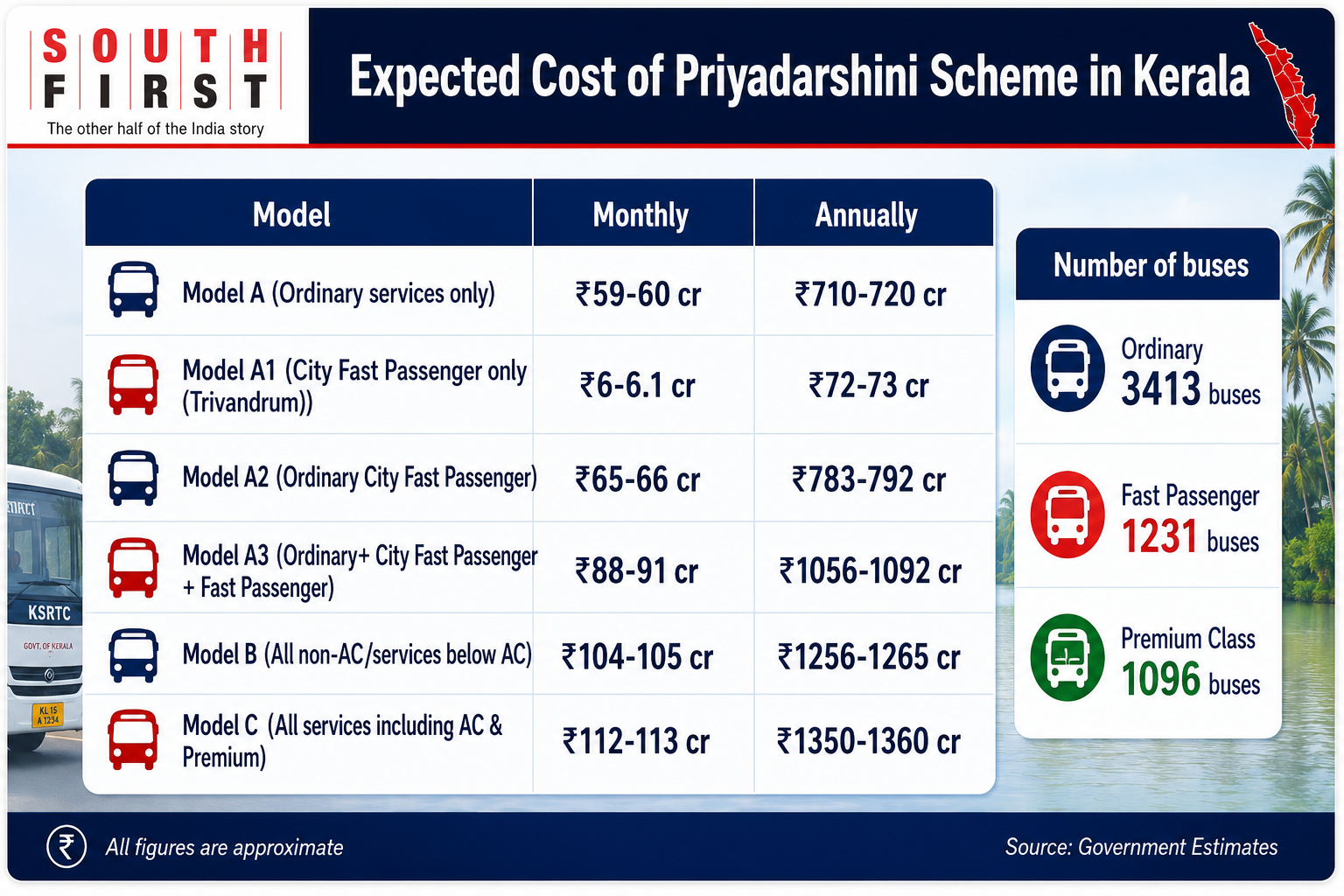
Expected cost of the Priyadarshini scheme in Kerala (AI-generated)
The corporation estimated that restricting the scheme to ordinary services alone — the phase eventually cleared by the Cabinet — would require a monthly reimbursement commitment of around ₹59–60 crore, translating to nearly ₹720 crore annually.
The figures escalated sharply when additional categories were included.
Introducing the scheme in City Fast Passenger services in Thiruvananthapuram alone would add another ₹6 crore a month. A combined Ordinary and City Fast model would push annual liability close to ₹800 crore.
If Fast Passenger services were also included, the projected annual burden would cross ₹1,000 crore.
Extending concessions to the entire non-AC fleet was estimated to cost nearly ₹1,250 crore annually. In comparison, a universal rollout including AC and premium services could take the state’s yearly commitment beyond ₹1,350 crore.
Officials said the financial commitment matrix prepared by KSRTC became the principal deterrent against adopting the more expansive models seen in Karnataka or Telangana.
“The concern was sustainability,” a senior official said. “The wider the coverage, the larger the recurring reimbursement obligation on the state exchequer.”
The Cabinet eventually opted for a calibrated approach — one that attempts to balance welfare expansion with the fragile financial realities of the state transport corporation.
Also Read: ‘Slumdog Millionaires’ in Kochi’s ‘Vietnam Colony’
Another detailed deliberation during the Cabinet meeting was surrounding the mode of implementation, with the government leaning towards the issue of zero-value tickets.
According to discussions in the meeting, multiple implementation models currently followed in other states were examined before arriving at the broad consensus.
The zero-value ticket system — already in operation in Tamil Nadu — was viewed as a simpler and faster mechanism that would avoid delays associated with issuing smart cards or conducting digital authentication for every journey.
The meeting also reviewed the experiences of Delhi, Karnataka, Andhra Pradesh, Telangana and Punjab, where free travel is linked either to smart cards or identity verification through Aadhaar and other government documents.
Ministers reportedly noted that such systems involve additional administrative costs and verification procedures.
Another key issue that came up for discussion was the inclusion of transgender persons within the scheme.
States such as Karnataka, Andhra Pradesh, Telangana and Tamil Nadu currently extend the concession to transgender passengers, and the matter was actively considered during the deliberations.
The Cabinet also examined whether beneficiaries should be charged a one-time fee of ₹40 for issuing cards if a card-based system is adopted at a later stage.
However, with the zero-value ticket model emerging as the preferred option, the necessity of collecting such a charge was also debated.
Restrictions on the scope of free travel formed another major part of the discussions.
The government considered limiting the concession to ordinary and city services, while deliberations were also held on possible in-state travel restrictions, fare ceilings, kilometre limits and monthly caps to regulate financial liability.
Officials pointed out that the zero-value ticket system would provide accurate passenger data and route-wise travel statistics, helping the government estimate subsidy requirements more efficiently while ensuring accountability in reimbursements to KSRTC.
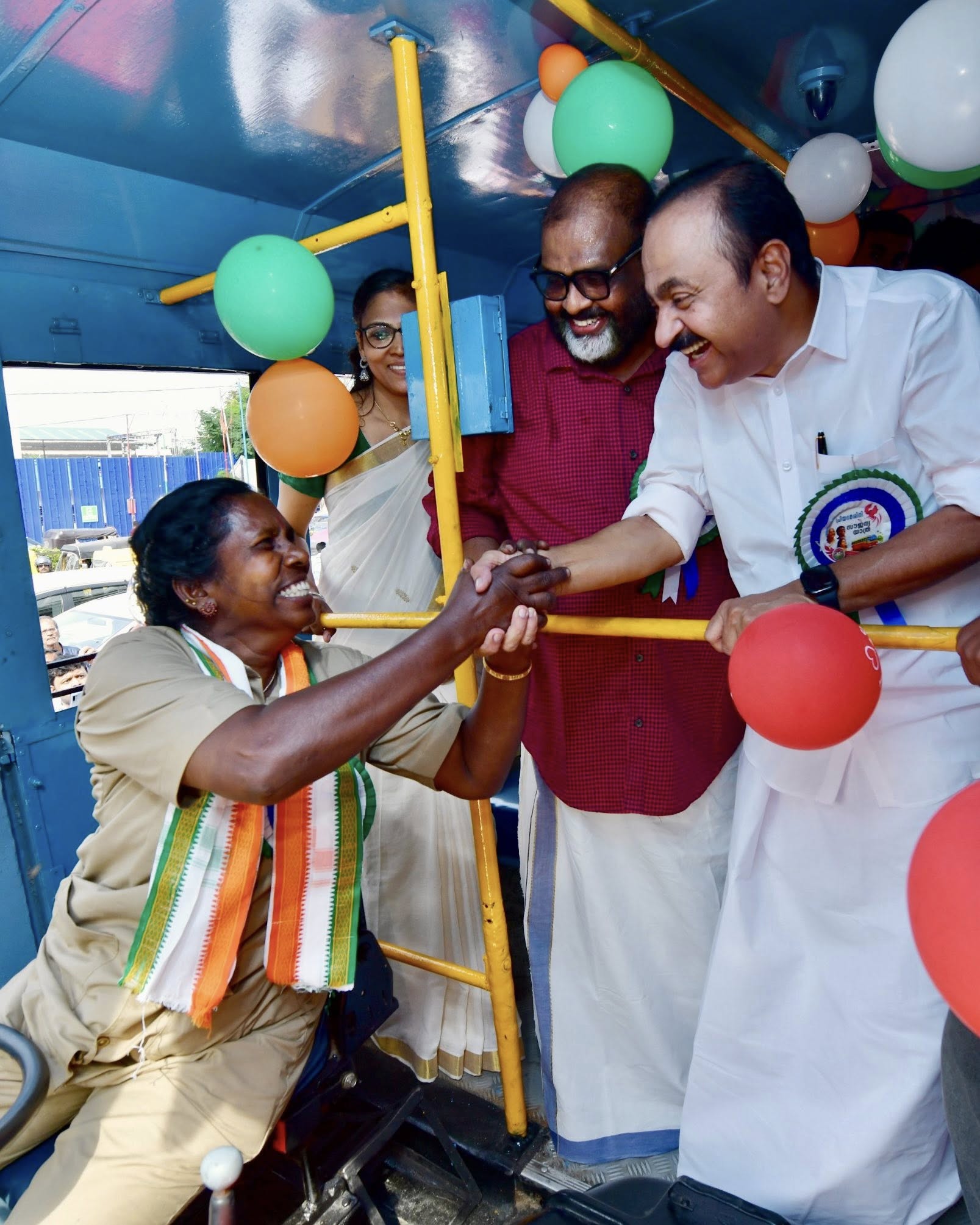
Chief Minister VD Satheesan shaking hands with VP Sheela, the first woman driver of KSRTC, who was behind the wheel in the inaugural bus.
Priyadarshini scheme was flagged off on 15 June with Chief Minister VD Satheesan and ministers joining the inaugural journey from Thampanoor to the Secretariat Durbar Hall in Thiruvananthapuram.
Launched at the Thampanoor KSRTC Complex, the project extends free travel benefits to women and transgender persons in 3,125 ordinary-category buses across Kerala.
The scheme covers Ordinary, City Ordinary, Limited Stop Ordinary, Point-to-Point, Gramavandi, Fair Stage LS and Town-to-Town services.
The inaugural service was driven by VP Sheela, KSRTC’s first woman driver, while Jayakumari served as conductor for the historic first trip.
Ministers CP John, KA Thulasi and Chief Secretary Dr A Jayathilak were among those who travelled on the maiden service.
Passengers availing the benefit will not require special registration, identity cards or certificates. Conductors will issue zero-value tickets through electronic ticket machines. To help commuters easily identify eligible services, special Priyadarshini stickers have been affixed on the front and sides of buses included in the scheme.
Describing the project as a transformative welfare initiative, Chief Minister Satheesan said the impact of Priyadarshini would be felt in every household, particularly among working women who travel long distances daily.
“Let the money they have spent on tickets for so long become a small saving for them. It will strengthen their confidence and determination,” the Chief Minister said.
The Priyadarshini scheme has been implemented as part of the UDF government’s Indira Guarantees programme.
(Edited by Muhammed Fazil.)



