

Published Jun 19, 2026 | 7:00 AM ⚊ Updated Jun 19, 2026 | 7:00 AM

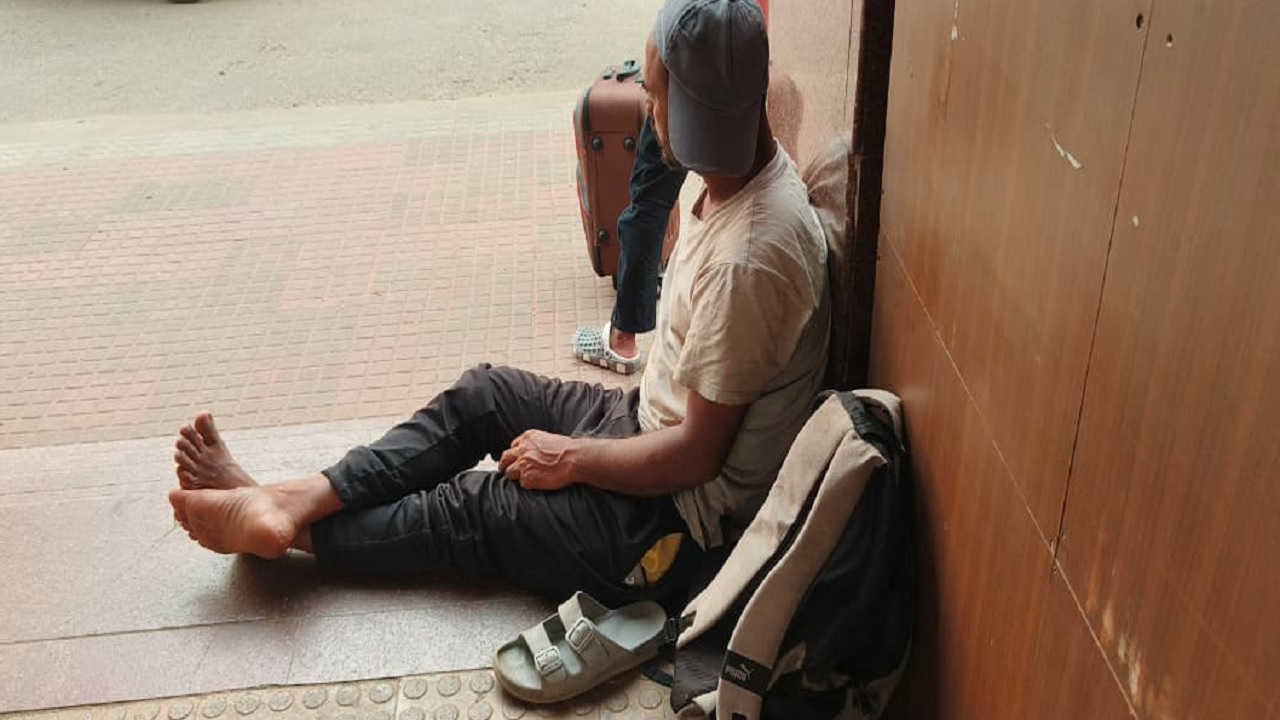
A migrant worker sitting at Aluva railway station.

Synopsis: Arrests of Bangladeshi nationals in Kerala have fueled right‑wing claims linking identity concerns to migrant labour shortages. Experts counter that 99% of workers are Indian citizens, with delays tied to monsoon, West Asian conflicts, and farming season. Perumbavoor’s plywood industry faces raw material crises, while political tensions and security concerns heighten suspicion of Bengali‑speaking migrants.
A series of arrests of Bangladeshi nationals residing in Kerala without valid documents has, over the past week fueled a growing right-wing narrative that identity verification concerns are behind the delayed return of migrant workers to the state.
Kerala police recently arrested three Bangladeshi nationals in separate cases: Mohammed Naddu Hasan in Kollam, Salman Khatun in Kanhangad and a couple, Melan Khan and Mughal Khandal, in Chavara for allegedly residing in India using forged or invalid documents.
The narrative has gained traction in Kochi’s Perumbavoor, Kerala’s largest migrant labour hub, where industries are grappling with acute labour shortages and local authorities estimate that only around 25 percent of migrant workers have returned after travelling home during the West Bengal and Assam elections.
However, ground realities suggest that the reasons behind the crisis extend far beyond identity verification concerns.
Also Read: ED questions former Kerala CM Pinarayi Vijayan’s daughter T Veena in CMRL-Exalogic case
A significant number of migrant workers still lack proper documentation.
Benoy Peter, Executive Director of the Centre for Migration and Inclusive Development (CMID), told South First that the growing right-wing narrative claiming migrant workers have not returned to Kerala because most of them are Bangladeshi citizens is baseless.
“It is part of a political narrative and has no connection with reality. I won’t say there are no Bangladeshi citizens in Kerala, a few such cases have been reported. But 99 percent of migrant workers in Kerala are Indian citizens who have the constitutional right to work anywhere in India.” he said.
According to Peter, the delay in the return of migrant workers is largely linked to three factors — the monsoon season in Kerala, the West Asian conflict and its aftereffects on several industries in the state and the ongoing farming season in northeastern states.
”The majority of migrant workers in Kerala are from minority communities, especially those from West Bengal. For them, South India particularly Kerala, is seen as a safe hub with comparatively less religious discrimination. Other parts of India do not always offer the same sense of security.” he said.
Peter noted that employment opportunities in the construction sector usually decline during the monsoon season, reducing the urgency for workers to return immediately.
“Generally, migrant workers do not actively participate in Assembly or Lok Sabha elections in the same way they engage in panchayat elections. However, this time many viewed voting as part of an identity crisis. Out of fear and confusion regarding their identity, many chose to cast their votes.” he added.
Speaking about workers in the fishing sector, Peter said many are from the Sundarbans region of West Bengal. Their return has also been delayed due to Kerala’s annual trawling ban during the monsoon season.
Migrant workers arrive at Aluva railway station.
“Nearly 80 percent of the migrant workforce in Ernakulam, especially in Perumbavoor comes from Domkal, a border region in Murshidabad district. Almost every household there has at least one member working in Kerala. Since it is currently the farming season, many have temporarily remained in their villages for agricultural work.” he said.
“The Antyodaya Express trains, which are completely unreserved superfast services, brought large numbers of workers from West Bengal back to Kerala after Bakrid. Videos of these crowded trains, particularly from Aluva railway station, went viral. They will definitely return, and there is no doubt about that,” he said.
Questioning the focus on workers from West Bengal, Peter asked, “Why is the BJP solely targeting the West Bengal workforce? Why is there silence regarding workers from Assam? One in every five migrant workers in Kerala is from Assam, where BJP is in power for years. If there were adequate job opportunities and social security there, would they come all the way to Kerala for work?”
Also Read: The economics of a bus ticket: Why Kerala’s free travel scheme is about mobility and progress
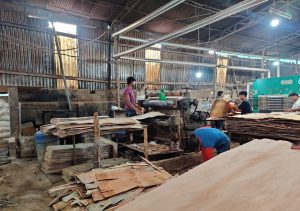
A plywood unit in Perumbavoor
Perumbavoor is one of India’s largest plywood manufacturing and export hubs and is widely regarded as the heart of the country’s plywood and timber industry. The region produces a wide range of products, including commercial plywood, marine plywood, film-faced shuttering plywood and decorative plywood.
Manufacturers in Perumbavoor supply products across India and export to markets in the Middle East, Africa, and other parts of the world.
The industry, which employs a large number of migrant workers, is now facing a severe crisis due to a shortage of raw materials.
Speaking to South First, plywood manufacturer Eldhose George A. said, ”Phenol-Formaldehyde (PF) resin is one of the key raw materials used in plywood manufacturing. It is derived from petroleum products. Due to the ongoing conflicts in West Asia, imports of essential chemicals have been severely affected. These materials are mainly sourced from Arab countries and Iran. At the same time, prices have risen sharply.
For instance, the price of phenol has increased from Rs 85 to Rs 160/kg. The rise in raw material and energy costs has pushed up overall plywood manufacturing expenses by 6 percent to 15 percent. Production has declined, resulting in reduced demand for labour.”
According to Benoy Peter, Kerala’s plywood industry witnessed rapid growth during the 1990s. Before Kerala emerged as the country’s leading plywood producer, Assam dominated the sector. However, Assam’s plywood industry suffered a major setback in December 1996 when the Supreme Court imposed a ban on veneer and plywood mills operating in forest areas across the Northeast to protect tropical evergreen forests.
“Following the ruling, the plywood manufacturing hub gradually shifted to Perumbavoor, where manufacturers adopted rubberwood as an alternative to forest timber. During this transition, entrepreneurs brought not only second-hand machinery from Assam but also skilled migrant workers from the state,” Benoy said.
However, he warned that Kerala’s dominance in the sector could face challenges in the coming years. “Tripura is rapidly expanding rubber cultivation, which could eventually threaten Kerala’s long-standing monopoly in both rubber production and plywood manufacturing,” he added.
Raza Mollah, a Murshidabad native currently working as a hotel bearer in Kochi, said he returned to Kerala immediately after the elections after his employer sponsored travel tickets for him and his co-workers.
“Many people are facing documentation-related issues, especially those from minority communities. That does not mean they are not Indian citizens. Bengali-speaking Muslims are often labelled as illegal immigrants simply because of their language and identity.” he told South First.
Mollah said that after a few arrests involving West Bengal residents in Kerala, migrant workers have increasingly been viewed with suspicion.
“We are worried that growing rumours and mob vigilantism could lead to incidents similar to the lynching of a Dalit migrant worker in Palakkad, who was falsely accused by a mob of being a ‘Bangladeshi infiltrator.” he said.
Amid a labour shortage in the construction sector, wages have now been standardised in the Perumbavoor region.
Contractors have fixed the daily wage at ₹1,100 for masons and ₹900 for helpers, rejecting workers’ demands for ₹1,500 and ₹1,300 respectively. The rates remain above the state-notified minimum wages of ₹935 for masons and ₹845 for helpers.
Contractors are also struggling to supply enough workers to meet the growing demand for labour, a situation they believe will ease once the full workforce returns.
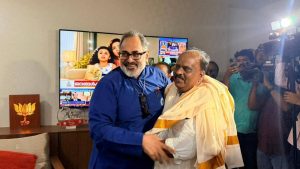
BJP state president and MLA Rajeev Chandrasekhar (L) congratulating BB Gopakumar after he was made the Legislative Party leader.
BJP MLA from Chathannoor in Kollam, B.B. Gopakumar, told South First that security concerns surrounding migrant workers cannot be ignored.
“The NIA arrested Al-Qaeda-linked terrorists from Perumbavoor just a few years ago. Earlier, in 2012, a Crime Branch team arrested three suspects linked to the banned terrorist outfit Lashkar-e-Taiba from a hideout in Perumbavoor. Therefore, it is mandatory to verify their identity documents, and the police are now carrying out strict monitoring,” he said.
Gopakumar also alleged that West Bengal Chief Minister Mamata Banerjee had previously been lenient towards illegal migrants, and that a small percentage of them may have reached Kerala.
“Among migrant workers, there are people who lack proper documents. During the LDF government’s tenure, several terrorist outfits managed to establish roots in Kerala, and some migrant workers have links with such outfits. That is a reality,” he claimed.
He further suggested that the delay in the return of migrant workers to Kerala could be due to increased employment opportunities after the BJP came to power.
(Edited by Amit Vasudev)



