

Published Jul 02, 2026 | 11:00 AM ⚊ Updated Jul 03, 2026 | 10:58 AM

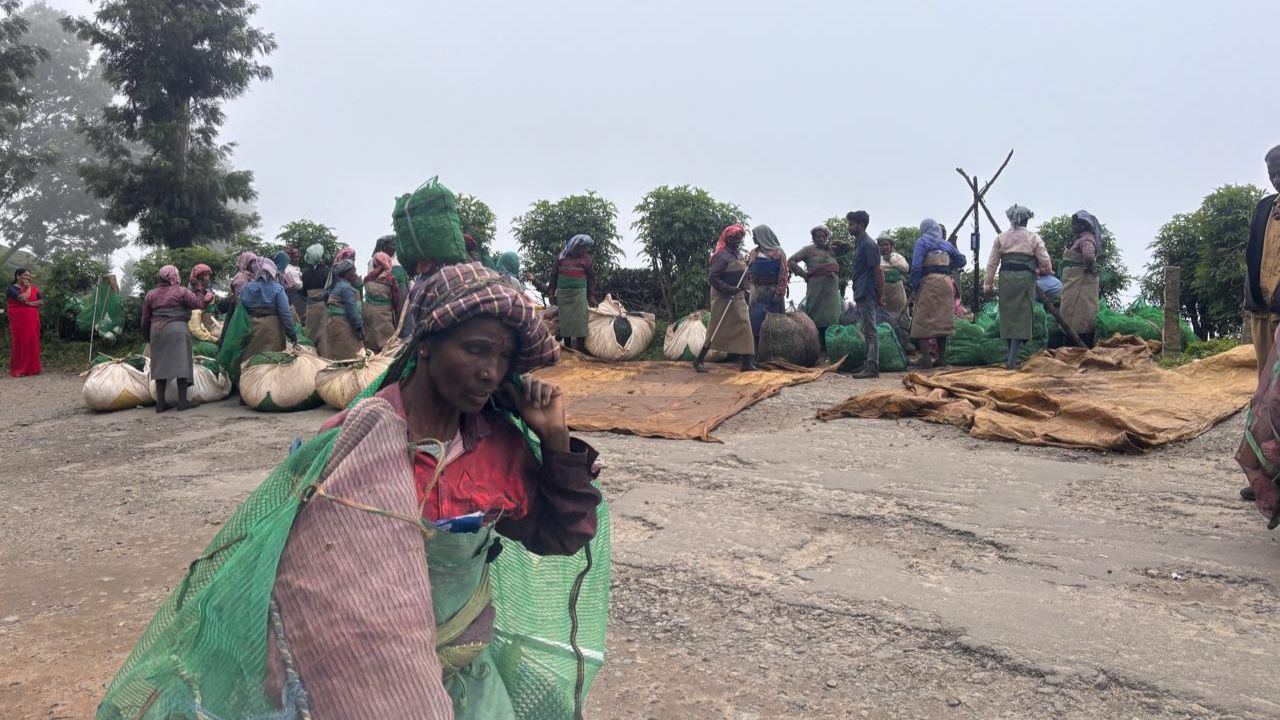
Workers in Munnar waiting to weigh the tea leaves.

Synopsis: Even a century and four generations after they were brought as tea plantation workers, the Tamil community in Kerala’s Idukki district, especially the areas surrounding Munnar, has yet to be formally recognised as the residents of the state. From obtaining caste certificates to accessing various government benefits, they allege that Tamil people are treated as second-class citizens.
There is hardly anything that can match the deep sense of calm and relaxation you feel while sipping a fragrant cup of tea. But have we ever paused to think about the thousands of hands that toil before those tea leaves finally reach our homes? Have we ever reflected on the pain and century-long struggle behind that labour?
Sixty-six-year-old K Premalatha lives in Kanthalloor in Kerala’s Idukki district. Her ancestors, originally from Tamil Nadu, were brought by the British government nearly 100 years ago to work in tea plantations.
Born and raised there, Premalatha spent more than 45 years plucking lakhs of kilograms of tea leaves with her own hands before retiring from work, without even receiving a pension.
However, that is not her only problem.
Even after 100 years, Premalatha said, Kerala still refuses to accept her as one of its own citizens.
Not just Premalatha, but thousands of Tamil tea estate workers living in areas surrounding Munnar continue to face a situation where, even after a century, they are not treated as full citizens of Kerala.
From obtaining caste certificates to accessing various government benefits, Premalatha and many others allege that Tamil people are treated as second-class citizens.
They further allege that although they had caste certificates until recently, the Kerala government has now started refusing to renew those certificates, particularly after Tamil workers in Kerala intensified protests demanding land rights.
Premalatha’s granddaughter, R Anushiya, representing the fifth generation of the family, has completed her undergraduate degree and is currently seeking admission for postgraduate studies. However, she has not received any response even months after she submitted an application to renew her caste certificate, her family said.
The problem does not stop with caste certificates alone.
When South First visited the area to understand how the system works, it was found that nearly all Tamil tea estate workers living in Kerala seem trapped in a vicious loop.
Also Read: Elephants sans passage, people without peace: Trapped in Chinnakanal’s endless conflict
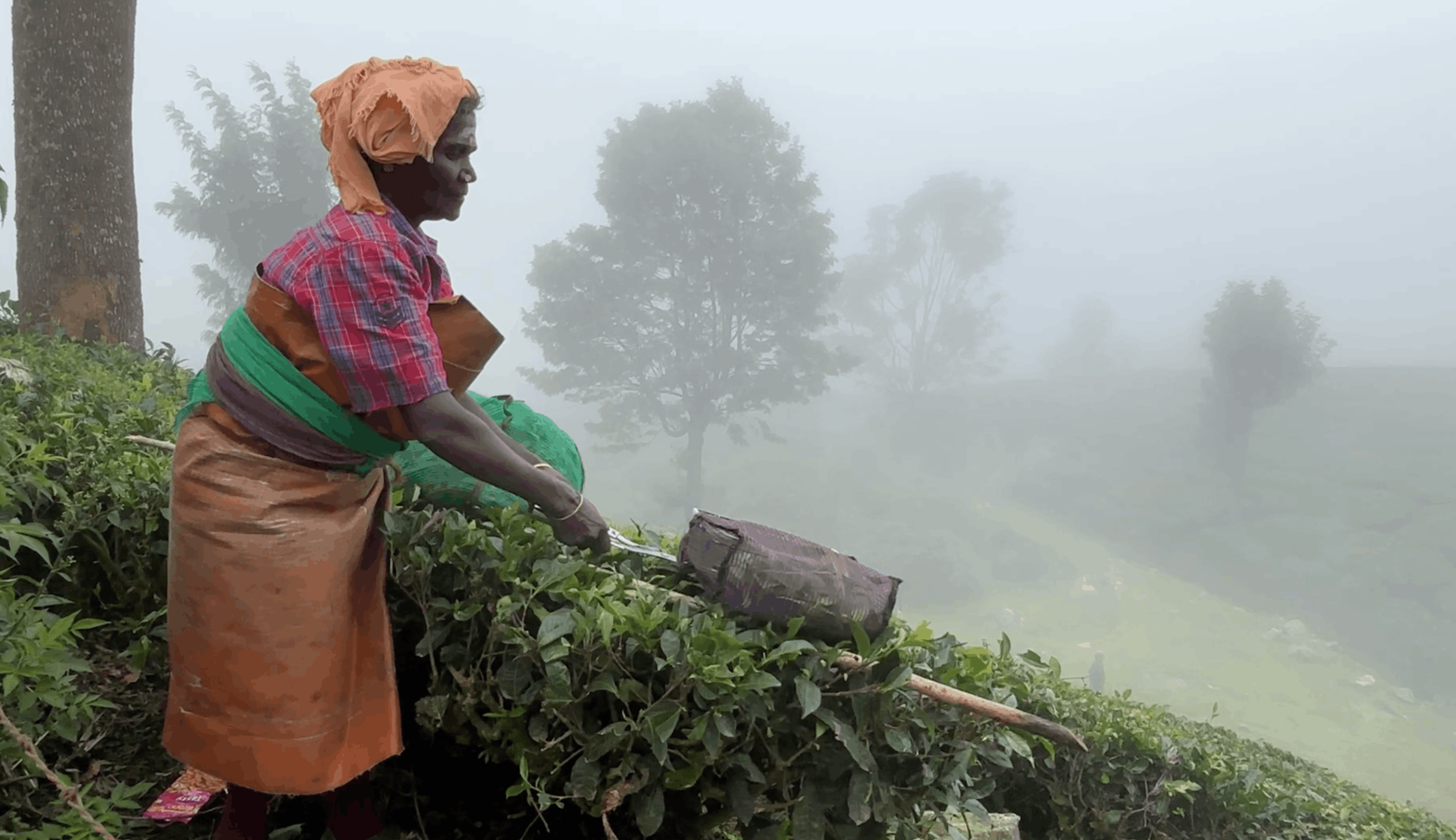
Estate worker plucking tea leaves.
During the 1800s, the British brought thousands of Dalit workers, along with smaller numbers from other communities, from present-day northern Tamil Nadu districts such as Chennai, Tiruvallur, Chengalpattu and Kanchipuram, as well as from the then-undivided Tirunelveli district in southern Tamil Nadu, to Idukki district for plantation labour.
These workers were employed in tea cultivation across Munnar and several parts of Idukki district.
However, according to social activist R Arumugam alias Riyaz from Munnar, Tamil people had been living in this region as indigenous tribal communities even centuries before British plantation labour migration began.
Riyaz said his grandfather, Subramanian, migrated from Tamil Nadu to Munnar in 1942 at the age of 18 to work in plantations.
He claimed that tribal communities descended from Pandya-era populations that migrated from Madurai had already settled in this region long ago.
According to the records, communities such as Pulayars, Irulas, Kurumbars and Paliyars, found extensively across Idukki district, are migrants from Tamil Nadu and continue to be Tamil-speaking communities even today.
According to the 1971 Census, around 1.23 lakh Tamils lived here, said Riyaz. He estimated the current Tamil plantation worker population at roughly 70,000.
Plantation workers do not own homes. Once workers reach retirement age, companies evict them from company housing. Because of this, the Tamil population has steadily declined over time.
Many who leave eventually settle in places in Tamil Nadu like Tiruppur, Coimbatore, Chennai or wherever they can find work.
Currently, tea cultivation is carried out across 27 divisions in Munnar.
The majority of plantations are operated by Kannan Devan Hills Plantations Company, while the remaining estates are managed by Tata Consumer Products Limited, Harrisons Malayalam Limited, and Jayashree Tea & Industries.
According to various documents, tea is cultivated across nearly 24,000 hectares and around 22 million kilograms of tea are harvested annually.
These companies employ both permanent and contract workers, with Tamil workers forming the overwhelming majority.
A smaller number of North Indian workers are also employed.
Among permanent employees alone, Riyaz estimated, there are about 12,000 workers.
Among Tamil communities dependent on Munnar plantations today, roughly 30,000 are Dalits. Apart from them, smaller populations from intermediate castes such as Mukkulathor, Pillaimar and Chettiar communities also live there.
Yet, even after generations, most of these Tamil communities continue to remain trapped as daily wage labourers.
Before examining workers’ allegations that the Kerala government treats them as second-class citizens, it is equally necessary to understand how plantation companies themselves continue to keep these workers in deeply vulnerable conditions.
Although Tamil workers migrated to Munnar over 100 years ago, and four generations have now passed, the majority remain daily wage labourers without land ownership or independent housing.
Most tea estates in Idukki district are privately run. When a worker joins a plantation, the private company provides the family with one of the estate’s “line houses”.
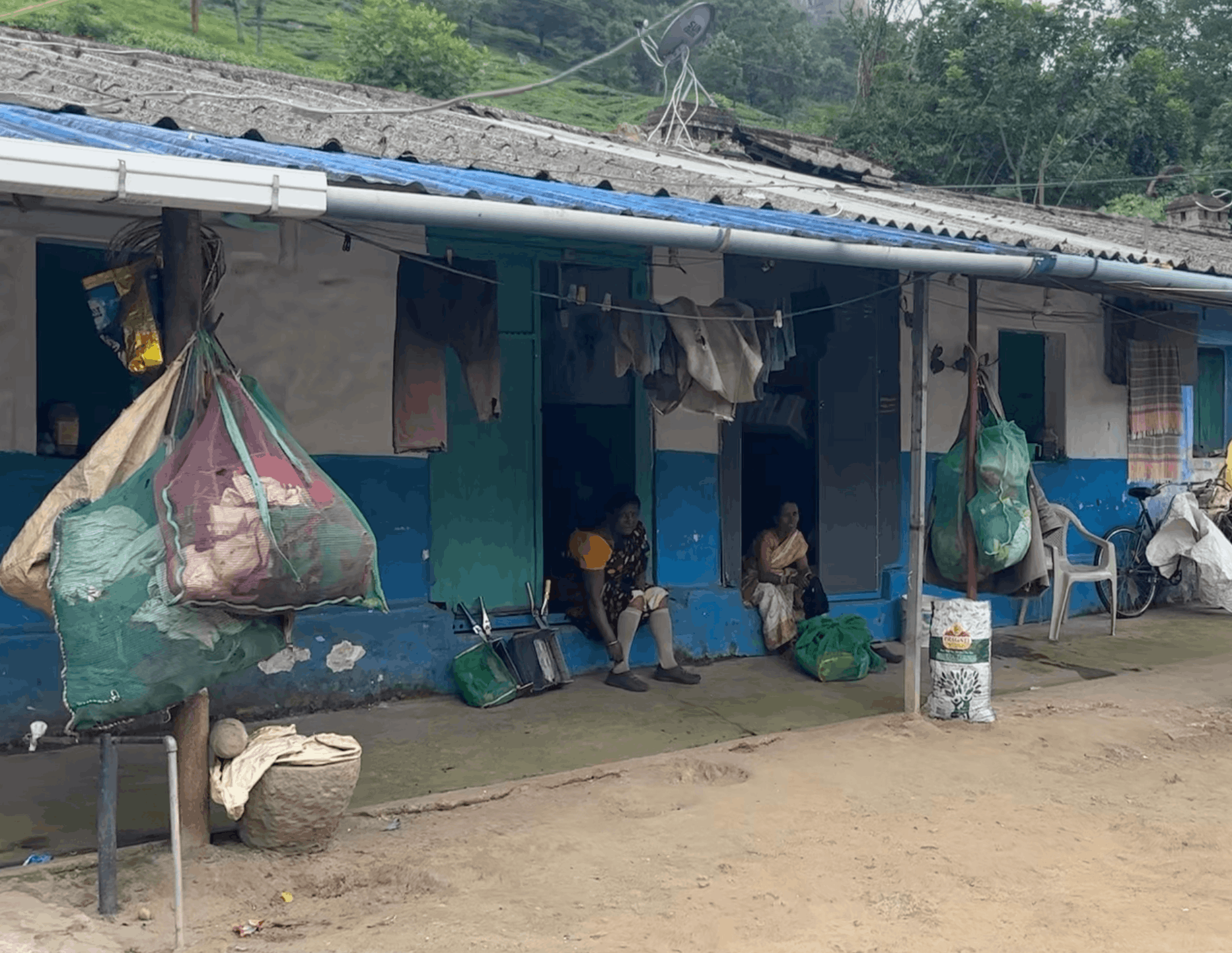
Tea estate quarters for estate workers.
These houses offer minimal facilities; at best, a 10×10 single room with a tiny cooking space. Whether a family has four members or ten, everyone must live within that space.
This has been the reality for many families across four generations. Under current conditions, a worker is expected to pluck around 20-30 kilograms of tea leaves per day.
For this, workers are paid between ₹500 and ₹550 daily. Residents said even this wage was achieved only after prolonged struggles.
If workers pluck beyond the company’s quota, additional payment is provided. This remains the community’s only source of income.
If a worker begins working at age 20, once they complete roughly 40 years of service and reach retirement age, the company terminates employment with only minimal compensation.
“The maximum compensation usually does not exceed ₹2 lakh,” said Riyaz.
Not only that, the company also takes back the house provided to the worker. After retirement, the worker must leave the estate.
Some workers manage to save enough during their lifetime to buy land or homes elsewhere in Kerala and settle down.
However, the majority prioritise supporting their families throughout their working lives and ultimately reach retirement age with neither land nor housing.
One such person is Kalidas. A former estate worker, his family has worked as tea plantation labourers in Munnar for three generations.
Kalidas spent 25 years plucking as much as 200 kilograms of tea per day.
However, since he is no longer physically able to work in plantations, the company has now asked him to vacate his house.
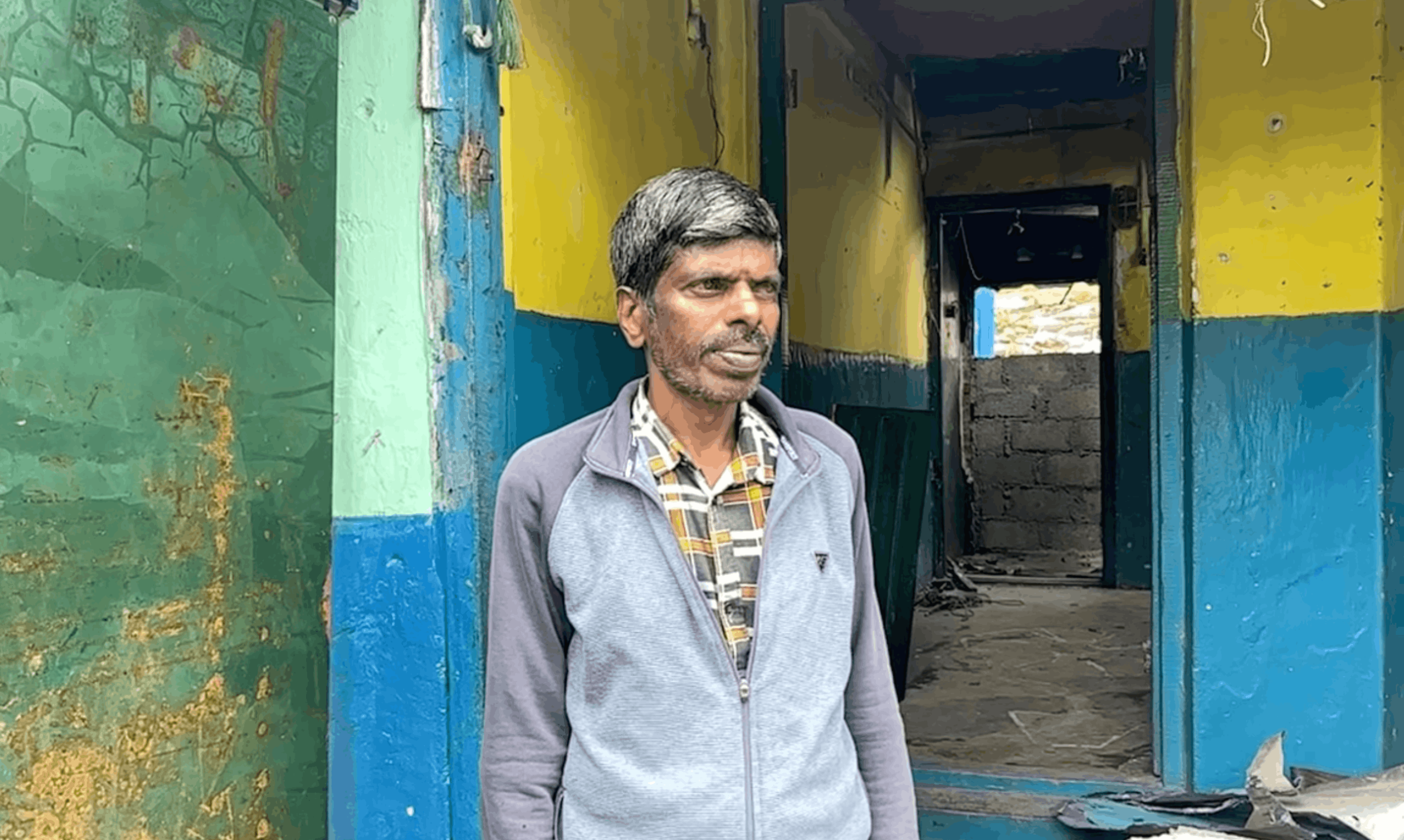
Former tea estate worker Kalidas.
Recently, videos showing plantation officials attempting to demolish Kalidas’s house went viral on social media.
Speaking about it, Kalidas said, “I worked for this company for 25 years. Now, because my health is poor, I thought I could survive by running a small petty shop (roadside stall) here itself. But they say I cannot run a shop and that I must vacate the house. I have nowhere else to go.”
Unlike government employees, these workers receive neither pension nor substantial retirement benefits. Unless they manage to buy land or build a house during their working years, they are left with nothing.
While workers said plantation companies continue to treat them like bonded labourers, they also allege that even after becoming permanent residents of Kerala, the government still treats them as outsiders from Tamil Nadu.
The biggest example, they noted, is caste certificates.
Tamil communities there used to receive caste certificates without difficulty. But according to Murugan, spokesperson of the Kerala unit of the Viduthalai Chiruthaigal Katchi (VCK), problems began after the 2015 Pombilai Orumai protest.
The Pombilai Orumai protest was led by Tamil women plantation workers demanding equal wages and labour rights. After that movement, Tamil communities also began demanding land rights.
Workers now allege that the government fears granting them certificates because such recognition could strengthen future land ownership claims.
In Kerala, caste certificates generally require renewal once every three years. Following this procedure, Premalatha applied for renewal eight months ago.
Now, Tamil applicants seeking caste certificates must prove that their ancestors migrated to Kerala before 1950. For this, they must produce documentary evidence or bring two witnesses.
Following these rules, Premalatha brought two witnesses at her own expense to the Devikulam Taluk office and completed every required procedure.
Yet, even after eight months, no certificate has been issued. She is not alone.
Her son, writer Prabhakaran K Munnar, has also been denied certificate renewal. Prabhakaran completed his PhD and currently works as a guest lecturer at a college in Palakkad.
“My ancestors settled here and struggled through countless hardships. Amid all of that, I managed to earn a PhD. During my studies, I was selected for the Rajiv Gandhi Fellowship for SC students, a scheme awarded to only a limited number of students across India. The Government of India has already officially recognised me as belonging to a Scheduled Caste. Yet the local government refuses to issue me a caste certificate, saying I belong to that very same community.”
He has been waiting six months after applying for a certificate renewal. However, ordinary procedures appear very different.
When South First randomly inquired at a village office in Alappuzha district, officials explained that when a Kerala citizen applies for a caste certificate renewal, it is usually issued within four to seven days.
A village officer either verifies through SSLC certificates or sends an ASHA worker to physically verify the applicant’s home.
From this itself, it can be understood that delays occur specifically in issuing certificates only to Tamil people.
Devikulam Sub Collector Arya VM told South First that delays in issuing community certificates to members of the Tamil linguistic minority stem purely from legal and technical issues, not discrimination.
“The perception that the delay is linked to their linguistic identity is subjective and does not reflect reality,” she said.
Explaining further, Arya said that under the Presidential Order, applicants whose families migrated before the 1950s are required to produce certificates from two witnesses establishing eligibility.
“Officials processing these applications cannot issue certificates without the required witness documents. If they do so and any discrepancy is found later, they could be held accountable. We are aware that many applicants find it difficult to produce these documents,” she said.
She added that both former and current MLAs have raised the issue with the administration, and efforts are underway to find a solution.
“This is entirely a legal issue creating difficulties for people. It has nothing to do with bias or discrimination on any ground,” Arya said.
However, Pombilai Orumai leader A Gomathi questioned this logic.
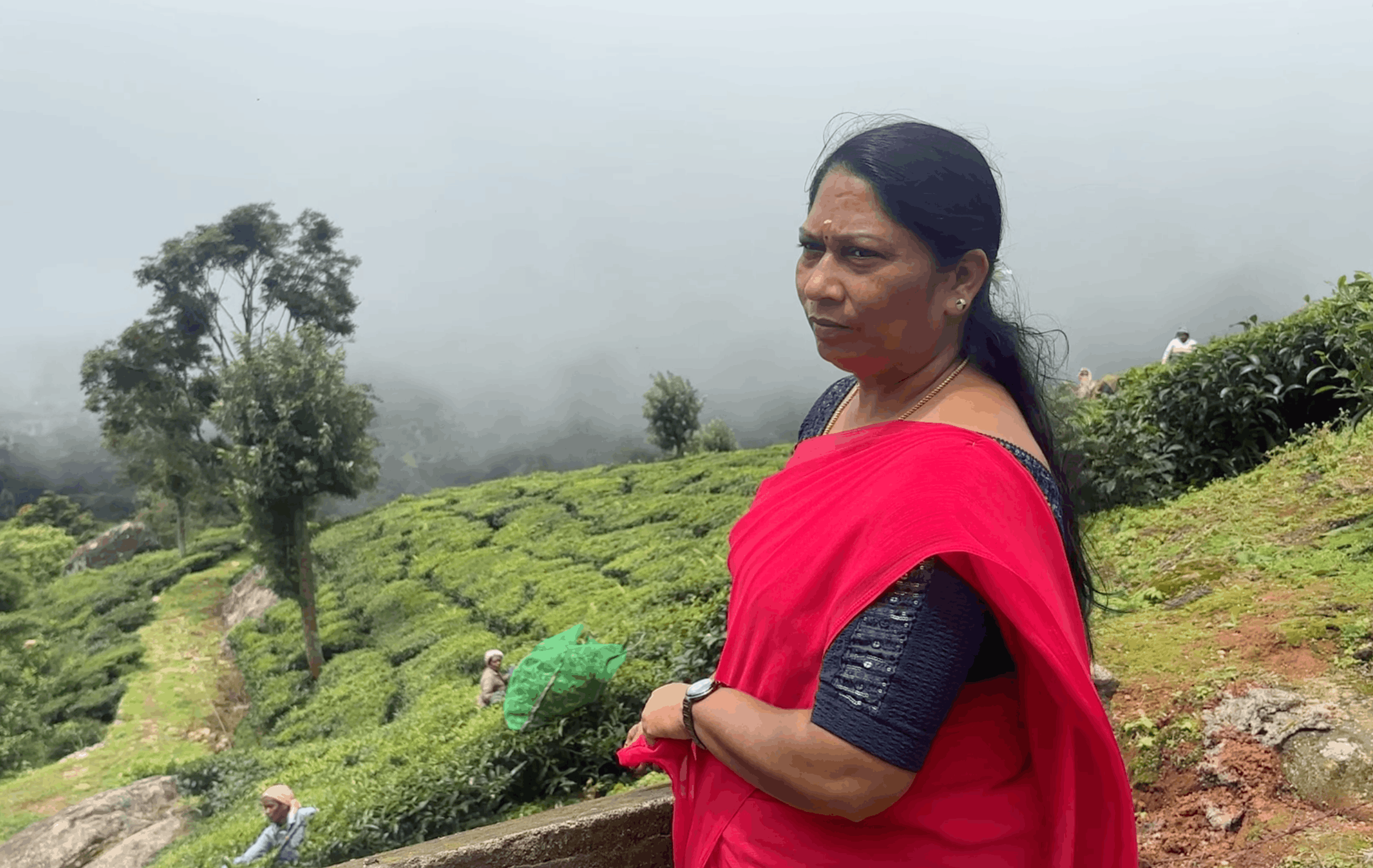
Pombilai Orumai Protest organiser A Gomathi.
“How can we possibly prove that we were living here before 1950? Our ancestors are buried here. But we have no documents proving where they lived generations ago.”
Delays in obtaining caste certificates affect not only workers but also students from their families.
Anushiya, Prabhakaran’s family member, is currently struggling to pursue an M Com degree because she lacks a valid caste certificate.
Similarly, caste certificates are needed when registering land ownership with local village bodies after purchasing land.
Explaining further, Gomathi said, “If you are Hindu, you must pay ₹6 lakh. If you are a Christian, you must pay ₹4 lakh during registration. To prove my exemption eligibility, I need my caste certificate. Since the government is delaying issuing certificates, even buying land has become impossible for Tamil people.”
Gomathi had converted from Hinduism to Christianity. Like her, many others have also converted to Christianity. Currently, when they try to register their land, they are required to provide a caste certificate to prove their Christian community status, which would also be economically beneficial for them.
However, the current denial of caste certificates is preventing them from purchasing land. Gomathi said that this issue is not limited to Christians alone; even those of us who identify as Hindus are now unable to obtain the required certificates.
Also Read: Walking through Kerala’s Blue-Flag-certified Kappad Beach
Even after living in Kerala for more than 100 years, Gomathi said, Tamils are still not recognised as Kerala people.
“We have plucked lakhs of tonnes of tea here and generated profits for plantation companies and this state for generations. But they have never recognised us as people of Kerala. Instead, they mock us as Pandikkaarans. Whenever we demand our rights, they said, ‘You are Pandikkaarans; go back to your own place.’”
The word Pandikkaaran is commonly used in Kerala to refer to Tamils. Prabhakaran explained, “Pandikkaaran is a racially discriminatory term used to portray Tamils as inferior, dirty, uncivilised people.”
Gomathi continued, “For younger Tamil generations here, job opportunities are very limited. Because Tamil is their mother tongue and many do not have strong Malayalam skills, even degree holders end up working as taxi drivers, tourist guides or employees in textile shops.”
She pointed out that across Kerala, there is only one Tamil MLA. “As far as politicians are concerned, we are seen merely as a vote bank.”
Non-resident of Kerala
Normally, Indians living abroad for long periods are referred to as Non-Resident Indians (NRI).
But in Kerala, the government uses the term Non-Resident Keralite (NRK) in connection with Tamil communities, residents allege.
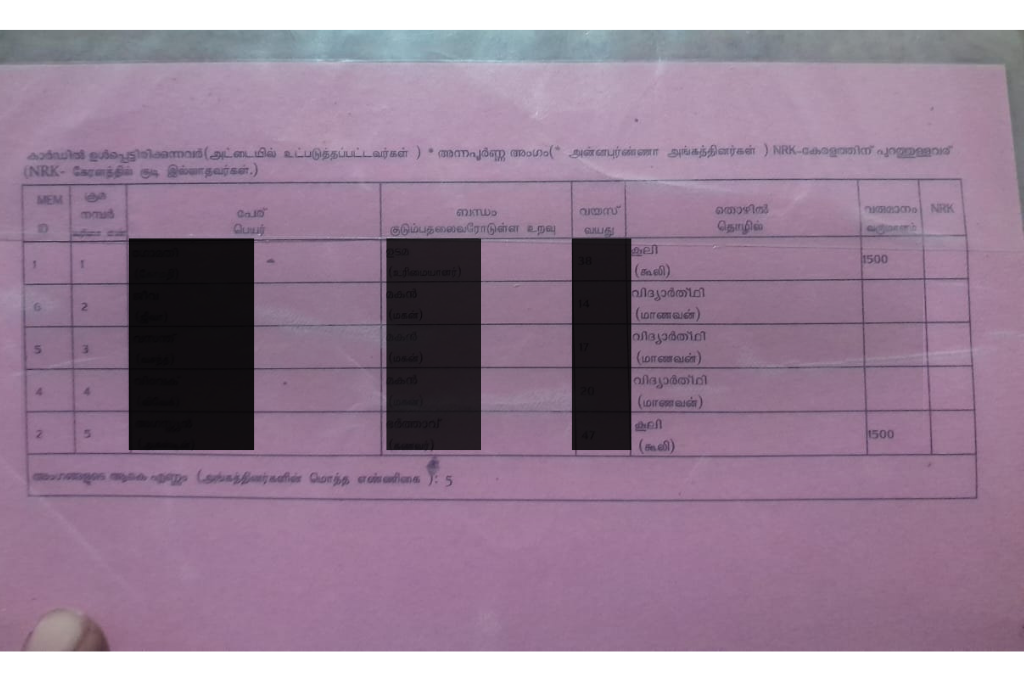
A ration card carrying the ‘NRK’ classification.
Speaking about this, Gomathi said, “Our ration cards mention that we are not residents of Kerala. This issue started five or six years ago. When we questioned officials, they said this category applies to people living abroad. But it has been marked for us too. If laws like CAA or NRC are implemented, this will definitely create problems for us. We are living here like Sri Lankan refugees.”
She alleged the state deliberately uses such classification to reinforce the idea that Kerala belongs to Malayalis and not to Pandikkaarans.
While newer smart ration cards like those held by people such as Prabhakaran no longer explicitly display this wording, Gomathi showed her own ration card, which contains wording indicating that she is not a resident of Kerala.
She claimed that this applies broadly to all Tamil plantation workers.
Prabhakaran, Gomathi, Murugan and others repeatedly said one thing: If they receive land rights, every other human right will naturally follow. But they said everyone in power is ensuring that it does not happen.
Prabhakaran specifically pointed to a 2018 Kerala government order concerning housing for plantation workers.
Following recommendations of the Retired Justice Krishnan Nair Commission, created to study Kerala’s plantation sector crisis, the Kerala government issued Government Order (Ms) No. 44/2018 on 29 June 2018. The order accepted multiple measures to address long-pending structural issues affecting plantation workers and estate management.
The government approved major relief measures, including the abolition of the plantation tax, freezing agricultural income tax collection from plantation owners for five years, exempting estate mergers from building tax, and waiving Forest Department fees charged for cutting rubber trees.
Most importantly, after acknowledging that plantation labour quarters had become uninhabitable, the government decided that new houses would be constructed under the LIFE Housing Scheme.
The cost would be shared equally between the government and plantation owners in a 50:50 ratio. Estate owners were required to provide land free of cost.
The order also proposed creating legal mechanisms for state intervention in abandoned plantations and allowing workers’ cooperatives to run estates with government financial support.
Additional recommendations included timely wage revision, extending ESI benefits to plantation workers, and creating a dedicated plantation policy. Yet, even eight years after the order was issued, workers said none of these housing promises has materialised.
“This government order is not legally enforceable, so it is not mandatory. It only recommends that if the company provides land, the government would construct houses for the workers. However, since the company did not agree to this, the government order was never implemented,” said a Kerala cadre IPS officer, K Sethuraman.
Speaking about caste certificates and other documents, he added, “Whenever you apply for certificates, your residential address is required. But these estate workers do not have a permanent address of their own — all the houses they live in are company-provided quarters. On that basis, certificates are being denied. The only permanent solution to all these issues is for them to have land of their own and a permanent residential address.”
Although a small number of tea workers have received five-cent land allocations from the government, thousands of workers still depend entirely on private plantation companies for shelter.
For these workers, land rights remain the foundation upon which all other human rights depend.
They believe obtaining ownership of land would finally guarantee dignity and security.
Even after a century, they said, they continue to live as landless labourers, vulnerable nomads who can be expelled at any time.
Their long-standing demand is simple.
The Kerala government must create conditions for them to live with dignity rather than allowing them to remain plantation labourers generation after generation.
The same government that determines their wages and retirement age, they argued, must also take responsibility for ensuring what happens to them after retirement.
That, they said, remains the unfinished struggle of Kerala’s Tamil tea estate workers, a struggle for dignity, recognition and the basic right to call the place they built with their labour home.
(Edited by Muhammed Fazil.)



