

Published Jun 15, 2026 | 5:10 PM ⚊ Updated Jun 15, 2026 | 5:10 PM

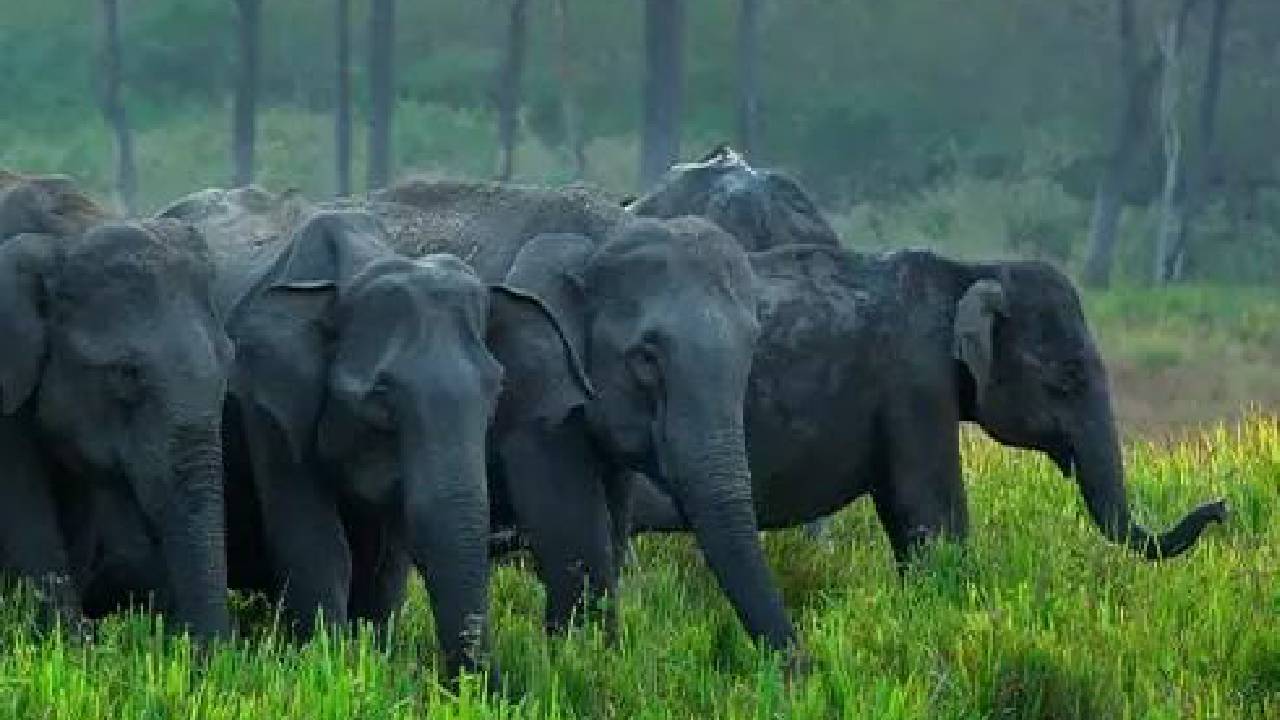
Human settlements have fragmented traditional elephant corridors. (Pic: Kerala Tourism)

Synopsis: A woman’s death in Chinnakanal has reopened painful questions over whether rehabilitation policies, tourism expansion and years of ecological neglect turned one of Kerala’s historic elephant corridors into a permanent conflict zone. Beneath the recurring attacks lies a larger tragedy — a shrinking landscape where frightened families and displaced elephants are now forced to confront each other almost every day.
The death of 36-year-old Mari — a landless daily wage worker trampled by a wild elephant at Chinnakanal near Munnar in Idukki on 8 June — has once again exposed the deep and unresolved fault lines of one of Kerala’s most troubled human-wild elephant conflict zones.
Beyond the immediate tragedy lies a question that has haunted the high range for more than two decades: did a government decision meant to rehabilitate landless tribal families end up permanently disrupting elephant habitat in the ecologically sensitive Chinnakanal?
In 2002, the AK Antony-led UDF government allotted land to 559 tribal families in Chinnakanal.
Conservation experts now argue that the move, though socially driven, fragmented elephant corridors and severed traditional migratory routes connecting larger forest landscapes.
The result, they say, is a region where elephants have been trapped within human settlements for years, intensifying conflict, crop destruction and loss of life on both sides.
Today, both humans and elephants are paying the price.
Also Read: Rising cases of deaths due to wildlife attack in Kerala
For Chinnakanal residents, Mari’s death is not an isolated incident.
It is part of a crisis that has simmered for years in a village that sits in the middle of one of Kerala’s historic elephant corridors.
With the Kerala State Human Rights Commission stepping in to seek answers from the authorities, it has once again brought the area’s long-running human-wild elephant conflict under intense scrutiny.
Taking suo motu note of the incident, the commission has directed the Munnar Divisional Forest Officer to conduct an immediate inquiry into elephant attacks in Chinnakanal during the past three years.
The panel also asked officials to examine whether elephants in the region have effectively become trapped due to the loss or obstruction of their traditional migratory paths.
The commission further sought concrete recommendations to prevent recurring attacks and directed senior officials from both the Forest Department and district administration to appear before it at Thodupuzha on 15 July.
Forest officials admit that at present at least 17 wild elephants in separate herds are moving through the Chinnakanal region.
Despite claims of intensified monitoring, residents continue to live amid frequent crop destruction, damaged homes and constant fear of surprise encounters.
Wildlife experts have repeatedly pointed out that Chinnakanal forms part of a natural elephant route connecting the Chinnar Wildlife Sanctuary with the Periyar Tiger Reserve through the Munnar-Anamudi landscape.
Long before plantations, roads and settlements expanded into the hills, elephants used these forest stretches as unhindered migratory pathways.
The roots of the present conflict are also tied to a major rehabilitation project undertaken in 2002 during the tenure of former Chief Minister AK Antony.
Landless families belonging to communities including Malayarayas, Hill Pulayas, Muthuvans and Mannans tribes were relocated to Chinnakanal’s 301 Colony, with each family allotted one acre of land.
Over the years, however, the settlement became one of the most vulnerable zones for elephant encounters.
Even official records had warned about the brewing ecological crisis years ago.
In its 2017 report, the Comptroller and Auditor General (CAG) flagged the fragile situation unfolding around the Anayirangal Reservoir in Munnar — a landscape long known as a thriving habitat for wild elephants because of its abundant water sources and rich fodder.
The report noted that in 2002, the state government rehabilitated landless tribal families in Pandhadikkalam, 301 Colony and the 80-Acre settlement adjoining Anayirangal.
Over time, 15 human settlements emerged around the reservoir, including five new tribal colonies created following the land assignment.
But the rehabilitation effort gradually placed vulnerable communities within an active elephant habitat.
The CAG observed that Chinnakanal and the Anayirangal region soon witnessed repeated incidents of elephant attacks, deaths, injuries, destruction of crops and damage to homes.
The report also raised concerns over increasing tourism activities that were disturbing wildlife movement in the ecologically sensitive landscape.
In perhaps the starkest indication of the severity of the conflict, the audit report recorded that several rehabilitated families eventually abandoned the settlements, unable to cope with the relentless threat posed by recurring elephant encounters.
Also Read: Idukki’s elephantine problem
The Kerala High Court had strongly commented on the issue in 2023 while hearing petitions connected to the capture and relocation of the rogue elephant Arikomban.
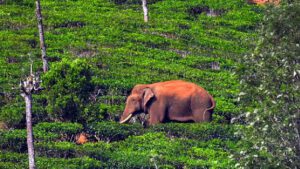
Arikomban roams around a tea estate in Munnar before capturing. (Supplied)
The court observed that rehabilitating people into a known elephant habitat had been an imprudent decision on the part of the government.
In one of its most striking observations, the court remarked that relocating residents of the 301 Colony appeared more feasible than repeatedly attempting to remove elephants like Arikomban from their natural habitat.
Even after the capture and relocation of Arikomban, Chinnakanal’s troubles have persisted, underlining that the conflict extends far beyond a single elephant.
Also Read: Arikomban released again, this time in the upper reaches of Kodayar
As the Chinnakanal issue once again became live, a strongly worded intervention made in 2023 by former Indian Forest Service officer Prakriti Srivastava has once again brought focus back to the roots of the crisis.
Arikomban, captured from Idukki, Kerala, was recaptured from Cumbum in Tamil Nadu’s Theni, and sent to Kalakkad- Mundanthurai reserve, a low elephant-dense area. (Supriya Sahu/X)
Srivastava, who served as Divisional Forest Officer (DFO) of Munnar between 2002 and 2004, had then offered a rare insider account of how administrative decisions ignored repeated warnings about settling people inside a known elephant corridor.
In her detailed statement issued at the height of the Arikomban controversy, the former officer categorically stated that the conflict now gripping Chinnakanal was not sudden, but the outcome of decisions taken despite objections raised by the Forest Department.
She clarified that the issue of Mathikettan encroachments and the later rehabilitation of landless tribal families in Chinnakanal had often been wrongly merged in public discourse.
A suggestion she had once made to relocate Mathikettan encroachers to Chinnakanal was merely an informal recommendation made in desperation to protect Mathikettan forests and had no legal or administrative sanction.
Srivastava pointed out that Mathikettan was eventually cleared of encroachments and later notified as a National Park, which today remains a thriving wildlife habitat.
However, the larger crisis unfolded elsewhere.
She revealed that in 2003, nearly 276 hectares in Chinnakanal were assigned to 559 landless tribal families following a Cabinet decision.
As DFO, she had objected to the move, warning authorities that the land fell within a traditional elephant corridor and that human-wildlife conflict was inevitable if settlements were permitted there.
Those warnings, she noted, went unheeded.
“Within a year of settlement, conflict escalated,” she had stated, adding that the mushrooming of resorts in the region further blocked elephant movement and worsened the situation.
In one of the most striking observations in the statement, Srivastava remarked that wildlife often ends up paying the price for human errors.
“It is ironical that we humans commit the misdeeds and the hapless wildlife have to pay the price while also being villainised by being called ‘rogue’, ‘thief’ and other such anthropomorphic adjectives,” she said.
The former officer also highlighted a structural flaw in governance, alleging that land assignments by the Revenue Department were routinely carried out without consulting the Forest Department, creating long-term ecological and social consequences.
She further disclosed that several high-level discussions had taken place over the years, including in 2006 and 2009, but no lasting solution was implemented.
A comprehensive draft mitigation plan prepared in 2017, she said, had identified the problem in detail and proposed long-term measures. But the proposal never moved beyond the draft stage, reportedly because of the scale of financial and structural changes required.
Throwing weight behind the arguments, an official with the Divisional Forest Office, Munnar said, “Relocating elephants may offer temporary relief, but it cannot resolve the deeper ecological crisis unfolding in Chinnakanal.”
“The real issue is the steady fragmentation of traditional migratory corridors and mounting human pressure inside elephant habitats. Unless long-term habitat restoration and scientific land-use planning are pursued together, Chinnakanal will remain a conflict zone for both people and wildlife,” the official added.
Also Read: Settlers, Kerala Forest Department locked in a territorial battle
To read alongside the observations made by the IFS officer came the findings and recommendations of a five-member expert committee.
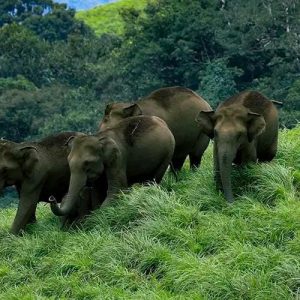
An elephant herd (Kerala Tourism)
It was appointed by the Kerala High Court in 2023 to address the escalating human-wild elephant conflict in the Chinnakanal and Santhanpara regions.
In its report submitted to the court in 2024, the panel painted a grim picture of an elephant population trapped within fragmented habitats and increasingly forced into human settlements.
The committee warned that unless traditional movement routes were restored and ecological pressures reduced, the conflict would continue to intensify.
At the centre of the recommendations was the reopening of the historic elephant corridor linking Anayirankal and Old Devikulam in Munnar.
The panel stressed that securing the 60-acre shola forest corridor was critical to reconnect the isolated elephant population in Chinnakanal with the larger Munnar landscape, which spans nearly 4,500 square kilometres.
Restoring the corridor would allow elephants to move freely through their traditional migratory paths, reducing repeated encounters with humans and easing pressure on both wildlife and local communities, the report said.
The committee also recommended the voluntary relocation of the conflict-prone 301-Acre and 80-Acre colonies in Chinnakanal, with priority to be given to the 301-Acre settlement.
It further suggested exploring the possibility of declaring the region a conservation reserve to curb encroachments and illegal activities that threaten wildlife habitats.
The report also raised concerns over the growing disturbance caused by off-road jeep safaris in the Kolukkumala area near Suryanelli.
With more than 180 safari jeeps operating in sensitive habitats, the panel called for a scientific study to assess whether restrictions or even a complete ban on jeep operations were necessary.
Yet, despite the detailed recommendations, the conflict continues unabated.
“People here live with constant anxiety. But nobody can honestly say the elephants are invading our land. We entered forests that were once part of their route. The problem is that now both humans and elephants are trapped in the same space,” Maruthan of Chinnakanal said.
For the people of Chinnakanal, every stretch of mist-covered road and every fall of darkness carries the fear that an wild elephant could emerge without warning.
But for the elephants, these hills are not unfamiliar territory. Long before settlements, roads and tourism arrived, these forests formed part of ancient migratory paths travelled for generations.
(Edited by Majnu Babu).



