

Published Apr 26, 2026 | 4:19 PM ⚊ Updated Apr 26, 2026 | 4:19 PM

AI-generated representational image.

Synopsis: Kerala’s heat is no longer just about rising temperatures—it’s spreading and lingering differently as expanding concrete landscapes trap warmth well beyond cities, even into semi-rural areas. Despite growing evidence and policy awareness, the state still lacks a focused, ground-level strategy to map and tackle this emerging urban heat island effect.
The heat this summer hasn’t just been intense — it has felt different.
Across Kerala, from dense city centres to rapidly expanding towns, the discomfort lingers well past sunset, clinging to concrete walls and narrow streets that refuse to cool.
With “high” UV warnings in place and some districts edging toward heatwave conditions, attention is slowly shifting to a quieter, less visible factor shaping this experience: the urban heat island effect (UHI).
Even as temperatures climb, the state lacks something basic — a comprehensive, government-led study mapping how and where this phenomenon is taking hold.
Pockets of development are increasingly behaving like heat traps, where vanishing tree cover and growing stretches of asphalt and glass push local temperatures above those in surrounding rural areas.
Experts point out that in Kerala’s humid climate, the impact is often sharper at night, when built-up areas release stored heat, prolonging stress on people, infrastructure, and ecosystems.
Also Read: Unannounced power cuts amid heatwave spark political clash in Kerala
Heat in Kerala is no longer confined to city limits. It lingers, spreads, and now settles into areas that once stayed cooler.
Traditionally, the UHI explained why cities were warmer than rural surroundings: concrete and asphalt absorb and retain heat, while the loss of vegetation reduces cooling through evapotranspiration. But in Kerala, that pattern is blurring.
The state’s development has dissolved the clear divide between “urban” and “rural.”
Continuous settlements—mixing housing, commerce, and infrastructure—have created a “rurban” landscape.
Heat is following this shift. Researchers describe this as thermal sprawl: heat spreading beyond dense urban cores into peri-urban and semi-rural areas.
The mechanics remain the same—low-albedo surfaces absorbing solar radiation, heat-retaining construction materials, and declining greenery—but the scale is different. Highways, dispersed commercial hubs, and expanding residential zones now act as heat reservoirs.
The impacts are visible. Electricity demand surges as cooling becomes essential, increasing emissions and worsening air quality. Health risks from prolonged heat exposure are rising, and even local water bodies face ecological stress.
According to the Kerala Urban Policy Commission, 80.7 percent of the population could be urban by 2050.
In Kerala’s already continuous landscape, that signals not expansion, but intensification. The issue is no longer isolated heat islands—but a merging, expanding heat footprint that is harder to detect and contain.
Researchers also warn that changing landscapes could quietly reshape heat patterns of a particular area.
This got highlighted in a recent study published in the Journal of Agrometeorology which brought fresh attention to how changing landscapes are quietly reshaping heat patterns across Palakkad district.
Conducted by researchers from the Kerala Agricultural University, the work tracks summer land surface temperatures against shifts in vegetation and built-up areas, using satellite-based indicators.
The findings point to a clear pattern: where green cover has thinned and concrete has spread, surface temperatures tend to climb, particularly during the already harsh March–May period.
Palakkad’s unique geography, influenced by the Palakkad Gap, appears to intensify this effect, allowing heat to build more readily over exposed surfaces.
The study underscores a familiar but often overlooked reality—when tree cover and natural landscapes give way to dense construction, the ground holds and radiates more heat, setting the stage for localized UHI conditions even beyond major city limits.
Incidentally, Palakkad is one of the districts which received alert from the India Meteorological Department, the other day, for having heatwave like conditions.
Also Read: Sweltering Kerala reports suspected heatstroke death, IMD issues warning
A policy brief released in April 2024 by the Woodwell Climate Research Center offers a stark reminder of how quickly Kerala’s climate is shifting.
Drawing on data from 2023—one of the warmest years in the past century—it notes that the state endured its deadliest heatwave in recent memory.
The findings, already shared with the Kerala State Disaster Management Authority (KSDMA), are part of an ongoing effort to refine the State’s Heat Action Plan.
The study, carried out with GeoHazards International and the GeoHazards Society, combines daily temperature records with downscaled climate model projections to map emerging heat patterns.
The trends are hard to ignore.
Across Kerala, temperatures typically peak in March or April before easing with the monsoon. But that rhythm is changing. Summers are stretching, beginning as early as February and lingering well into May.
Projections suggest that by 2030, March temperatures could rise by 0.45 to 0.7°C. By mid-century, the increase may reach around 1°C under one scenario, and climb to between 1.25 and 1.55°C under another.
What stands out is not just the gradual warming, but the sharper rise in extreme heat days—outpacing monthly averages. The shift points to a future where heat is not only more intense, but more persistent.
The state has acknowledged the UHI risk in its policy frameworks, but a comprehensive, stand-alone strategy is still missing. Meanwhile, just across the border, a working model already exists.
A 2024 report by the Tamil Nadu State Planning Commission—prepared with the Tamil Nadu State Land Use Research Board, the United Nations Environment Programme and CEPT University—maps urban heat hotspots across the state and outlines targeted responses.
2024 report by the Tamil Nadu State Planning Commission on UHI
It does more than flag the problem. It prioritises intervention zones and recommends adaptive measures tailored to specific regions.
The findings point to a shift over two decades: a sharp 59 percent increase in areas recording night-time temperatures between 24°C and 26°C, alongside a 28 percent drop in extreme daytime highs.
The implication is clear—cities are holding on to heat after sunset. Chennai stands out for rising night-time temperatures, while Thoothukkudi records intense daytime heat.
In several urban pockets, including Chennai and Thiruvallur, heat island intensity has climbed by nearly 3°C, linked to dense construction and shrinking green cover.
Tamil Nadu has followed this with urban cooling guidelines, building a longer-term response beyond emergency measures.
In Kerala, officials see value in that approach.
“Kerala would benefit from a dedicated, state-level UHI action plan or equivalent targeted urban cooling strategy. While Kerala does not currently have a standalone ‘UHI Action Plan’, its existing frameworks explicitly recognize UHI as a growing risk and call for mitigation. A dedicated plan would strengthen long-term, data-driven interventions beyond the current response-focused Heat Action Plan,” an official with the Kerala State Land Use Board said.
The official added that such a plan could bring in granular hotspot mapping, sustained measures such as urban greening and heat-resilient infrastructure, and closer integration with master plans.
Also Read: Blistering heat persists in Kerala; heat stroke clinics activated across hospitals
Even as questions linger over the absence of a comprehensive, state-led study on the UHI in Kerala, the KSDMA maintains that the issue has been on its radar for years and is being addressed through policy and planning measures.
Officials point out that as early as 2010, the state had begun tracking heat-related risks.
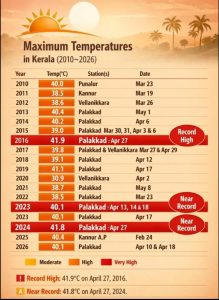
KSDMA’s chart on maximum temperature
Inputs from the Centre for Earth Science Studies had then underlined the need for cooling interventions, marking one of the earliest institutional acknowledgements of rising heat stress in the state.
Over the years, the government moved to formalise its response. Heat wave, sunstroke and sunburn were notified as state-specific disasters, with norms for assistance put in place in 2019.
This was followed by the release of the Kerala Heat Action Plan in 2020, which KSDMA officials describe as “fairly well drafted” and capable of addressing emerging challenges.
The conversation around heat, however, has widened more recently.
In February 2025, KSDMA, in collaboration with the Energy Management Centre, convened a panel discussion titled “The Rising Heat and Urban Heat Island Effect: The Kerala Context.” The deliberations went beyond temperature readings.
Experts examined how dense construction, changing land use and high humidity are combining to intensify heat stress across urban pockets. The discussion touched on the strain on public health systems, disruptions to livelihoods, and the growing pressure on infrastructure. Participants also highlighted the role of cultural habits and daily routines in shaping heat exposure.
There was broad agreement on one point: Kerala’s response cannot remain confined to advisories.
The built environment itself needs rethinking. Climate-sensitive design, better urban planning and behavioural shifts were flagged as necessary steps if cities are to remain liveable.
Despite this recognition, implementation at the grassroots has been slow. KSDMA had earlier directed local self-government institutions to prepare their own heat action plans. So far, only Moodadi grama panchayat in Kozhikode has come forward with one.
That gap has now prompted renewed urgency at the top.
In a high-level meeting chaired by Chief Minister Pinarayi Vijayan on 25 April, the state rolled out a multi-sector response as temperatures continue to climb.
One of the key decisions was to push all local bodies to prepare location-specific heat action plans, backed by financial support from the State Disaster Mitigation Fund.
The directive signals a shift from broad frameworks to localised action. Officials say future planning must factor in long-term climate projections and area-specific vulnerabilities rather than rely solely on state-level templates.
The science is clear, the signals are visible, and policy acknowledgement is already in place. What remains missing is cohesion: a data-driven, state-wide strategy that maps hotspots, guides local action, and embeds cooling into the way Kerala builds and grows.
Moreover, the question is no longer whether Kerala can manage rising heat, but whether it can redesign its habitats fast enough to stay livable in a warming future.



