

Published Apr 23, 2026 | 3:10 PM ⚊ Updated Apr 23, 2026 | 3:53 PM


Representational image. Credit: iStock

Synopsis: Kerala is under a heat wave warning after temperatures crossed 41.1°C in Palakkad, Thrissur and Kollam, with deviations above 4.5°C. Authorities have activated statewide alerts, urging precautions against heat and high UV exposure. Vulnerable groups face heightened risks, while hospitals, farms, and infrastructure feel the strain. Public advisories stress hydration, shade, protective clothing, and adjusted work hours.
Kerala on Thursday, 23 April, reported a suspected case of heatstroke death, even as the Meteorological Department (IMD) issued a heat-wave alert for the state sweltering under the merciless summer sun.
A 37-year-old man died at a private hospital in Kannur on Thursday morning. He had been undergoing treatment since Wednesday.
The deceased, MV Sanal Kumar of Pallipoyil in Kannur’s Chakkarakkal, had collapsed while constructing a well in the neighbourhood on Wednesday afternoon. He had complained of physical weakness before collapsing. On falling unconscious, Kumar was rushed to the hospital, where he died on Thursday morning.
While initial reports pointed to heatstroke as the likely cause of death, the state’s Disaster Management Department officials clarified that the exact cause has yet to be medically confirmed.
They were waiting for the postmortem report to confirm the cause of Kumar’s death.
In a separate heat-related incident, 4-year-old Issa John suffered sunburn while playing outdoors at her residence at Wandoor in the Malappuram district.
The girl was taken to a hospital, where her condition was stated to be stable.
With temperatures soaring and UV levels remaining high, the Kerala State Disaster Management Authority has issued strict advisories urging people—especially those engaged in outdoor labour—to take precautions.
The IMD, on 23 April, issued a heat wave warning for Kerala after temperatures crossed 41.1°C in parts of the state, with deviations exceeding 4.5°C above normal levels.
Based on official observations from IMD monitoring stations, Palakkad, Thrissur and Kollam districts have met the criteria for a heat wave, prompting a formal alert. The IMD has indicated that the heat wave status will be formally confirmed if the prevailing conditions persist for at least two consecutive days.
According to the Kerala State Disaster Management Authority (KSDMA) while the warning has been officially declared for these three districts, rising temperatures across the state have led authorities to advise strict safety precautions in all districts.
Experts note that Kerala’s coastal geography significantly worsens the impact of high temperatures. Elevated humidity levels mean that the heat index — or “feels-like” temperature — is considerably higher than the recorded temperature, increasing the risk of heat-related illnesses even in areas not officially under heat wave classification.
On 23 April, weather station at Palakkad recorded 41.1°C, Punalur (Kollam) recorded 39.8°C and Vellanikkara (Thrissur) recorded 39.3°C.
Thrissur, Palakkad and Kollam are placed under Orange alert. Whereas, except Idukki and Wayanad, all other districts are placed under yellow alert.
Also Read: Blistering heat persists in Kerala; heat stroke clinics activated across hospitals
Meteorologists describe a heat wave as a spell of unusually high temperatures, persisting for several days, that can pose serious risks to human health.
But what qualifies as “unusual” is not the same everywhere. It depends on what a region is used to. What feels extreme in one place may be routine in another.
At its core, a heat wave is both a physical condition and a statistical one. On the ground, it is that stifling air that feels unbearable, the kind that drains energy and strains the body.
In scientific terms, it is measured either by how far temperatures rise above the norm or by how high they climb in absolute terms. Some countries also factor in humidity through heat index calculations, while others look at how rare such temperatures are in historical records.
In India, the benchmark is clear.
A heat wave is considered when the maximum temperature hits at least 40°C in the plains or 30°C in hilly areas. Beyond that, severity is judged in two ways.
One method looks at deviation from normal temperatures. If the day’s maximum is 4.5°C to 6.4°C above average, it falls under a heat wave. Anything exceeding a 6.4°C departure is classified as a severe heat wave.
The second method focuses purely on actual temperature. When the mercury reaches 45°C, it is deemed a heat wave regardless of past averages. Cross 47°C, and it escalates into a severe category.
These labels are not applied lightly.
The conditions must be recorded at a minimum of two weather stations within a meteorological sub-division, and they must persist for at least two consecutive days. Only then is the declaration made—on the second day.
Coastal regions follow a slightly different yardstick.
Here, the air is already moderated by the sea, so even a smaller rise can have a strong impact. A heat wave may be declared if temperatures are at least 4.5°C above normal, provided the actual maximum touches 37°C or more.
The nights, too, are under scrutiny.
A “warm night” is noted when daytime temperatures have crossed 40°C and the minimum temperature remains significantly elevated. If the night temperature is 4.5°C to 6.4°C above normal, it is termed a warm night. A departure beyond that is classified as a very warm night. These nights offer little relief, compounding the stress on the body.
What makes heat waves particularly dangerous is not just the temperature alone.
Humidity can trap heat, making it harder for the body to cool itself. Wind conditions, or the lack of them, can worsen the situation. And when such conditions linger, the cumulative effect becomes harder to bear.
In the end, a heat wave is not just a number on a thermometer. It is a convergence of factors—temperature, duration, local climate, and atmospheric conditions—all coming together to create a period when the air itself feels unforgiving.
At the same time, in response to the broader temperature surge, the KSDMA has activated precautionary measures under the KaWaCHaM (Kerala Warnings, Crisis and Hazards Management System).
As part of this, sirens were sounded in all districts after 12:30 pm today to alert the public to the heightened heat risk.
Across Kerala, soaring temperatures and a persistently high UV index are beginning to leave a visible mark on daily life, public health, and livelihoods.
Health officials warn that heat waves, often described as silent killers, are now a growing threat. Their effects are not always immediate, but they can escalate quickly. Dehydration, heat cramps, exhaustion and, in severe cases, heat stroke may become increasingly common as the mercury climbs.
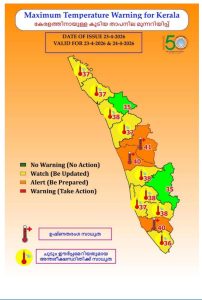
Maximum temperature warning as of 22 April
Doctors point out that the body starts showing early signs in subtle ways—fatigue, dizziness, nausea, muscle cramps. Left unchecked, the condition can worsen.
Heat stroke, marked by body temperatures crossing 40°C, can lead to delirium, seizures and even death.
The risk is not evenly spread.
Children, the elderly, and those living with heart, respiratory or kidney conditions are especially vulnerable. People with psychiatric illnesses also fall into the high-risk category, particularly when medications affect the body’s ability to regulate temperature.
Adding to the concern, the state health department has urged strict caution as the state faces intense heat and high ultraviolet radiation levels. It stressed that the UV index remains particularly high between 11 am and 3 pm, making direct exposure to sunlight during these hours risky.
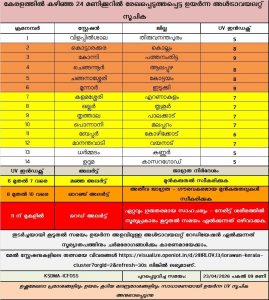
UV index chart as of 22 April
“Continuous exposure can lead to sunstroke or heatstroke. Self-protection is crucial,” the department said in a statement, calling on the public to avoid stepping out during peak hours unless necessary. It highlighted that children, the elderly, pregnant women and those with serious illnesses need to take extra care. Those working outdoors have been advised to shift duties to early mornings or evenings wherever possible, and to seek medical attention at the first sign of discomfort.
In response to the rising cases, the government has set up special heat stroke clinics in major hospitals across the state.
These facilities are equipped with cooling systems, essential medicines and trained staff to handle heat-related illnesses.
A dedicated heat health action plan has also been rolled out, with strengthened surveillance to track and respond to cases more efficiently.
The impact of the heat goes beyond hospitals.
Farmers are already feeling the strain. Extended spells of high temperatures are known to reduce crop yields and disrupt plant reproduction. Water stress in fields is intensifying, in some cases halting photosynthesis altogether and leading to crop loss.
Livestock too are under pressure—reduced appetite, falling productivity and weakened immunity are being reported, with heat stress occasionally turning fatal.
Infrastructure is not immune either. Transport networks, electricity systems and railway operations tend to falter under prolonged heat. The broader economic effect is harder to measure but evident—labour productivity dips as outdoor work becomes riskier and more exhausting.
The KSDMA has issued a detailed public advisory, urging people to limit direct sun exposure, especially during peak hours.
Residents are being asked to drink water frequently, even without feeling thirsty, and to avoid beverages that accelerate dehydration such as alcohol, caffeinated drinks and soft drinks. Light, loose cotton clothing is recommended, along with protective gear like hats, umbrellas and footwear when stepping outside.
Dietary advice has also been issued—more fruits, vegetables and traditional cooling drinks like buttermilk and oral rehydration solutions are encouraged.
Authorities have flagged a parallel risk: fire hazards.
High temperatures increase the chances of fires breaking out in markets, buildings and waste dumping yards. Local bodies have been asked to step up safety audits. Forest regions face a similar threat, with residents and tourists urged to remain alert and avoid activities that could trigger fires.
Vulnerable groups—including bedridden patients, pregnant women and differently abled individuals—are advised to remain indoors during peak hours. Workers exposed to the sun, such as construction labourers, farmers, delivery personnel and street vendors, are being encouraged to adjust working hours and take frequent breaks.
Alongside rising temperatures, ultraviolet radiation levels have surged. UV rays, a component of sunlight, can cause more than just sunburn. Prolonged exposure can damage skin and eyes, weaken the immune system, and even affect cellular DNA, increasing the risk of serious diseases including cancer. Skin discoloration and premature ageing are also linked to excessive exposure.
Precautions are straightforward but essential—avoid direct sunlight during peak hours, use hats, umbrellas, sunglasses and sunscreen, and wear full-body cotton clothing where possible. Even during travel, taking breaks in shaded areas can make a difference.
Against the UV exposure, an orange alert, signalling extreme caution, has been issued for Kollam, Pathanamthitta, Alappuzha, Kottayam and Idukki districts. A yellow alert remains in place for Ernakulam, Thrissur, Palakkad, Malappuram, Kozhikode and Wayanad.
Outdoor workers, fishermen, tourists, bikers and those with pre-existing skin or eye conditions have been asked to take extra precautions. The risk is amplified near water bodies and sandy areas, where UV rays are reflected, and in high-altitude regions where exposure intensifies.
Officials stress that the situation calls for awareness more than alarm. They further stressed: stay hydrated, stay shaded, and don’t take the sun lightly.



