

Published Sep 15, 2026 | 6:15 PM ⚊ Updated Sep 15, 2026 | 6:15 PM


Keralam will be the first in India to introduce a computer-based Hazard Perception Test as part of the driving test.

Synopsis: Keralam is set to introduce a computer-based Hazard Perception Test from 1 December, requiring applicants to identify potential dangers in simulated road situations before they can take the ground and road tests. The move aims to promote safer driving, but motor driving schools oppose it, arguing that the state cannot add a new licensing requirement beyond the Central Motor Vehicles Rules, 1989.
Keralam is set to put aspiring drivers through a new test before they can earn their licence—and driving schools are already seeing red.
The state will become the first in the country to introduce a computer-based Hazard Perception Test (HPT) as part of the driving test. The move, billed by the Transport Commissionerate as an effort to build a safer driving culture through the licensing process, will come into effect from 1 December 2026.
Currently, licence applicants must clear the online Learner’s Licence Test before appearing for the two-part driving test: the ground test followed by the road test.
The new requirement, however, has not gone down well with motor driving schools. They argued that the state cannot introduce conditions beyond those prescribed by the Central Motor Vehicles Rules, 1989.
The driving schools are preparing to take up the issue with Transport Minister CP John and the Transport Commissioner Nagaraju Chakilam. They also warned of legal action if the instruction is not withdrawn.
Also Read: Eight people killed after car tailends parked lorry
According to the Motor Vehicles Department (MVD), the introduction of HPT is to assess whether applicants can recognise and respond to dangers on the road before they turn into accidents, shifting part of the focus from simply handling a vehicle to assessing how quickly a driver can recognise and respond to dangers.
Transport Commissioner Nagaraju said the move was evidence-driven. Many road crashes stemmed not merely from poor vehicle handling, but from inattention, delayed reactions and errors in judging developing hazards.
MVD officials said the present system cannot adequately assess several requirements prescribed under Rule 15(3) of the Central Motor Vehicles Rules, particularly clauses 15(3)(m), 15(3)(n), 15(3)(u) and 15(3)(w), including a driver’s ability to deal with unexpected obstacles and changing road conditions.
The Transport Commissioner issued a circular on HPT on 12 September, stressing the need for such an initiative. It said a candidate cannot be realistically tested on every possible driving situation during a conventional road test.
Driving at night, dealing with different weather conditions, anticipating an unexpected obstruction and safely responding to hazards are among the situations difficult to reproduce during a routine test. Officials also pointed to practical difficulties in providing hands-on road training covering every component prescribed in the training syllabus under Rule 31.
The proposed HPT aims to bridge this gap by testing how a candidate observes the road, identifies a developing risk and decides when to react, rather than simply checking whether the person can operate the vehicle.
An Assistant Motor Vehicle Inspector (AMVI) said the exercise would encourage a shift from reactive to preventive driving.
“Instead of waiting for a hazard to become an immediate threat, candidates would be trained to pick up early warning signs — such as a ball rolling towards the road, a pedestrian about to step out or a vehicle preparing to reverse,” he said.
The test could also help address inattention and tunnel vision, particularly in Kerala’s mixed-traffic conditions, where pedestrians, two-wheelers, buses, parked vehicles and other road users compete for a driver’s attention. The ability to scan beyond the immediate line of travel and recognise hazards developing in the peripheral field of vision is therefore an important part of safe driving.
Officials also see a role for HPT in tackling tailgating and excessive speed.
Understanding how speed, road conditions and stopping distance interact can help drivers make safer decisions, particularly when roads are wet and braking distances increase.
The move follows practices adopted in several countries.
The United Kingdom introduced hazard perception as part of its theory test in 2002, requiring candidates to watch video clips and respond to developing hazards. Australia has also incorporated hazard perception testing in states including Victoria, New South Wales and Western Australia, including at stages of the transition to provisional licensing.
The Netherlands and New Zealand use similar computer-based approaches to assess hazard awareness within their driver-licensing systems.
A Motor Vehicle Inspector summed up the rationale for the change: conventional tests can establish whether a candidate can operate a vehicle, but they do not necessarily ascertain whether the person can process a rapidly changing traffic situation.
“Hazard perception is not an advanced driving skill. It is a basic survival skill. Young and inexperienced drivers are particularly vulnerable because the problem is often not their ability to control the vehicle, but their ability to recognise risks early,” the official said.
Also Read: Three killed after lorry overturns
The Transport Commissioner’s circular directed authorised motor driving schools across the state to start providing hazard perception training for the next three months using open-source computer-based training tools.
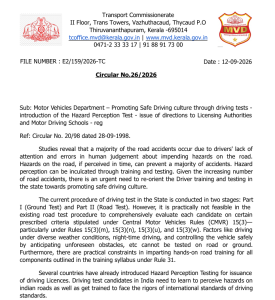
An excerpt from the circular on Hazard Perception Test issued by the Transport Commissioner
The move aims to prepare learner drivers for the new test and ensure compliance with Rules 15 and 31 of the CMVR.
From 1 December, the driving test will be conducted in four stages. A candidate must first clear the online Learner’s Licence Test, followed by a mandatory 30-day gap. The second stage will be the computer-based HPT, after which the candidate can proceed to the ground test and, finally, the road test.
The HPT will consist of 10 one-minute video clips, each worth 10 marks. Each video will feature up to two potential hazards. Candidates must identify the hazards by clicking when they perceive them. A timely response will fetch full marks, while a delayed response will result in a deduction.
The 10 clips together will carry 100 marks, of which candidates must score at least 60 marks to pass. Only those clearing the HPT will be allowed to proceed to the ground and road tests.
The Commissioner also asked Regional Transport Officers and Joint Regional Transport Officers to begin on-site inspections from 1 October.
The inspections will assess whether driving schools under their jurisdiction have the facilities required to provide computer-based HPT.
Also Read: Kerala logs nearly 99,000 accidents, over 7,600 deaths in two years
Meanwhile, the HPT circular met opposition, with the All Kerala Motor Driving School Owners’ Samithi questioning its legal validity and deciding to seek its withdrawal.
Speaking to South First, Samithi state president V Jayashankar said the organisation would approach the Transport Minister and the Transport Commissioner next week to seek the circular’s immediate withdrawal. If the government does not act, the association plans to challenge it legally.
Jayashankar pointed out that the Kerala High Court had already made it clear that the state government and the Transport Commissioner cannot impose conditions beyond the framework of the Central Motor Vehicles Rules (CMVR), 1989.
In All Kerala Motor Driving School Instructors and Workers Association v. Transport Commissioner, Justice N. Nagaresh had partially struck down provisions in Circular No. 4/2024 issued by the Transport Commissioner.
The court held that while the Transport Commissioner could issue administrative guidelines to streamline driving tests, such directions could not go beyond the Central rules or encroach upon powers vested exclusively with the Centre under Section 12 of the Motor Vehicles Act, 1988.
“There is already a judgment on this issue. Despite that, the Transport Commissioner has once again issued an order on his own. We will first approach the Transport Minister and the Transport Commissioner and seek its withdrawal. If that does not happen, we will challenge the circular legally. We expect to meet them next week. The CMVR is clear, and it does not have an HPT for qualifying. It rests with the Centre to introduce such a test,” Jayashankar said.
The association’s move sets the stage for another confrontation between driving schools and the Transport Department over how driving-test procedures and related conditions are regulated.
(Edited by Majnu Babu).



