

Published May 05, 2026 | 10:19 AM ⚊ Updated May 05, 2026 | 10:19 AM

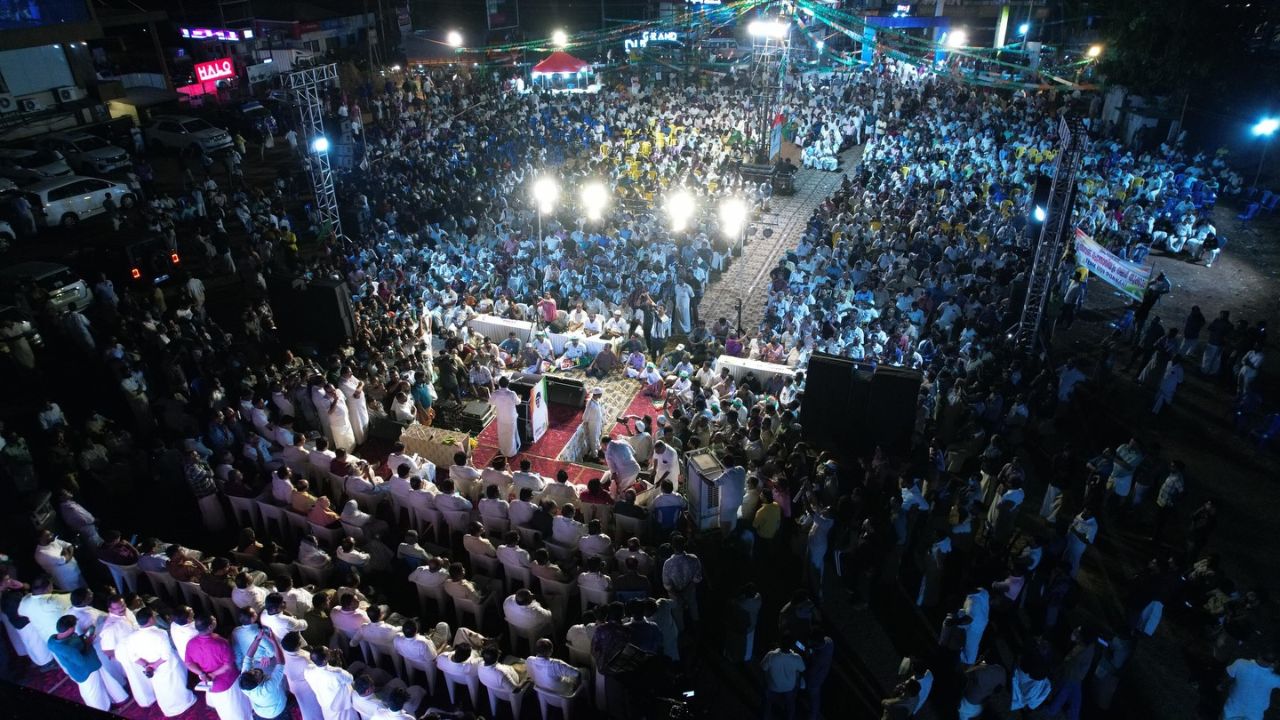
An election related public meeting in Kerala.

Synopsis: What unfolded on 4 May was less an election result and more a political upheaval, as ministers, veterans, and once-safe bastions across LDF, UDF, and NDA crumbled under a fierce and indiscriminate voter backlash. From dramatic reversals of towering margins to legacy seats slipping away and high-profile bets failing, Kerala’s electorate delivered a blunt message — no name, no fortress, no past victory was strong enough to hold.
On 4 May, Kerala did not deliver a routine electoral verdict — it unleashed something far more unsettling for those in power.
Senior Congress leader AK Antony’s description of an “anti-incumbency cyclone” doesn’t feel like exaggeration when one looks at the wreckage it left behind.
Established figures, some thought to be electorally invincible, found themselves swept aside with surprising ease. Strongholds cracked, reputations faltered, and carefully built political equations came undone in a matter of hours.
The damage was heaviest for the LDF, as expected, but the turbulence showed little regard for party lines; even the UDF and NDA watched a few of their prominent faces stumble when it mattered most.
This wasn’t just a swing — it was a churn, and at its centre lies a story of how Kerala’s biggest names misread the ground beneath their feet.
Also Read: Decoding the UDF tsunami! The forces behind the wave
Coming first to the LDF, there are candidates who not long ago rode on comfortable margins and political momentum, but now find themselves on the wrong side of a sweeping verdict. The scale of the reversal is hard to miss. In the 21-member Council of Ministers, only seven managed to hold on. The rest — more than a dozen — have been unseated, many by striking margins.
Among the most closely watched defeats is that of Health Minister Veena George.
After a decisive win from Aranmula in 2021 with a margin of 19,003 votes, she was defeated by UDF’s Abin Varkey by 18,985 votes. A near mirror image, but in reverse.
Industries Minister P Rajeeve, who had secured Kalamassery by 15,336 votes last time, lost by 16,312 votes to UDF’s VE Abdul Gafoor. The swing is not subtle.
Local Self-Government Minister MB Rajesh, who scraped through Thrithala in 2021 with just over 3,000 votes, went down by 8,385 votes to UDF’s VT Balram. The constituency that once leaned his way has clearly shifted.
In Nemom, Education Minister V Sivankutty lost to BJP state president Rajeev Chandrasekhar by 4,978 votes. The turnaround is sharp — Sivankutty had defeated O Rajagopal there in 2021.
Higher Education Minister R Bindu, who sought a second term from Irinjalakuda, was defeated by UDF’s Thomas Unniyadan by 10,212 votes. Her earlier margin of 5,949 votes has been wiped out and then some.
From Mananthavady, OR Kelu, who handled SC/ST and backward classes welfare, lost by 10,543 votes — another reversal from his 9,282-vote win in 2021. He lost to UDF’s Usha Vijayan.
Devaswom Minister VN Vasavan suffered one of the steeper defeats, losing Etumanoor by 19,752 votes to UDF’s Nattakom Suresh. In 2021, he had won the same seat by over 14,000 votes.
Sports and Waqf Minister V Abdurahiman took a gamble by shifting constituencies — from Tanur, where he had narrowly won in 2021, to Tirur. The result: A loss by 24,137 votes to UDF’s Kurukoli Moideen. The switch proved costly.
Animal Husbandry Minister J Chinchurani lost Chadayamangalam by 7,486 votes to UDF’s MM Naseer, a significant drop from her earlier winning margin of 13,678.
Transport Minister KB Ganeshkumar, a long-time representative of Pathanapuram since 2001, was defeated by UDF’s Jyothikumar Chamakala by 8,310 votes. His earlier cushion of over 14,000 votes has evaporated.
Registration Minister Ramachandran Kadanapally lost Kannur by 18,551 votes. His 2021 win came with a slender margin of 1,745 votes — this time the electorate decisively moved away.
Water Resources Minister Roshy Augustine, another veteran who had represented Idukki since 2001, was defeated by Roy K Paulose by 23,822 votes. In 2021, his margin stood at just 5,573.
Forest Minister AK Saseedran has perhaps seen the most dramatic fall. From a commanding 38,502-vote victory in 2021, he lost Elathur by 12,162 votes to Vidya Balakrishnan. He lost to UDF’s TO Mohanan.
There are others.
Take KK Shailaja. Few in Kerala politics have seen a trajectory as dramatic over three consecutive elections.
In 2016, contesting from Kuthuparamba, she secured a comfortable win with a margin of 12,291 votes. Five years later, shifted to Mattanur, she didn’t just win — she rewrote the record books, storming to victory by 60,963 votes, the highest margin the state had seen.
And yet, 2026 told a different story.
Moved once again, this time to Peravoor — a constituency she had represented earlier in 2006 but failed to retain in 2011 — Shailaja ran into familiar trouble.
The opponent was the same man who had defeated her earlier, Sunny Joseph.
The result echoed the past. She went down again, this time by 14,453 votes. A leader who symbolised electoral dominance just five years ago found herself edged out in a seat with history she couldn’t overturn.
A similar reversal unfolded in Payyannur.
TI Madhusoodanan had swept the constituency in 2021 with a massive margin of 49,780 votes. Payyannur wasn’t just another seat — it had been a CPI(M) bastion since 1967. That continuity snapped this time. A rebel candidate, V Kunhikrishnan, contesting with UDF backing, pulled off a striking upset. Madhusoodanan lost by 7,487 votes, marking the end of a decades-long political hold.
Taliparamba followed a near-identical script. Since 1977, the constituency remained firmly with the CPI(M). That streak, too, came to an end.
Senior leader TK Govindan Master, who had parted ways with the party, entered the fray with UDF support. He defeated PK Shyamala — a seasoned CPI(M) face and wife of the party’s state secretary, MV Govindan — by 12,551 votes.
Notably, Shyamala herself had won the seat by 22,689 votes in 2021, underlining how sharply the ground had shifted.
Then there was Perambra.
For decades, it stood as a CPI(M) citadel. From 1980 onwards, the constituency had never slipped from the party’s grasp. TP Ramakrishnan, who is also LDF convener, reinforced that dominance in 2021 with a margin of 22,592 votes. But 2026 broke the pattern. Fathima Thahiliya, an IUML candidate, emerged victorious by 5,087 votes — another instance where a fortress gave way.
For a party that has long relied on organisational discipline and stronghold politics, the message from 2026 is unambiguous: Past margins offer no guarantees, and even the safest seats can turn uncertain overnight.
And then there is Pala — less a constituency, more a legacy.
For decades, the seat was inseparable from KM Mani. From 1967 until his death in 2019, he remained its unbroken representative, building not just a political base but an emotional anchor for Kerala Congress (M). That connection made every subsequent contest here carry more weight than usual.
His son, Jose K Mani, stepped in to carry that legacy forward. In 2021, the attempt faltered — he lost to Mani C Kappen by 15,378 votes. The 2026 contest offered a chance to reclaim both the seat and the sentiment. The opponent remained the same. The outcome didn’t change enough. Jose K Mani lost again, this time by 2,991 votes.
The margin narrowed, but the verdict didn’t.
Also Read: Duopoly fatigue, cult worship and anti-incumbency shape Tamil Nadu 2026 verdict
The setbacks for the UDF cut into some of its better-known faces, across regions and political trajectories.
In Manalur, TN Prathapan fell short by the narrowest of margins. The former Lok Sabha MP from Thrissur (2019) and a two-time MLA — having represented both Nattika and Kodungallur — lost to LDF’s C Ravindranath by just 126 votes. It’s the kind of result that will be pored over booth by booth, because it leaves very little room for easy explanations.
In Beypore, the contest had a different texture. PV Anvar, who had only recently aligned himself with the UDF, took on PA Muhammad Riyas and lost by 7,487 votes. Anvar’s political journey has been anything but linear — having been with the Left in 2016 and 2021 before breaking away in 2024. This time, the attempt to unseat Riyas didn’t gather enough ground support to bridge the gap.
Kottarakkara offered another telling story. P Aisha Potty, once a prominent CPI(M) face, returned to the fray under the Congress banner. Her electoral history in the constituency is hard to overlook — first making headlines in 2006 by defeating veteran R Balakrishna Pillai, and then building on that with victories in 2011 and 2016, the latter by a margin exceeding 42,000 votes.
She was sidelined in 2021 when KN Balagopal was fielded instead, and he went on to win comfortably. In 2026, Potty sought a comeback from the opposite camp, but the result didn’t tilt her way — Balagopal retained the seat, though by a much tighter 1,012 vote margin.
The BJP’s push to convert visibility into votes ran aground in several high-stakes constituencies, with a string of prominent candidates finishing far behind expectations.
In Thiruvananthapuram’s Vattiyoorkavu, R Sreelekha — one among the party’s most recognisable faces — ended up third.
The constituency had been spoken of as one where the BJP could break through. Instead, the contest tilted firmly in favour of the UDF, with K Muraleedharan emerging ahead.
Kanjirapally delivered an even sharper jolt. Union Minister George Kurian, fielded with strong backing and central attention, failed to make an impact on the ground. The seat went decisively to UDF’s Rony K Baby, who opened up a margin of 29,662 votes. Sitting MLA N Jayaraj held on to a substantial vote share but settled for second place, leaving Kurian trailing in third despite the weight behind his campaign.
In Palakkad, another constituency the BJP had quietly marked as winnable, Shobha Surendran could not bridge the gap. She went down to UDF candidate Ramesh Pisharody by 13,147 votes, a result that underlined the party’s struggle to consolidate support even where it sensed opportunity.
Manjeswaram told a story of reversal.
K Surendran, who had come close twice — losing by 89 votes in 2016 and 845 votes in 2021 — slipped once again. UDF’s AKM Ashraf won the seat with a margin of 29,252 votes. For Surendran, the shift from near victories to a distant finish marked a steep fall.
(Edited by Muhammed Fazil.)



