

Published May 04, 2026 | 5:20 PM ⚊ Updated May 04, 2026 | 6:19 PM

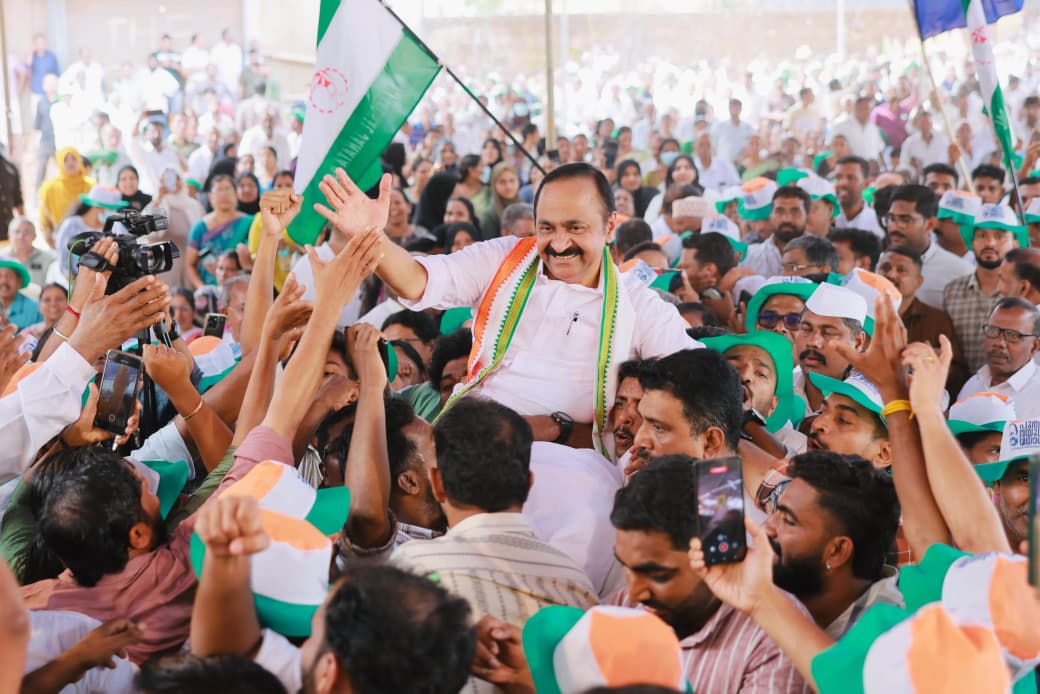
VD Satheesan attributed the UDF's strong showing to growing anti-incumbency sentiment and sustained organisational groundwork. (File pic)

Synopsis: Anti-incumbency sentiments, Pinarayi Vijayan’s autocratic ways, CPI(M)’s cult worship, consolidation of minority votes in favour of the Opposition, and the projection of Team UDF — all contributed to the LDF’s debacle.
With the CPI(M)-led LDF suffering a historic defeat in Kerala, the UDF has stormed back to power after a decade in opposition.
Exit polls had hinted at an edge to the UDF, but few expected a tsunami, except Congress leader V D Satheesan, who had repeatedly claimed the alliance would cross 100 seats. He even vowed to quit politics if it fell short.
On Monday, 4 May, evening, Satheesan was all grins as the UDF swept across Kerala, leaving LDF in tatters.
Riding a strong anti-incumbency wave, the UDF is leading in 102 seats, even in traditional LDF strongholds.
Kerala, the first state in India to bring a communist government to power through the ballot and often seen as its final stronghold, has now effectively voted out the last CPI(M)-led government in the country.
The factors that contributed to the UDF tsunami go beyond anti-incumbency sentiments.
Also Read: The growing cult of individual worship in CPI(M) Kerala
In a brief chat with South First, Satheesan attributed the UDF’s strong showing in Kerala to growing anti-incumbency sentiment against the LDF government and sustained organisational groundwork over the years.
VD Satheesan
Satheesan also stressed that his earlier confidence in the 100+ seat outcome was based purely on internal data analysis and ground-level assessments conducted by the Congress and the UDF.
Congress MP Shashi Tharoor remarked that the electorate has clearly signalled a desire for change, moving away from a decade of LDF rule and opting for a new direction for the state.
Tharoor added that initial trends showed the UDF ahead even in some high-profile LDF constituencies, calling it a strong indication of public sentiment.
Political analyst Adv. A. Jayashankar observed that anti-incumbency feeling against Chief Minister Pinarayi Vijayan and the LDF government had been visible in earlier Lok Sabha and local body elections as well. He said that beyond caste, religion and long-standing political loyalties, a significant section of voters appeared to be seeking change this time.
He said public dissatisfaction was further shaped by issues such as the ASHAs’ protests and the government’s handling of people-centric concerns, which collectively influenced the electoral mood.
Also Read: Pinarayi Vijayan becomes ‘demi-god’ in communist politics of Kerala
D Dhanuraj, founder chairman of the Centre for Public Policy Research, told South First that the outcome cannot be seen as simple anti-incumbency but rather as ”anti-Pinarayi sentiment.”
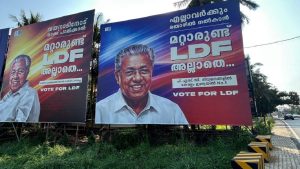
The LDF’s message appears to revolve almost entirely around the incumbent CM Pinarayi Vijayan.
He said the Opposition to the LDF, in effect, becomes the LDF itself, and at the final phase of this government, Chief Minister Pinarayi Vijayan has turned into a liability for the CPI(M).
He pointed out that LDF campaign hoardings prominently featured only Pinarayi’s image, with no visible representation of other leaders, unlike even the BJP, where, alongside Narendra Modi’s face, around 25 percent of space has been given to local leaders.
He added that such a single-leader branding might be expected in parties like Kerala Congress (M), but not in the CPI(M), which is not traditionally leader-centric.
Referring to former CPI(M) chief ministers such as VS Achuthanandan and EMS Namboodiripad, he said they never adopted what he described as the current ”arrogant style” associated with Vijayan.
He felt that voters do not tolerate arrogance from any leader, and Pinarayi was no exception. He further said the party secretariat is expected to meet within two days, after which a clearer picture will emerge on how the CPI(M) plans to address and compensate for the damage.
Even well-performing ministers were swept away in the UDF tsunami, as the single-man projection strategy backfired—Vijayan could not escape responsibility for the defeat.
Meanwhile, Sukumaran T, a local CPI(M) activist from Kottayam, said that if the party had not lost this election, it would have risked losing itself. He described the defeat as necessary, arguing that it could help some ”Pinarayi Vijayan Bhakths realise that the CPI(M) is not led by a single captain but is rooted in an ideology focused primarily on people’s issues.
He added that the party would eventually return to power after making corrections and internal rectifications.
Also Read: If not Pinarayi Vijayan, who? A question LDF struggles to answer
Senior psychologist B Gopakumar told South First that apart from strong anti-incumbency, communal polarisation also played a crucial role in shaping the outcome.
He stated that a clear pattern of communal polarisation worked in favour of the UDF this time, with Muslim and Christian votes lost by the alliance in previous Assembly elections returning and polling decisively for the UDF.
This, he noted, prevented the LDF from sustaining its earlier electoral wave.
He also pointed out that the BJP and CPI(M) share a common pool of voters, and a split in this segment benefited the UDF. He opined that the CPI(M) remains dependent on Hindu votes, particularly OBC Ezhava voters, who did not fully consolidate behind the party this time.
The BJP, he added, gained significantly from sections that earlier leaned towards the UDF, especially within the Nair community, while also cutting into CPI(M) votes.
Gopakumar cited the BJP’s performance in Chathannur as an example, noting that Kollam is traditionally an LDF stronghold, yet the BJP managed to open an account there, reflecting the impact of vote shifts and polarisation.
Congress worker Jais Mathew said that several social groups that had stayed away from the Congress over the years have now returned to the UDF fold, including minorities who, according to him, have regained trust in the alliance. He denied that communal polarisation is the biggest factor behind the victory, saying it may explain results in 80–85 seats, while the rest reflect people’s anger against the LDF.
Also Read: Can individual charisma shift votes in Kerala?
Gopakumar pointed out that Left leaders who contested against their own party significantly contributed to the UDF’s victory.
He said that CPI(M) rebel V Kunhikrishnan’s win in Payyannur was a major setback for the party, especially as he defeated sitting MLA TI Madhusoodanan by 7,487 votes, overturning a massive 2021 margin of 49,780 votes.
Despite facing strong cyber-attacks from Left supporters, Kunhikrishnan managed to hold his vote base and secure 76,640 votes against Madhusoodanan’s 69,153.
For the first time in over five decades, the CPI(M) is facing a serious challenge of losing its hold on the Taliparamba constituency in Kannur district. The UDF-backed independent candidate TK Govindan is sailing comfortably to the podium, marking a significant political shift in the region.
CPI(M) candidate P K Shyamala, wife of state secretary M V Govindan, has lost the contest. Following the results trend, reports indicate that sections of CPI(M) cadres have begun targeting both Shyamala and Govindan on social media, leading to allegations of cyber-attacks.
He also cited Ambalapuzha, where veteran former CPI(M) leader G Sudhakaran, now an Independent, is leading CPI(M)’s H Salam, with a margin of 21,839 votes. Gopakumar noted Sudhakaran’s earlier criticism of the party’s decline and Vijayan’s leadership and said the party’s failure to effectively reconcile with such veterans further weakened its position.
In Kottarakkara, he pointed to Aisha Potty’s strong contest against CPI(M)’s KN Balagopal as another example of how former Left leaders posed serious challenges to the party.
According to him, these rebels largely continued to hold their Left ideological base, which meant they also drew traditional CPI(M) votes while simultaneously strengthening the UDF-led space in closely fought constituencies.
Gopakumar said this pattern of internal rebellion, similar in nature to the RMP’s influence in Vatakara, played a crucial role in splitting the Left vote and indirectly boosting the UDF’s overall performance.
Speaking to South First, Philip Mathew, a Kerala Congress (Joseph faction) activist, said that the ”Team UDF” narrative played a crucial role in the alliance’s landslide victory.
He added that while factionalism within the UDF was once severe, this time all groups accepted the Team UDF approach, which allowed each faction its own space with minimal disputes.



