

Published May 05, 2026 | 8:53 AM ⚊ Updated May 12, 2026 | 11:45 AM

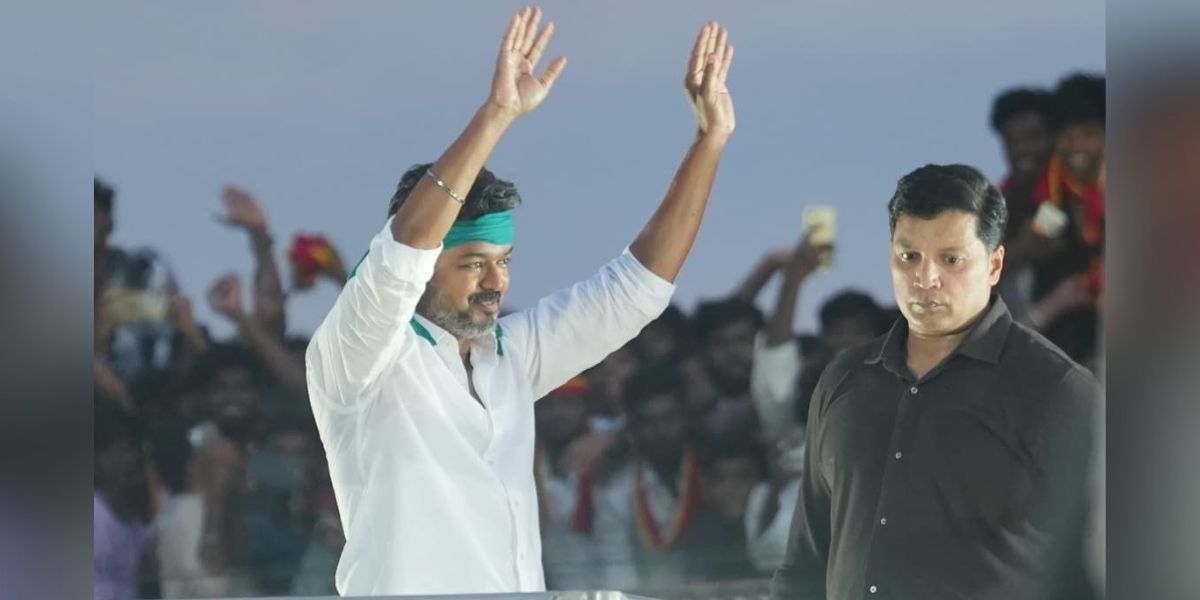
TVK chief Vijay in Thiruvarur.

Synopsis: The victory of actor Vijay’s TVK in the Tamil Nadu Assembly polls has put an end to the nearly 60-year-long duopoly of the DMK and the AIADMK in Tamil Nadu. Other than anti-incumbency, duopoly fatigue and Vijay’s massive popularity as an actor cost the Dravidian parties the election.
Nearly 60 years of DMK-AIADMK duopoly came to a screeching halt in Tamil Nadu on Monday, 4 May. Political newbie Tamilaga Vettri Kazhagam (TVK), riding on its founder Vijay’s popularity, emerged as the single largest party in a state that has voted out 15 sitting ministers, along with Chief Minister MK Stalin.
At first look, the verdict, although a broken mandate, seems like a clear anti-DMK sentiment. Perhaps the first takeaway is that the voters intended to oust the incumbent. One could argue that the defeat of bigwigs, including Stalin and a score of his prominent ministers, including Anbil Mahesh, Palanivel Thiaga Rajan, and TRB Rajaa, points to a clear anger against the DMK.
Yet, anti-incumbency is just one of three key factors that have paved the way for a new political upstart to shift electoral dynamics in Tamil Nadu.
Cracking down on dissenters, ignoring caste crimes, and failure to address concerns of drug abuse and women’s safety have been the big criticisms against DMK.
It is noteworthy that Tamil Nadu has a history of voting out the incumbent in every election since 1984 (except in 2016), and the result of the Tamil Nadu Assembly elections 2026 is in line with the state’s convention.
Also Read: MK Stalin concedes defeat, says DMK will serve as ‘exemplary opposition’
The TVK earned 34.9 percent of the votes in Tamil Nadu. It is a groundbreaking debut for any political party, not just in Tamil Nadu but in India in recent political history. Even MGR (former chief minister MG Ramachandran) didn’t poll this many votes in his first outing as the founder of AIADMK.
However, if one were to go by political convention, a 35 percent vote share in a three-cornered contest is seen as a minimum requirement to win a majority of seats. By that convention, it is neither a sweep nor a wave election, but there is no denying that Vijay’s party was preferred more than others in the fray.
If not for two variables — TVK in the fray and its choice of pre-poll alliances — AIADMK as the primary Opposition party would have been the beneficiary of this “vote for change” convention in Tamil Nadu. With the entry of TVK, voters in Tamil Nadu no longer had to choose between just DMK and AIADMK.
South First had previously reported that AIADMK and Naam Tamilar Katchi (NTK) — another party that promises alternative politics — would be the collateral damage in TVK’s electoral debut. The article highlighted that although Vijay’s TVK is snatching away votes from DMK as well, more would be from AIADMK and NTK.
The results show that the vote split was even wider than expected. While some sensed a groundswell for TVK, nobody seems to have anticipated Vijay’s party to emerge as the single largest by a mile, not even the Axis My India exit poll that predicted a neck-and-neck contest between TVK and DMK, with a slight edge to the former.
Also Read: After 59 years, Tamil Nadu set to have a non-Dravidian party government
The mandate makes it clear that — other than anti-incumbency, which is conventional — the duopoly fatigue against the two Dravidian giants drew votes to TVK, a vote for change instead of choosing the two regular parties. The push for “anyone except DMK and AIADMK” is the second key factor that influenced the outcome of the Tamil Nadu Assembly polls 2026.
However, what made TVK win big numbers when other alternative parties like NTK couldn’t, despite the duopoly fatigue? The answer lies in the third and most potent factor for TVK’s big win — the massive popularity of Vijay as an actor spilling over into his political debut.
In an earlier ground report from Tamil Nadu, South First had reported how Vijay’s fans across the state were voting for TVK, even when they were unable to recall who the party’s candidate was in their constituency.
Even before the ground report, when we analysed who would be voting for Vijay, a clear distinction emerged — a “40” factor. Closer to the election, his status as a Tamil film industry superstar kept fuelling his journey as a political debutante. In a popularity contest, there was no defeating Vijay.
Tamil Nadu’s political landscape has a penchant for larger-than-life, iconic leaders, especially from the film industry. For years, that space had been lying vacant, and Vijay fit the bill like no other.
The Tamil Nadu Assembly elections 2026 turned the electoral battle into something more with a massively popular celebrity cashing in on the state’s political convention of ousting the incumbent and seizing the opportunity emerging out of a duopoly fatigue.
The stars aligned for this superstar whose next challenge is mustering the numbers to get a majority and provide a stable government that delivers on his promises.
(Edited by Muhammed Fazil.)



