

Published Apr 21, 2026 | 7:00 AM ⚊ Updated Apr 21, 2026 | 7:00 AM

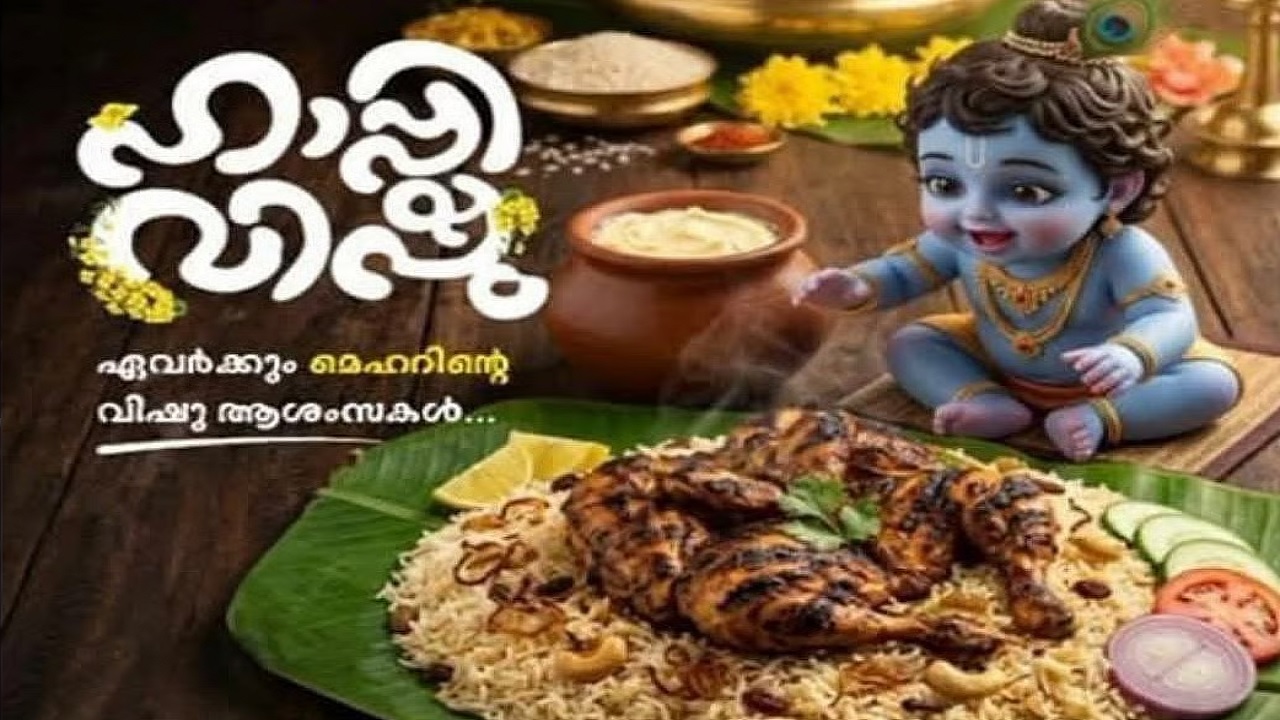
Featuring Lord Krishna before a banana leaf serving chicken mandhi

Synopsis: A series of restaurant advertisements in Kerala depicting Lord Krishna alongside non-vegetarian dishes such as mandhi and biryani has triggered police cases and protests from Hindu groups, who view the imagery as an affront to Vishu traditions. While the restaurant owners have apologised and blamed a designer’s error, organisations like the Hindu Aikya Vedi have demanded an NIA probe, alleging a pattern of deliberate provocation.
In Kerala, sadya is more than a meal – it carries the weight of region, belief and habit. In Kannur and across Malabar, many families—Hindu, Christian and Muslim—lay out a banana leaf where fish fry or a rich chicken or beef dish sits comfortably beside the traditional spread.
But travel south, and the story shifts.
There, the sadya is ‘pure vegetarian’, untouched by meat. For many in the south, the very idea of a Vishu or Onam feast with non-vegetarian dishes feels almost unthinkable.
Yet, across all these differences, one thread remains unchanged: offerings to Lord Krishna during Vishu are deeply rooted in ‘purity’ – fruits, vegetables, sweet dishes and butter placed with devotion.
It is within this delicate balance of faith and food that a recent advertisement by Mehr Mandi & Grills in Alappuzha struck a nerve. Featuring Lord Krishna before a banana leaf serving chicken mandhi—a popular Yemeni dish—it blurred a line many hold sacred.
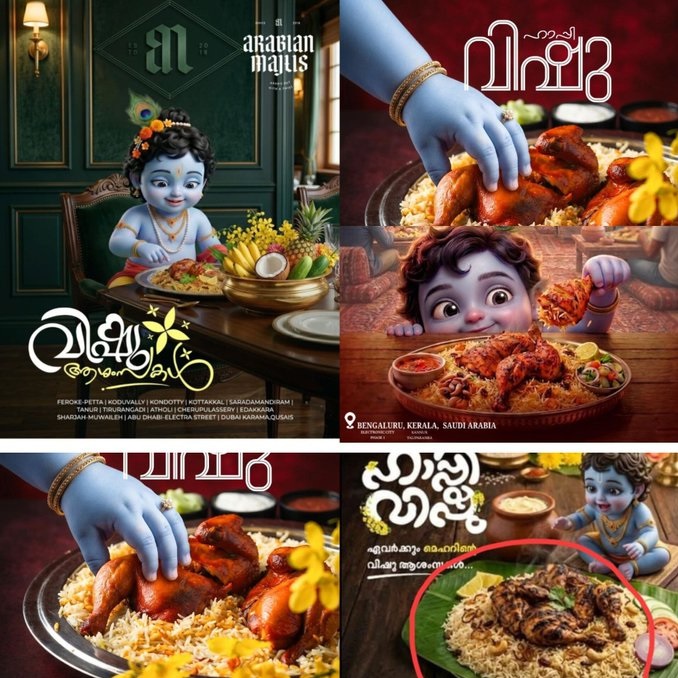
Posters shared by the restaurants as part of their Vishu celebrations
The reaction was swift, with protests led by groups like Vishwa Hindu Parishad.
Now, with similar incidents surfacing in Malappuram, the debate has reignited – touching nerves around religion, food habits, creative expression and the uneasy question many are beginning to ask: was this merely a mistake or something more deliberate?
The controversy first broke out in Cherthala in Alappuzha, where Mehr Mandi and Grills restaurant’s Vishu poster showed Lord Krishna seated beside a plate of mandhi.
The image triggered protests and police registered a suo motu case under Section 192 of the BNS. Two persons—Arshad (36) and Shamnas (30)—were named as accused, with Shamnas arrested.
Organisations like Hindu Aikya Vedi and VHP intensified protests, demanding closure of the hotel and cancellation of its licence.
Soon after, a similar incident surfaced in Malappuram.
In Tirurkkad, a restaurant’s Vishu advertisement featured Sree Krishna alongside shawaya, with the tagline ”Serving the Prosperity of Taste.” Police registered a case under Section 192 of the BNS against three individuals—Musthafa Kunduvayil, Shahul Hameed and Muhammed Shahin—citing potential to hurt religious sentiments and provoke unrest.
They were later released on station bail. Protests were also staged by supporters of the Vishwa Hindu Parishad.
The controversy widened Monday in Kottakkal, also in Malappuram, where restaurants Arabian Majlis and Raidan used images of Krishna to promote non-vegetarian dishes like mandhi and biryani. Police registered similar cases here as well, with those involved released on station bail.
Mehr Mandi and Grills restaurant owners have issued a public apology following the controversy.
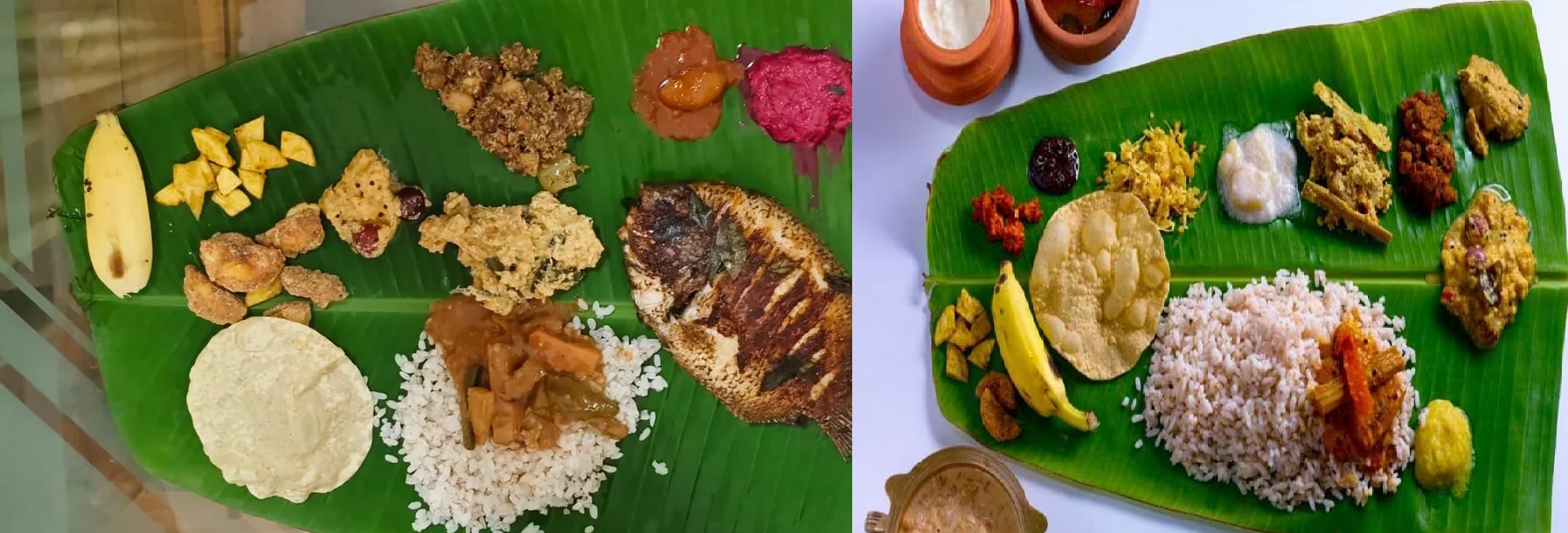
Malabar sadya and Travancore sadya
”The poster was created as part of extending Vishu wishes to our customers. However, even before posting it, we felt the image was inappropriate and released an alternative poster,” they said in a statement.
“Unfortunately, the earlier version was somehow leaked on social media and screenshots containing our contact numbers were widely circulated, turning it into a nationwide controversy, especially on platforms like X, where it triggered hate.”
They added that the situation affected them to the extent that they were unable to use their own contact numbers.
”We sincerely regret the incident and clarify that we never intended to hurt anyone’s religious sentiments. A business can succeed only by respecting all sections of society and this was never done deliberately,” the statement read.
The hotel, run by a group of nine friends, attributed the issue to the designer’s lack of awareness.
The Hindu Aikya Vedi has demanded a probe by the NIA into the series of incidents linked to the Vishu poster controversy.
Speaking to South First, Hindu Aikya Vedi Vice President V Padmanabhan said that the apology issued by Mehr Mandi and Grills could have been accepted if the issue had remained an isolated incident.
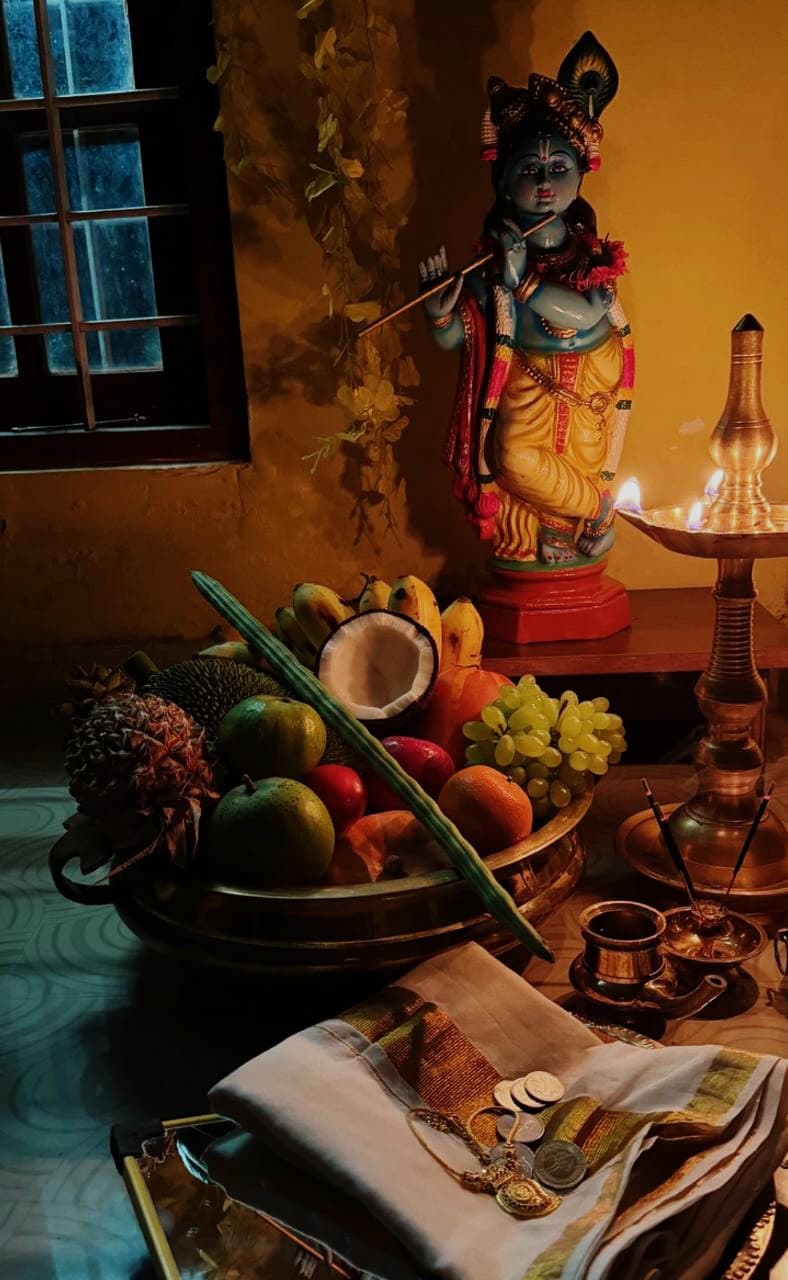
Vishu Kani
”The restaurant claimed the poster was created out of ignorance. That might have been acceptable had it not led to a series of similar incidents. Later, similar posters surfaced in Malappuram, indicating a clear agenda,” he said.
He added that while businesses are free to promote their products, certain representations were offensive.
”Vishu Kani, the auspicious first sight viewed on Vishu morning, is sacred. Some shops in Ernakulam even placed a shoe in the arrangement as part of promotions. Can this be considered acceptable?” he asked.
State president RV Babu also expressed concern, drawing parallels with past incidents. ”A few years ago, a short story titled ‘Muhammed the Idiot’ published in Hindu newspaper led to major conflicts in Kerala and Karnataka. Such incidents often begin small but can escalate into larger unrest. It is important to investigate whether any extremist organisation is behind these developments. We suspect a planned conspiracy.” he said.
Echoing similar concerns, some BJP leaders stated that Kerala society is religiously sensitive and questioned how the designers or business owners failed to recognise the potential for hurt sentiments.
Social activist Rahul Easwar observed that Kerala society responded to the controversy with maturity, noting that members of the Muslim and Christian communities rejected the posters and supported action against the restaurant owners for hurting religious sentiments.
”I don’t see this as part of any conspiracy; it appears to be a case of ignorance,” he said.
Speaking to South First, right-wing political observer Shabu Prasad referred to the 2010 Kerala professor hand-chopping case in which Professor TJ Joseph of Newman College, Thodupuzha, had his right hand severed by activists linked to the banned Popular Front of India over allegations of blasphemy.
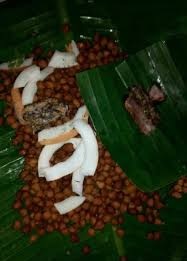
At Parassinikkadavu Muthappan Temple, offerings to Muthappan traditionally include dried fish, chickpeas, and pieces of coconut.
”What we are witnessing now is hypocrisy. If a Hindu restaurant owner had portrayed something that hurt Muslim religious sentiments, how serious would the reaction have been? Such incidents appear to be testing the tolerance of the Hindu community. We want to know who is behind this and what their motive is. Will Hindus alone be responsible for maintaining the social and secular fabric?” he asked.
Babu also called for responsibility from all sides, pointing out that similar advertisement patterns have surfaced in multiple places. He further alleged that a Muslim woman who offered Attukal Pongala and a Muslim girl who set up Vishu Kani were subjected to severe cyber-attacks from within their own community.
”No Muslim organisation or political party has apologised over the Vishu poster controversy. Ignoring such incidents in the name of secularism will only embolden religious extremism,” he said.
Speaking to South First, folklore researcher Nithin RS highlighted the regional variations in Hindu practices related to non-vegetarian food across Kerala.
”The Vishu poster controversy has been more intense in South Kerala, where Hindu traditions generally do not include non-vegetarian offerings as part of religious belief. However, in North Kerala practices are different. In temples like Parassinikkadavu Muthappan Temple in Kannur, fish and even toddy are offered to deity,” he said.
“Similarly, during the Wayanattukulavan Theyyam ritual, hunting and killing wild boar still takes place in Kasaragod and the meat is cooked and served as prasadam (sacred offering). Chicken is also offered in several temples.”
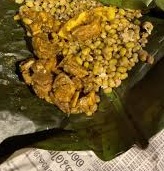
Roasted chicken and green gram are offered as ritual offerings at Madayi Kavu.
He pointed out that such practices are usually associated with Shiva and Devi temples, not with Krishna.
”During Vishu or Onam, individuals are free to eat what they choose but traditionally, devotees in Kerala do not offer non-vegetarian food to Lord Krishna” he noted.
Nithin also observed a shift in ritual practices over time.
”There is an irony in how society is becoming more Brahmanical. In earlier times, rituals like Guruthi involved the sacrifice of a chicken, with blood offered to deities such as Bhadrakali. Today, this has largely been replaced by symbolic offerings, like a red liquid made from turmeric and lime. In some places, the ritual has evolved into offering cooked chicken, which is then distributed as prasadam as seen in temples like Madayi Kavu and Thiruvar Kadu Bhagavathi temples in Malabar.” he said.
”Non-vegetarian food is not outside Hindu culture or belief. But sensitivity is crucial when it comes to religion. The Vishu poster became a major issue also because the restaurants involved were owned by Muslims. A balanced approach is necessary as Hinduism does not follow a single uniform practice. Customs vary widely, but depicting Lord Krishna with dishes like biriyani or mandhi could hurt sentiments. It was unnecessary.”



