

Published Apr 19, 2026 | 7:00 AM ⚊ Updated Apr 20, 2026 | 11:50 AM

Representational image. Credit: iStock

Synopsis: A revisit to Kerala’s 1991 literacy declaration shows it was never a sudden milestone, but the outcome of ideas that had been gathering strength—when public learning stepped out of classrooms during the Silent Valley movement to the district-wide mobilisation that redefined learning in Ernakulam. Together, they shifted literacy from a government programme into a people’s campaign, giving the Mananchira moment its lasting meaning.
When Chelakkodan Aysha took the microphone at Kozhikode’s Mananchira Grounds on 18 April, 1991, Kerala’s declaration as the country’s first totally literate state was given a face that captured the spirit of the movement behind it.
Aysha was 69 then, and until a few years earlier she herself had lived without literacy.
Her announcement that day was more than ceremonial—it symbolised the transformation of thousands who had entered the world of letters through one of the most ambitious mass education campaigns the country had seen.
As the state marks the 35th anniversary of that declaration this Saturday, the moment invites a look back at the social energy and collective resolve that made it possible.
The achievement at Mananchira was the culmination of efforts that had gathered force across Kerala, most visibly in Ernakulam, where the “Lead Kindly Light” campaign set out to eliminate illiteracy in a single year.
Drawing its name from the 1833 hymn, the campaign brought together the district administration, voluntary organisations and neighbourhood communities in an unprecedented mobilisation.
Its success was declared on 4 February, 1990, when then Prime Minister V.P. Singh announced Ernakulam as India’s first fully literate district, laying the groundwork for the state-level declaration that followed a year later.
But even before the Ernakulam experiment took shape, administrators had taken note of smaller but telling efforts at imparting literacy that ran alongside the mobilisation around the Silent Valley movement in the 1970s and 1980s, where community engagement and social awareness went hand in hand.
Also Read: A coast that won’t stay still—and Kerala’s Rs 4,000-crore attempt to hold it
Before Kerala was declared fully literate in 1991, the ground had already been prepared—in forests, village squares and crowded schoolyards where science met protest, and learning took on a new urgency.
A decade earlier, the rainforests of Silent Valley Reserve Forest in Palakkad had become an unlikely classroom. The proposed hydroelectric project there did more than trigger one of India’s earliest environmental campaigns. It altered how people understood knowledge itself—who produces it, who uses it, and who benefits.
What unfolded in the late 1970s and early 1980s was not just a conservation battle. It was a slow, deliberate process of public education.
At the centre stood the Kerala Sasthra Sahithya Parishad (KSSP). Founded in 1962 as a collective translating science into Malayalam, it had, by the mid-1970s, sharpened its focus to a more ambitious idea: “science for social revolution.” Silent Valley became the testing ground.
When the dam proposal surfaced in 1973, the debate might easily have remained confined to technical committees.
Instead, KSSP took the argument to the public. Its members—teachers, students, writers—moved from village to village, turning ecological data into everyday language. They explained biodiversity, questioned projected power gains, and raised concerns about irreversible damage. Street plays, songs and exhibitions replaced jargon-heavy reports.
Science, for perhaps the first time at that scale in Kerala, stepped out of classrooms and into public life.
When the project was finally shelved in 1983, following intervention by then PM Indira Gandhi, the victory carried lessons that went far beyond environmental protection. It showed that an informed public could shape policy—and that complex issues could be broken down, debated and owned by ordinary people.
Those lessons did not remain confined to environmental struggles.
By the late 1980s, Kerala’s literacy levels were already high, but gaps persisted—among women, in coastal belts, and within marginalised communities.
Earlier attempts, including KSSP’s own literacy centres in the late 1970s and a model project in Malappuram in 1986, had struggled to make a lasting dent. The problem was no longer access alone; it was motivation and reach at the margins.
The shift came when literacy was reimagined as a campaign rather than a programme.
In 1988, the National Literacy Mission, launched under Prime Minister Rajiv Gandhi, opened the door for a different approach.
The campaign approach it adopted—mass mobilisation, volunteer-driven teaching, and decentralised communication—drew clear inspiration from earlier grassroots successes, particularly the Silent Valley movement in Kerala. The experience had shown that complex ideas could be translated into public action when people were engaged directly, and that large-scale social change was possible when communities themselves became participants rather than passive recipients.
Also Read: Kerala BDS student death: Police book loan application over alleged harassment
Before the 1991 declaration that would later place Kerala at the forefront of India’s literacy map, Ernakulam had already begun to test an idea that many considered impractical.
In 1989, the KSSP laid out a blunt diagnosis of why earlier literacy drives had fallen short—and proposed something far more ambitious.
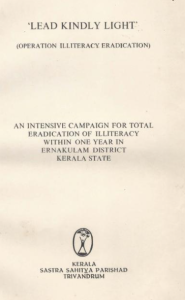
KSSP’s 1989 document that layout the literacy plan
The Parishad’s document did not spare the system.
It spoke of classrooms that failed to invite learning, instructors who were not sufficiently motivated, and learners who drifted in and out of programmes.
Monitoring was weak, feedback loops thinner still. There was, it noted, a lingering fatigue among voluntary agencies forced to work within rigid government rules. Above all, it pointed to the absence of a broader social will. Without that, literacy would remain a statistic rather than a shared commitment.
The answer it offered was not incremental. The proposal was to achieve near-total literacy in the 5–60 age group across Ernakulam district within a year.
At the time, the 1981 Census had placed the district’s literacy at 76.8 percent. Estimates suggested around 1.5 lakh people in that age bracket remained illiterate as of April 1988. The target—100 percent literacy before 1990—was audacious, even by optimistic standards.
What set the plan apart was its emphasis on participation.
Literacy, in this framework, was not confined to reading and writing; it was tied to functional awareness, to enabling people to engage with development itself.
Poverty alleviation, the document argued, could not be meaningfully discussed while large sections remained excluded from basic knowledge.
It proposed a district-level campaign and named it —“Lead Kindly Light.”
The title came from the 1833 hymn written by John Henry Newman. The phrase, with its quiet appeal for guidance through uncertainty, was borrowed to frame what was, in reality, a bold social experiment. Under that banner, Ernakulam was turned into a proving ground.
The campaign was structured in two phases: six months to prepare—training instructors, building local networks, and creating public momentum—and six months for teaching.
A District Literacy Committee was to anchor the effort, bringing together teachers’ groups, trade unions, civil service bodies, political parties, women’s organisations, youth groups, and elected representatives. It was less a programme and more a mobilisation.
When it unfolded, the scale surprised even its organisers. Nearly 30,000 volunteers stepped in, drawn by something harder to quantify than incentives—the appeal of the effort itself. The campaign blurred the usual lines.
Government officials and KSSP activists worked side by side, often from a control room that, by all accounts, remained open throughout the campaign. Administrative roles shifted; officials became organisers in the field.
Much of this hinged on the role of the then District Collector, K.R. Rajan, who had earlier been associated with the KSSP.
The initiative took shape around his push, with the Parishad stepping in to carry it forward. The National Literacy Mission was willing to back the experiment, though not to run it directly.
The operational structure that emerged—a District Literacy Society with the Collector as chairperson—gave the campaign both administrative backing and grassroots reach.
Before the state-level recognition came, the turning point had already arrived in Ernakulam.
On 4 February, 1990, then PM V.P. Singh declared the district India’s first fully literate one. It was the clearest signal yet that a campaign built on public participation could deliver where earlier efforts had struggled.
That moment did not stand alone. It fed directly into a wider push that culminated in April 1991, when Kerala was declared fully literate. What had begun as a district-level experiment expanded into a state-wide movement, carrying with it the same emphasis on mass involvement and functional literacy.
The numbers that followed reflected the shift. As per the 1991 Census, literacy in Kerala stood at 92.91 percent in rural areas and 95.58 percent in urban regions—figures that were well ahead of most parts of the country at the time. The trajectory since then has held steady. The Economic Review 2025 places Kerala’s literacy rate at 94 percent, far above the national average of 74.04 percent.
Long-term trends show how sharp the transformation has been.
In 1951, literacy in Kerala was just 47.2 percent. By 2011, it had nearly doubled, taking the state to the top position nationally with 94 percent literacy. Lakshadweep (91.9 percent) and Mizoram (91.3 percent) follow behind.
The gender gap, once pronounced, has narrowed significantly—from a 22 percentage point difference in 1951 to around 4 points in 2011. Female literacy in Kerala reached 92.1 percent, the highest in the country, while Bihar recorded the lowest at 51.5 percent.
Institutions that emerged alongside the campaign continue to carry the work forward.
The Kerala State Literacy Mission Authority coordinates literacy, continuing education, and lifelong learning programmes across the state. Its approach reflects an idea that took root during the Ernakulam experiment—that literacy goes beyond reading and writing, and is tied to awareness, health, and the ability to participate meaningfully in society.
However, it has to be noted that the milestones do not fully explain the depth of the shift. The literacy campaign worked because it drew strength from currents that were already running through Kerala society.
Kerala’s literacy gains were built on foundations laid much earlier—the region had invested in education in ways that were uneven but persistent—through missionary schools, princely state initiatives, , social reform movements that widened access to education, and a public culture that valued learning.
Local institutions—schools, libraries and neighbourhood groups—created the networks that campaigns could rely on. Women’s participation deepened both reach and continuity. Government support helped, but it worked best alongside community involvement rather than above it.
Seen from a distance of 35 years, the achievement was not a single breakthrough but the result of many forces moving in the same direction over time.
(Edited by Amit Vasudev)



