

Published Apr 18, 2026 | 9:41 AM ⚊ Updated Apr 18, 2026 | 9:41 AM

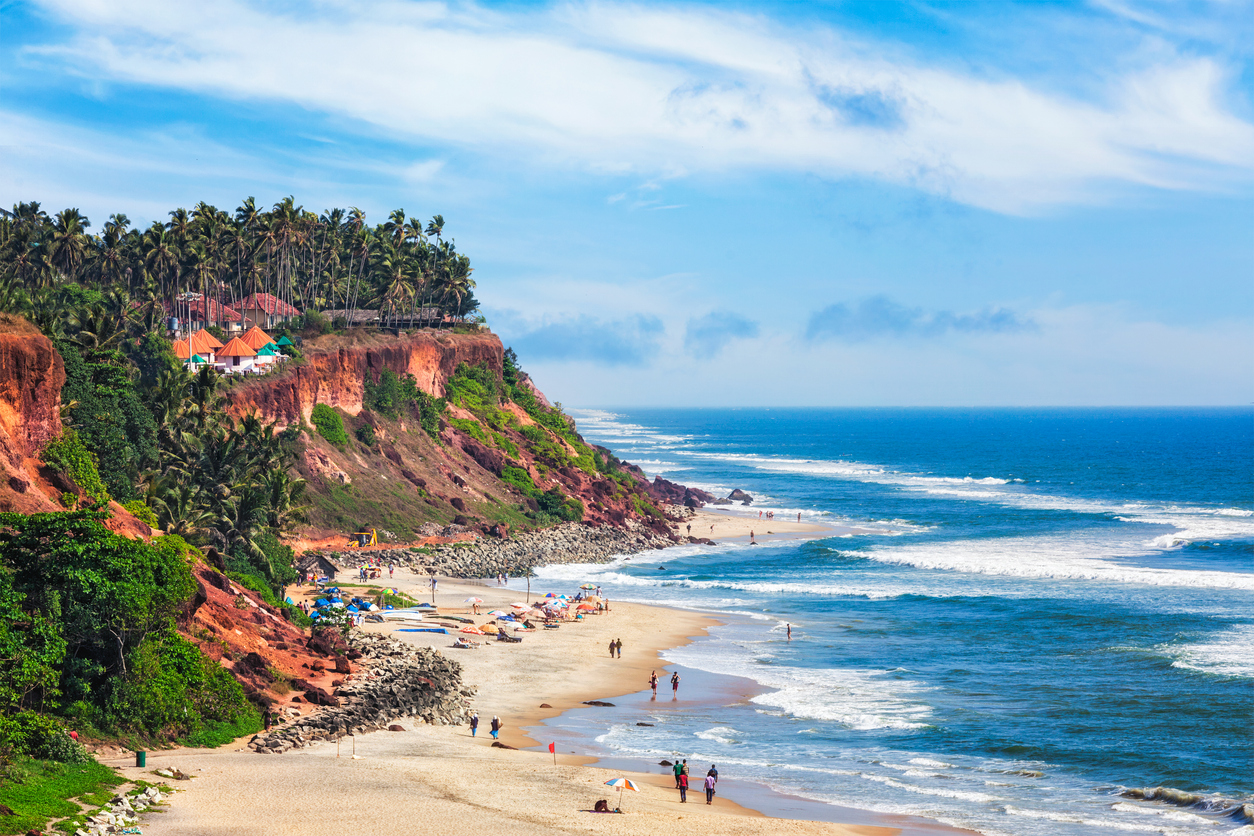
Varkala beach, Kerala. Credit: iStock

Synopsis: Kerala is lining up a ₹4,000-crore coastal protection push with Asian Development Bank support, shifting from earlier limited interventions to a more focused effort across some of its worst erosion-hit stretches. The plan blends hard engineering with livelihood support, as the state tries to steady nearly 90 km of a coastline that continues to slip away year after year.
Kerala’s long, restless coastline—stretching 590 km across nine districts—has for years been locked in a losing battle with the sea, with coastal erosion steadily eating away land, livelihoods, and any easy answers.
With no lasting solution in sight, the state is now turning to a more targeted, high-investment approach.
For a while, the state had looked to the World Bank for support.
That engagement did materialise, but in a limited way—focused on planning frameworks and selective interventions that covered only a fraction of the most vulnerable stretches. It wasn’t quite the scale the crisis seemed to demand.
Now, Kerala is turning to the Asian Development Bank (ADB) for a broader push.
A new ‘Kerala Sustainable Coastal Protection and Climate Resilient Planning Project,’ backed by the ADB, is set to roll out soon, zeroing in on 10 of the most vulnerable erosion hotspots. The shift signals a move away from piecemeal fixes towards something more expansive, even if still far from coast-wide.
The project, pegged at 466.67 million USD (around ₹4,013 crore), will be funded through a mix of 70 percent ADB loan and 30 percent state share.
The plan is to cover a 90 km stretch with a mix of interventions drawn from what officials describe as global best practices—offshore reefs to blunt wave energy, beach nourishment to rebuild lost sand, repairs and strengthening of seawalls, and sand retention structures to slow down further loss.
Alongside these, there’s also a quieter focus on livelihood support and capacity-building programmes, an acknowledgement that erosion here isn’t just about geography but about the people living on its edge.
Also Read: KC Venugopal eyeing Kerala CM chair? Expelled TN leader Hazeena Syed’s remark sparks row
Kerala’s long relationship with the sea is turning uneasy in stretches that once felt secure.
Across nine coastal districts—Thiruvananthapuram, Kollam, Alappuzha, Ernakulam, Thrissur, Malappuram, Kozhikode, Kannur and Kasaragod—erosion is steadily eating into the shoreline, with around 65 kilometres now classified as severely affected.
What this means on the ground is not abstract. Houses that stood a few years ago now sit dangerously close to the waterline.
Roads have narrowed or vanished. In some places, people have had to move with little notice, leaving behind land that has been in families for generations.
Public infrastructure—bridges, coastal roads, even small fishing harbours—has taken repeated hits.
The scale of distress has brought a steady stream of appeals to the government, from residents and elected representatives alike, calling for immediate protective measures.
Court interventions have added urgency, directing authorities to act in vulnerable stretches where delays could prove costly.
A set of critical hotspots has been identified across the coast:
These are not isolated trouble spots.
They reflect a broader pattern that the Kerala State Disaster Management Authority has been tracking for years.
According to an official with the KSDMA, the reasons are layered.
Wave action—driven by winds and, on rare occasions, extreme events like tsunamis—plays a part. Tides and storm surges add to the pressure during certain seasons. Sea levels are inching upward, altering the baseline along the coast.
According to the official, the nature of the coastline itself matters.
Some stretches are more fragile, shaped by loose sediments that shift easily. Human activity has made things worse in places. Construction close to the shore, changes to river flows through dams, and the loss of protective vegetation have all had a role. Climate change sits in the background, intensifying several of these factors at once.
The consequences are already visible.
Productive land has been lost, including small agricultural plots that supported coastal households. Infrastructure damage has become routine rather than exceptional. Communities that depend on the sea now face a different kind of risk, one that does not recede when the monsoon ends. Each season leaves them a little more exposed to the next.
Officials describe coastal erosion as an ongoing process rather than a one-time disaster. That makes the response harder. Protective measures—sea walls, groynes, beach nourishment—take time, funding and careful planning. Even then, they tend to shift the problem rather than eliminate it entirely.
Also Read: Viral claim says temperatures to hit 55°C in Kerala; KSDMA terms it fake
It was against this backdrop that the state moved a step closer to a large-scale coastal protection push, with the state government granting in-principle administrative sanction for a major project backed by the ADB.
The proposal, put forward by the Mission Director of the Project Management Unit under the Water Resources Department, seeks to roll out the ‘Kerala Sustainable Coastal Protection and Climate Resilient Planning Project’ across some of the state’s most vulnerable shoreline stretches.
The decision comes after months of back-and-forth with multiple funding agencies.
At one point, the state had explored support from the World Bank and even internal options such as KIIFB (Kerala Infrastructure Investment Fund Board).
Those discussions did yield results, but only to a point.
The World Bank-backed ‘Resilient Kerala Program-for-Results Project’ committed about USD 90 million (₹755 crore) under its additional financing window, primarily tied to a Shoreline Management Plan and targeted interventions in 30 critical locations covering around 30 km.
Officials, however, found the scale of assistance too modest for the problem at hand.
Kerala’s coastline has been under sustained stress, with erosion eating into several densely populated belts.
Limiting interventions to a handful of stretches was unlikely to make a lasting dent.
That gap is what brought the ADB into the picture.
While the World Bank engagement leaned more towards technical frameworks and selective investments, the state began looking for a partner willing to underwrite a broader, capital-heavy programme.
The ADB fit that requirement.
The Irrigation Department went on to prepare a Preliminary Project Report (PPR) for a more expansive intervention, focusing on 10 high-risk hotspots identified through studies and field assessments.
The proposed project—tagged PPRID-11669—comes with a price tag of about USD 466.67 million, or roughly ₹4,013 crore.
Of this, 70% (USD 326.67 million, approximately ₹2,809 crore) is expected to come as an ADB loan, with the state government bearing the remaining 30% share of around ₹1,204 crore.
Unlike the earlier programme, this one is structured under an Investment Project Financing (IPF) model, which is expected to speed up execution on the ground. The emphasis is on long-term, site-specific solutions rather than piecemeal fixes—something coastal engineers have been arguing for over the years.
The project has already cleared the required approvals from the Central government, with the green light coming in by July 2024.
The state’s latest decision effectively sets the stage for implementation.
The identified hotspots where the ADB assisted programme will be executed are,
The proposal – a major externally aided project covering nearly 90 kilometres of vulnerable shore – is pitched as a long-term response to coastal erosion, rising sea levels and the growing risks faced by fishing communities.
The project comes with an estimated outlay of $466.67 million, roughly ₹4,013 crore.
Of this, 70% (about ₹2,809 crore) is expected as an ADB loan, while the remaining 30% (₹1,204 crore) will be borne by the state.
At the same time, officials, with the Water Resources Department who are aware of the programme, stated that what is being proposed goes beyond routine coastal defence.
The plan combines offshore reefs, beach nourishment, restoration of sea walls and sand retention systems with livelihood support and capacity building. The idea is to stabilise shorelines while keeping ecological concerns and local economies in view.
The proposal folds in earlier coastal protection plans prepared for five erosion hotspots — Sanghumukham and Kollamcode in Thiruvananthapuram, Alappad in Kollam, Chellanam Phase II in Ernakulam, and Kappad in Kozhikode.
Separate files had been processed earlier for KIIFB funding.
In-principle sanction had already been granted for Kollamcode and Chellanam Phase II, while proposals for Kappad, Alappad and Sanghumukham are still under the Finance Department’s consideration for fund allocation through KIIFB.
Officials say the project is structured around three broad components: climate-resilient coastal protection and restoration, livelihood enhancement and community resilience, and institutional strengthening with a focus on integrated coastal zone management.
The scale of intervention outlined is considerable.
Around 120 kilometres of coastal roads, including key national and state highways, are to be protected from erosion and wave damage.
The plan also targets prevention of land loss and flooding in 33 coastal villages, many of which have seen repeated sea incursions in recent years.
Protection of homes, particularly those of fishing families, figures prominently in the proposal.
There is also a clear economic angle.
The project is expected to improve nearshore fishing prospects and support alternative livelihoods.
It ties coastal protection to future development — from infrastructure and highways to tourism. Beaches such as Shangumugham, Varkala, Kappad and Valiyaparamba are identified for revival, with an eye on boosting tourism activity.
Public infrastructure in coastal stretches — including the international airport, hospitals and schools — is listed among assets requiring protection.
The proposal also speaks of creating green belts and restoring lost beaches to bring back natural habitats that have steadily receded.
Beyond physical works, the plan emphasises strengthening the state’s technical capacity in understanding coastal processes, designing protection systems and managing large-scale projects. Monitoring mechanisms and institutional support are built into the framework.
Sajitha, who lives near Shangumugham, doesn’t bother to dress it up.
“We don’t talk about erosion like it’s some big issue anymore. It’s just part of life here,” she says. “When the sea is rough, we don’t sleep properly. You keep listening… whether it’s getting closer.”
She recalls how their courtyard used to stretch further out.
“There was space for the nets, for the children to run around. Now it’s all gone. The edge is right there. One strong season, and you don’t know what will be left.”
Asked about the new project, she nods, but without much certainty.
“They’ve come before, measured things, put stones, made promises. Some places get protection, some don’t. We don’t understand how they decide.”
A brief silence.
“If this really holds the sea back, that’s enough for us. Not big things. Just that we don’t have to keep packing up every few years and starting again.”
After years of piecemeal fixes and recurring damage, the hope is that this more concentrated effort might finally shift the balance, even if only along selected stretches of a coastline that has rarely stayed still.
(Edited by Amit Vasudev)



