

Published Jun 28, 2026 | 11:29 AM ⚊ Updated Jun 28, 2026 | 11:29 AM

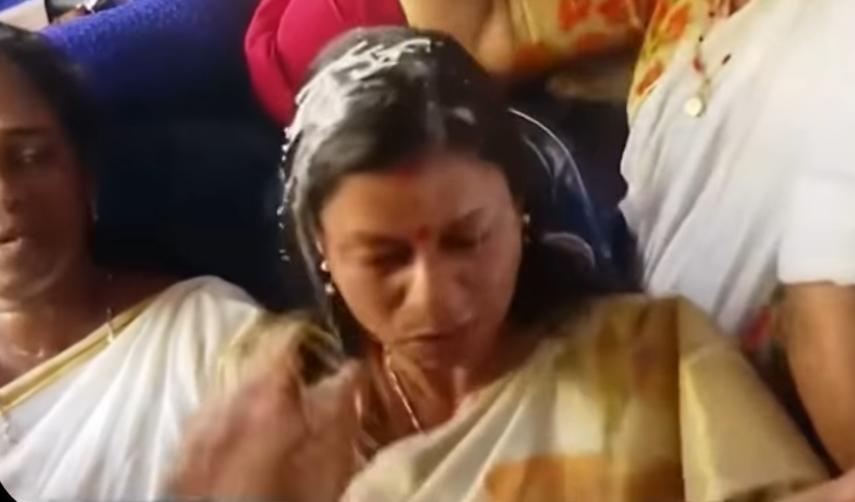
Minister Bindu Krishna ended up with hot payasam on her head.

At the zenith of excitement, Kerala Minister Bindhu Krishna felt a sudden burning sensation on her head.
Right after the announcement of the Assembly election results, Krishna, who days later became the Minister for Women and Child Development, ducked an innocuous public hug by an overenthusiastic male party leader. She had seen the embrace coming.
The incident was briefly debated, and as usual, troll factories went on an overdrive.
Little did Krishna then know that yet another minor Sword of Damocles — that would make many roar with laughter — was hanging over her head in the form of a cupful of piping hot payasam, the dessert that makes any celebration sweeter.
The celebratory moment involving Krishna was the launch of the Priyadarshini scheme, the UDF’s flagship programme offering free rides for women on state-run ordinary buses, on 15 June.
Krishna boarded an ordinary along with her followers, and placed herself on a seat strategically and convenient for television cameras. She proudly beamed as jubilant and sloganeering Congress workers crowded around her. Television cameras captured each moment of the historic event.
Then, the inevitable happened, adding a different dimension to the historic moment. The party workers had opted for payasam instead of laddos that could be easily procured, safely distributed and savoured.
Paper cups of hot payasam — it should be enjoyed hot — precariously changed hands overhead, deftly avoiding slogan-inspired fists excitedly punching the air in the available space beneath the bus’s roof.
And then, it happened. The minister didn’t see it coming.
Also Read: Why Kerala’s free travel scheme is about mobility and progress
Those who watched the incident on television missed the crucial part initially. The visuals showed a startled minister springing to her feet, frantically wiping her head and turning around to face the crowd.
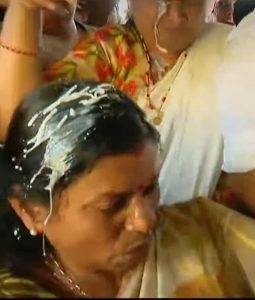
TV visuals suggested the payasam was accidentally spilt on the minister.
Television replays made the incident clearer. A cup of payasam that was being aerially distributed onboard, spilt on the minister after one of the fists cut short the sweet dish’s trip before it reached its intended destination.
After the initial confusion, Kerala had a hearty laugh at the Priyadarshini scheme’s baptism by payasam. Social media raced to come up with different humorous angles.
Minister Krishna laughed it away. Such things happen when excitement knows no bounds.
The payasam issue, however, did not stop there. It snowballed into a hot topic of debate on VIP security. A Deputy Superintendent of Police (DSP) has now been officially assigned to probe the incident.
The question the officer needs to answer is whether it was a stray fist behind the incident, or whether the local police had failed to shield a minister from the hot cup?
The probe also shifted the question from who spilt the payasam to who was supposed to prevent it.
In between the gooey payasam that singed the minister and the DSP’s probe is one lawyer: Advocate Kulathur Jaisingh. He lodged a complaint with the state police chief.
Jaisingh now feels that the public has misunderstood the issue. He asserted that he had never demanded an investigation into whether the payasam incident was deliberate, but asked whether the police had failed in providing adequate security to a Cabinet minister caught amidst an uncontrolled crowd.
It was Jaisingh’s question that prompted the probe by the DCP.
Also Read: A free ride with a heavy price tag
Incidentally, the only person who appears least interested in prolonging the controversy is the minister.
Krishna has repeatedly maintained that nothing suspicious had occurred.
The video, she said, clearly showed that someone accidentally brushed against the container in a crowded space.
“There is nothing unnatural about what had happened,” she remarked, adding that such incidents are possible wherever large gatherings take place.
Krishna also clarified that she has no complaint against anyone and has reportedly written to the police chief stating that no inquiry is required.
For her, the matter is over. But for the system, it is the beginning.
This is precisely where the controversy enters a different lane.
Police security for ministers is not merely a personal privilege extended at the request of the individual concerned. It is an institutional responsibility.
Security protocols exist to manage crowds, regulate proximity and minimise avoidable risks—whether the threat comes from an agitated protester, an overenthusiastic supporter, or, as fate would have it, a cup of hot payasam.
Jaisingh argued that if a minister could be exposed to scalding during a government programme, it raises legitimate questions about crowd management.
His contention is straightforward.
Even if the minister has forgiven the accident—or considers it as one—the Home Department still has a responsibility to examine whether standard security procedures were followed.
The issue, therefore, is less about intent than about preparedness.
That is the question investigators may ultimately examine.
Every accident has a cause. Not every cause amounts to negligence.
The DSP-level inquiry will likely focus on whether adequate police personnel were positioned around the minister, whether access to the stage was properly regulated, and whether established VIP security protocols were compromised in the enthusiasm of the celebration.
If officials conclude that procedures were followed, the matter could quietly end with the finding that unfortunate accidents happen.
If lapses are identified, however, the inquiry could recommend departmental action.
Whether that translates into warnings, adverse remarks, or transfers remains to be seen.
The real heat is on the police. The irony is difficult to miss.
The payasam lasted only a few seconds. The debate over policing has lasted days.
In Kerala politics, it seems, even payasam can leave a lasting aftertaste.



