

Published Jun 13, 2026 | 8:00 AM ⚊ Updated Jun 13, 2026 | 11:48 AM

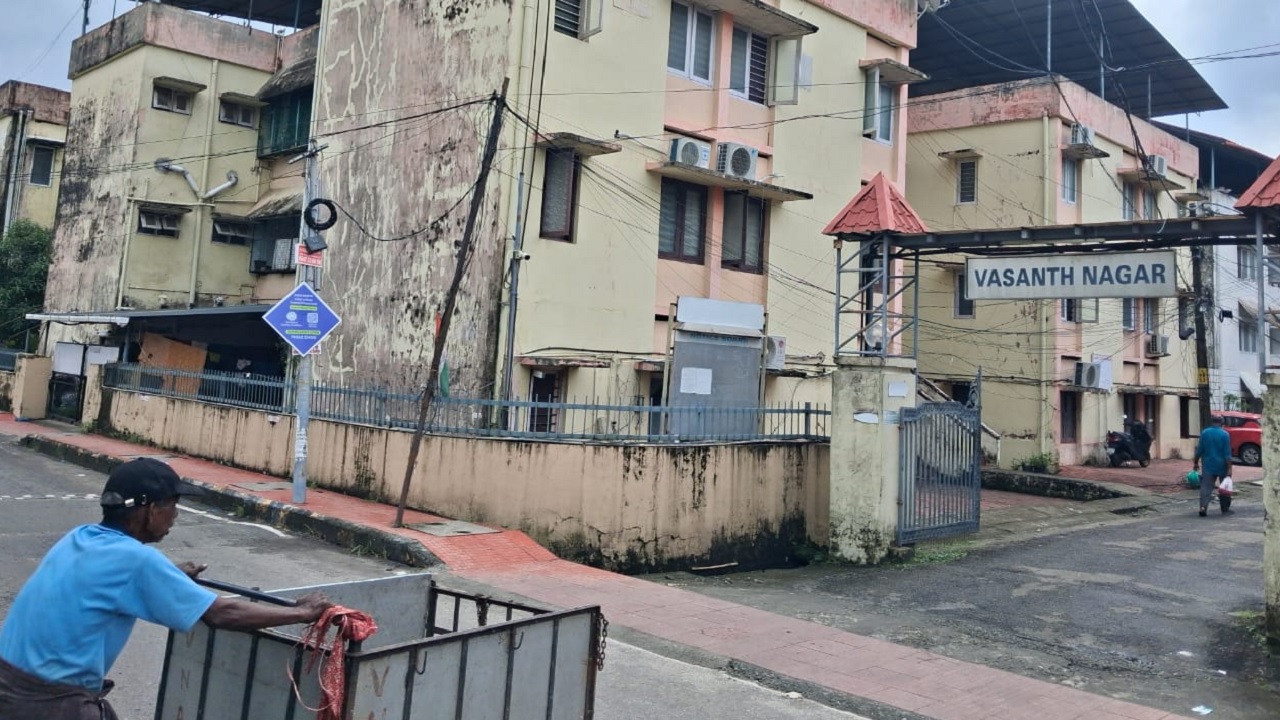
Vasanth Nagar

Synopsis: The Vasanth Nagar residential area near Kaloor Stadium is facing severe monsoon-related issues, putting nearly 500 residents at risk. KMRL and KSEB, sharing borders with the property, and their mismanagement are also affecting living conditions here. Above all, Kerala State Housing Board’s neglect and pending sale deed issues have made the situation more complex.
Shaji Varghese invested in a flat decades ago, hoping for a peaceful, comfortable retirement. Today, the investment is bringing the 70-year-old and his wife a life of panic and trepidation.
Varghese and his wife Annie Mathew are alone in Kochi after their children left for far-off lands, beyond the country’s borders. The elderly couple had hoped for a serene, safe and happy living when they purchased a flat at Vasanth Nagar near the Jawaharlal Nehru Stadium in Kochi’s bustling Kaloor.
Proper sleep and peace of mind are now things of the past for the septuagenarian and his wife. The flat they had purchased with much hope after spending a good share of their life savings now haunts them, day and night.
The condition of the flat is pathetic and deteriorating. It has now affected the health of the residents as well.
Kerala romanticises the monsoon that brings respite from the scorching summer sun. For the residents of Vasanth Nagar like Varghese, it is the season of uncertainty and fear, and with each rain, a sinking feeling kicks in. They are worried that a midnight downpour and the subsequent waterlogging might irreversibly affect their lives and properties.
South First visited the area for what appeared to be a routine monsoon story of flooding and a poorly maintained residential complex.
Beneath the surface was a larger, uglier truth. The pouring rain is not the root cause of the residents’ suffering. At the centre of their suffering is a government agency, the Kerala State Housing Board (KSHB).
Also Read: Kochi’s coastal areas witness sea erosion, sudden tidal flooding
Anjana George, film critic and secretary of the Vasanth Nagar Allottees’ Association, was rushing to the office of Kochi Metro Rail Limited (KMRL) with a complaint when South First met her.
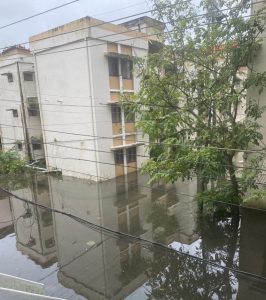
Vasanth Nagar after just one day of rain.
Vasanth Nagar shares its boundary with the Kochi Metro property and is located close to the JLN Stadium Metro Station.
“There are around 500 residents, including children, pregnant women and senior citizens, living in Vasanth Nagar, which is in immediate proximity to the ongoing Kochi Metro Phase 2 alignment,” she said.
While explaining the flooding at Vasanth Nagar, George shared the concerns of the residents.
“We wholeheartedly welcome the development of the 11.2-km elevated Pink Line Metro Corridor from JLN Stadium to Infopark. At the same time, we are deeply worried about the severe waterlogging vulnerability of our residential area. Geographically, Vasanth Nagar is at a significantly lower elevation than the surrounding terrain, making it highly susceptible to flash floods,” she said.
The construction of Metro Phase 1 had disrupted the natural drainage patterns of the area, causing floodwaters to rise nearly four feet in the colony.
“The flooding resulted in extensive property damage and put many lives at risk. With Phase 2 construction now underway, we fear an even greater catastrophe might happen if preventive measures are not taken immediately,” George added.
Also Read: Chellanam drowns in silence as the government fails to act
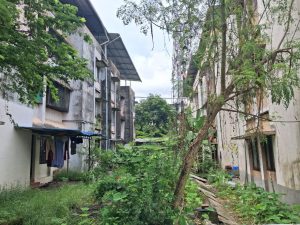
A natural stream running along the KSEB property boundary adjoining Vasanth Nagar passes through the residential complex and the Kochi Metro construction area.
Vasanth Nagar
Silt, debris and the city’s waste clog the stream during the rains, restricting the free flow of stormwater, the residents said.
Varghese told South First that they have urged both KMRL and KSEB to immediately clear, desilt, deepen and restore the stream to prevent flooding.
Residents have also requested a detailed drainage assessment to explore whether excess rainwater from Vasanth Nagar could be safely diverted through the stream.
While KSEB pruned tree branches in the city posing a threat to power lines ahead of the monsoon, residents alleged that inadequate maintenance of natural drainage channels within its property continues to worsen waterlogging and flash floods during heavy rains.
Also Read: Monsoon precautions to keep the doctor away
Most ground-floor residents of the Vasanth Nagar flats have already moved out of their homes and are now living in rented apartments, fearing flash floods and due to the poor condition of the buildings.
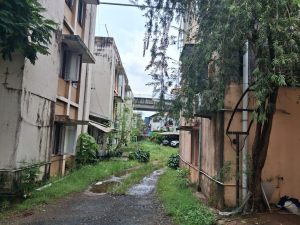
The poor condition of flats in Vasanth Nagar, with the Kochi Metro Rail corridor visible in the background.
Manu Rajagopal, one of the residents who shifted from Vasanth Nagar six years ago, told South First that the Kerala State Housing Board constructed the residential complex in 1990, comprising 210 flats. He purchased his flat in 1998.
He said the core issue is the lack of maintenance, as the Housing Board still retains ownership, preventing residents from carrying out proper upkeep. According to him, this is not unique to Vasanth Nagar but reflects a wider problem across many Housing Board residential complexes, which are turning into ”ghost houses” due to poor maintenance and lack of follow-up.
”For most of us, this was more than just a home; it was an investment meant to secure our retirement life. But now we are facing severe stress, and even our right to a dignified life has been compromised due to the inefficiency of the Kerala State Housing Board,” he said.
George said around 20 sale deeds are still pending in the complex.
Without the Housing Board’s consent, residents are unable to carry out maintenance in common areas as ownership remains unresolved.
Rajagopal also pointed to the Maharashtra Housing and Area Development Authority (MHADA) model in Mumbai, where residents can form associations once 70% occupancy is reached, and sale deeds are issued once 70% of the flat cost is paid.
Also Read: A guide to navigate through the viral disease
When George bought her flat in 2014, one of her friends also purchased an apartment the same year from a private builder near Champakkara Market for almost the same price—around ₹20 lakh.
What she got was a brand-new building with better facilities and a more comfortable living environment for the same amount.
George said her only ”mistake” was trusting the government system and believing that a Housing Board project would be safe and reliable—especially in Kochi, where people often worry about land mafias and irregularities in construction.
”The common spaces in this residential complex are in a pathetic condition and sometimes even the sunshades look scary,” she said.
“I have been infected with dengue two times, and dengue fever is almost a common phenomenon we suffer along with monsoon troubles. We live here fearing whether our vehicles parked outside will be destroyed in flash floods or whether any part of the building will collapse. After every rainy night, early morning calls among residents are common just to make sure everyone is safe.” she said.
On the pending sale deed issue, residents said there are options like auction or other legal measures that the Housing Board could initiate, but no action has been taken, nor has any inspection been conducted.
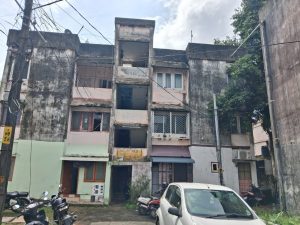
Vasanth Nagar Flats
Speaking to South First, Jasmine Thomas, Executive Engineer at the Housing Board, Ernakulam Division, said that the sale deed is usually transferred only after full payment is made.
She added that under the amended Registration Act, a no-objection certificate from the District Collector is mandatory to register government-owned property in a private party’s name.
The Collector must initiate action, call for reports from the taluk and village offices, and complete verification through all authorities concerned.
She said the Housing Board cannot intervene beyond this stage, and delays often occur due to this process.
Thomas also noted that before issuing sale deeds, residents are permitted to form only an allottee’s association, and even that must follow legal procedure.
Only after issuance of all sale deeds can a proper residents’ association be formed, which is essential for the maintenance of common areas.
The five-acre land and flats in one of Kochi’s prime locations reflect a larger reality- similar issues are being reported in several Housing Board properties across Kerala.
Meanwhile, those who bought from private builders are seen leading more stable and peaceful lives, residents said.
”In my friend circle, I have a nickname—Slumdog Millionaire and some even labelled our area as ‘Vietnam Colony’,” George said, referring to the 1992 Malayalam film about a colony struggling with ownership issues.
”If I had saved the money spent on the Vasanth Nagar Flat, I could have bought another house. That’s why I got that name,” she said, laughing wryly.
Residents are now seeking a practical solution from the Housing Board. They hope for basic support, like a drainage motor from the corporation during flash floods, and timely coordination from KMRL and KSEB.
The larger question of who the Housing Board is really helping by doing nothing remains open and yet to unfold.
(Edited by Majnu Babu).



