

Published Sep 07, 2026 | 12:45 PM ⚊ Updated Sep 08, 2026 | 10:33 AM

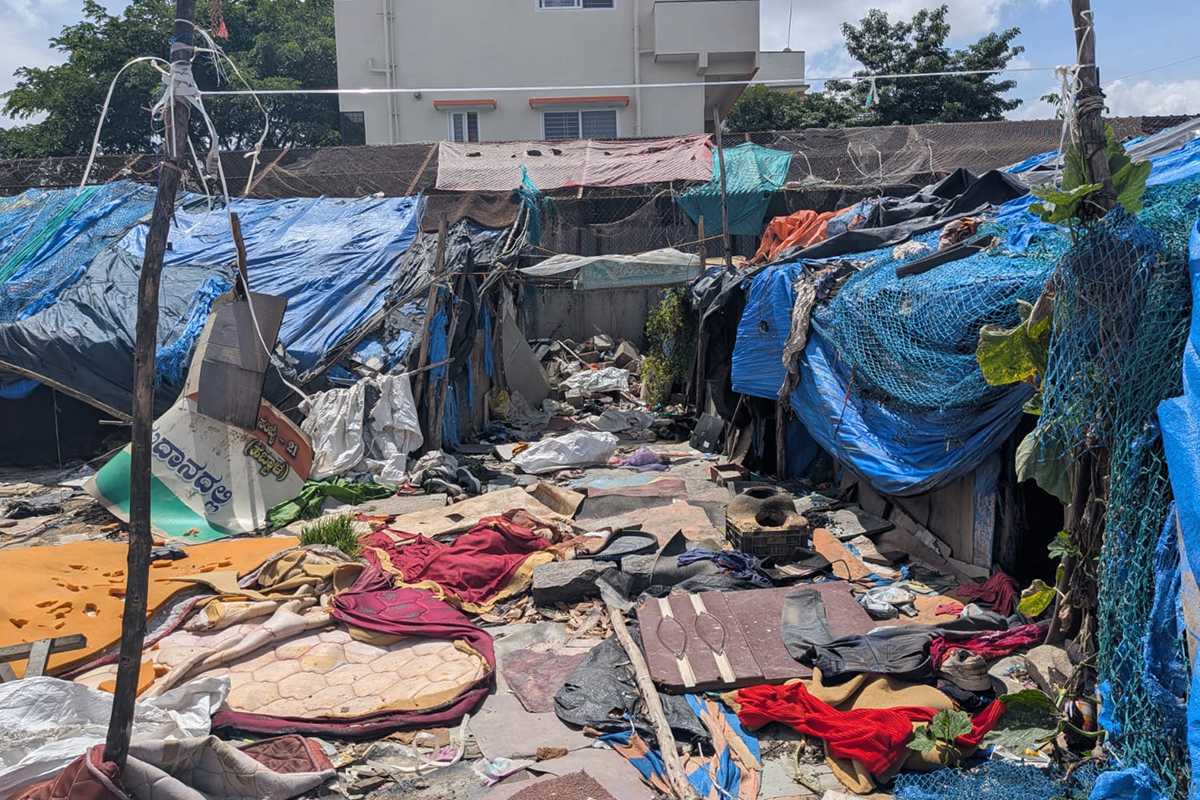
A cleared Bangladeshi settlement at Vishwapriya layout in Bengaluru.

Synopsis: Bengali-speaking migrant workers from West Bengal and Assam allege harassment, assault, demand for haftas and prolonged questioning during a Bengaluru Police verification drive to identify undocumented Bangladeshi nationals. Police, however, say the verification and deportation process follows prescribed procedures.
It happened two days before Operation Mukta was launched.
When Bengaluru police arrived at Jabbar Ali Mondal’s home in Thubrahalli early on August 6, the 42-year-old, who says he has lived in the city for nearly 24 years, was asleep.
A native of Murshidabad district in West Bengal, Mondal said he was taken to Varthur police station as part of a verification exercise to identify suspected undocumented Bangladeshi nationals. He said officers asked him to produce his Aadhaar card, voter records and birth certificate.
“After all this, the police kept saying I was Bangladeshi,” he said.
Mondal alleged that police made him unlock his phone and searched his photographs and other personal data. He said his original identity documents, including Aadhaar and voter-related records, were retained and that he was instead given photocopies.

Injuries sustained by Jabbar Ali Mondal.
He said he was kept at the station for around five hours on the first day and called again the following day, when he allegedly remained there for nearly 12 hours. He also said that those taken for questioning were made to sing the national anthem.
Mondal further alleged that he was assaulted at the police station, leaving him unable to work for five to six days and causing losses and medical expenses of around ₹10,000 to ₹15,000.
“I tried approaching the Human Rights Commission and will now try fighting my case through lawyers,” he said.
Varthur police’s response is awaited.
Mondal’s account comes against the backdrop of a large-scale Bengaluru Police drive in August to identify suspected undocumented Bangladeshi nationals.
“Operation Mukta” was carried out on August 8 and continued through the weekend across several parts of the city, including Electronic City, Begur, Whitefield and areas around Bannerghatta Road.
Many of those checked were migrant workers employed in waste collection, construction, housekeeping and other informal-sector jobs.
Electronic City DCP Narayana M said police verified nearly 3,000 people during the exercise and identified around 105 whom they suspected of being undocumented Bangladeshi nationals. Of these, 31 were subsequently deported on August 31, while verification and other proceedings were continuing in the remaining cases.
Police maintain that action is being taken only after documents and nationality claims are examined.
Several kilometres away, migrant workers in Yelanehalli described another encounter during the verification drive.
The settlement is home to around 200 people, mainly Bengali-speaking migrants from Assam, many of whom are engaged in garbage collection and segregation.
Sanjab Ali, an Assamese worker living there, alleged that police arrived early in the morning and took residents to Hulimavu police station.
“They whisked us to the police station. They did not even leave the women and children,” he said.
Ali said residents were taken at around 6 am and remained at the station until about 6 pm. He said he produced an Aadhaar card, a voter ID, and a birth certificate that linked him to Assam’s Bongaigaon district, but alleged that officers kept asking whether he was Bangladeshi.
Hulimavu police acknowledged that residents had been taken to the station for questioning as part of the verification exercise, but said all documents collected from them had been returned.
Ali, however, alleged that his birth certificate had still not been returned.
When he was called to the station again on September 3 along with another worker, Ali alleged that an officer slapped him twice and again searched his phone. “There was no Bangladeshi number or relative,” he said.
He alleged that police did not subject him to biometric verification or contact his family in Assam.
“I had never been taken to a police station before. It was humiliating,” Ali said.
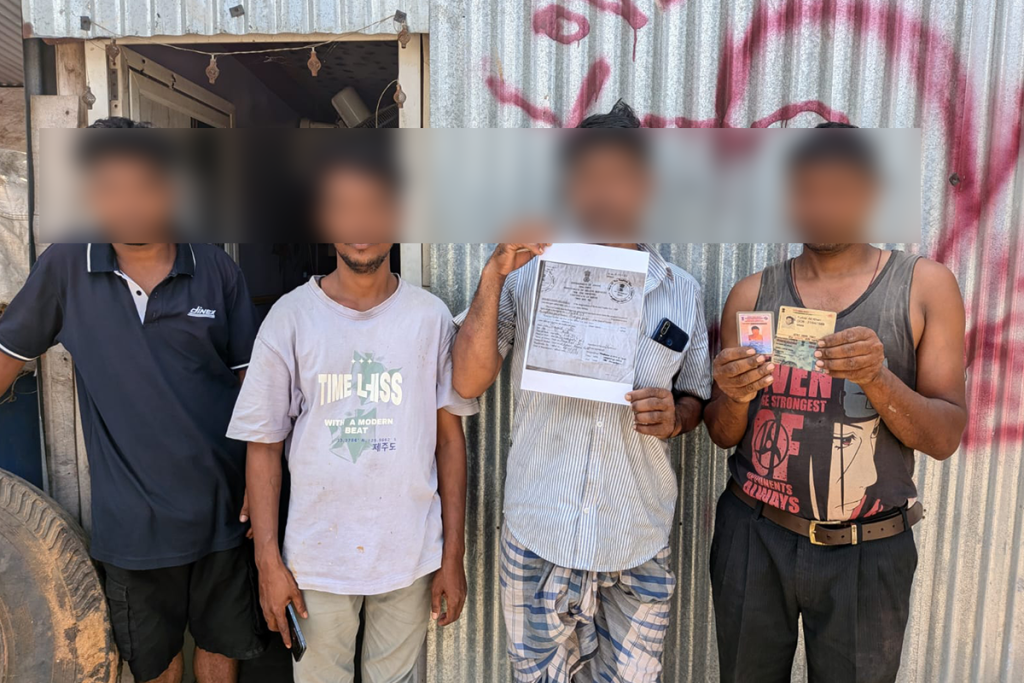
Sajib ali ( 2nd from left) and his fellow residents.
He and others in the settlement also alleged that police had earlier sought “hafta“, or payments, every month, and that such demands became more frequent after the city-wide verification drive. The cops denied the allegations.
Nazmina Khatun, a native of Assam’s Barpeta district who lives in the same area, said she was among those taken for verification.
“They took us and gave us food only late in the afternoon. They gave biscuits to the children. Why should we have to go through this?” she said.
Another worker, Jahangir Hussain, who lives near Electronic City, said police retained his mobile phone for nearly a month after he was taken for verification.
Police say the exercise has led to cases where Bangladeshi documents were recovered during verification.
Begur police said nine of the 31 people deported in the first batch had been living in sheds near Vishwapriya Layout, Begur, and working in garbage collection, construction and housekeeping.
According to Begur SHO (Station House Officer) Punith Kumar, some of them possessed Aadhaar cards, but police also recovered Bangladeshi national identity cards and birth certificates from their places of stay. Police suspected that the Aadhaar cards had been fraudulently obtained, he said.
Those identified as suspected undocumented immigrants were referred to the Foreigners Regional Registration Office (FRRO) for further verification. According to police, fingerprints, photographs, addresses, Aadhaar details and information contained in documents such as Bangladeshi National Identity (NIDs) cards and birth certificates are cross-verified during the process. The FRRO subsequently prepares the detention order.
“We coordinate with the Bangladesh Embassy in New Delhi to retrieve details of suspected illegal immigrants, and after receiving confirmation, we deport them,” Narayana said.
SHO Punith Kumar said confirmation from Bangladesh took around 20 days in some cases while the Bangladeshi migrants were detained near a facility in Doddagubbi.
Following verification, the first group of 31 was transported by train towards Malda in West Bengal, after which the Border Security Force coordinated their transfer at the India-Bangladesh border.
Police said the process was carried out in coordination with central agencies and that due procedure was followed before deportation.
“This is a necessary process, and we make sure no one is illegally treated, and due procedure is followed,” Narayana insisted.
Lawyers, trade unions and civil-rights organisations have, meanwhile, questioned how the verification exercise was conducted.
A joint report released on August 22 by the All India Lawyers’ Association for Justice, People’s Union for Civil Liberties, Domestic Workers’ Rights Union, All India Central Council of Trade Unions (AICCTU) and other organisations said migrant settlements falling under at least 10 to 12 police station jurisdictions were targeted during the August 8 operation.
The report documented allegations of residents being taken for verification despite producing Indian identity documents, as well as allegations of assault, phone searches and inconsistent document requirements.
The organisations argued that speaking Bengali, being a migrant worker or living in an informal settlement cannot by themselves form the basis for suspecting someone of being Bangladeshi.
Citing the Supreme Court’s 2024 judgment in Md. Rahim Ali v. State of Assam, the report said authorities must have some material basis for suspecting a person to be a foreign national and that any deprivation of liberty must follow a fair, individualised procedure.
Suman, a lawyer and member of AICCTU, said the objection was not to authorities investigating suspected undocumented migrants but to the manner in which people were identified and taken for verification.
“If there is material to suspect that somebody is a foreign national, first give them a notice. Then provide them an opportunity to produce their documents and follow the prescribed procedure,” he said.
He said local police verification cannot by itself conclusively determine a person’s citizenship and that nationality questions must ultimately be dealt with under the procedure prescribed by immigration and foreigners law.
He alleged that the drive selectively targeted Bengali-speaking Muslims living in slums and informal settlements, while those living in apartments and more affluent neighbourhoods were largely not subjected to similar scrutiny.
“Speaking to someone with a Bangladeshi number does not establish that a person is Bangladeshi. By that logic, speaking to someone in the US would not make you an American,” Suman said.
He said the union has submitted a memorandum to the Karnataka Home Minister Priyank Kharge seeking assurances against harassment and greater transparency regarding the verification process and any central government directions governing it.
The unions are also approaching the Human Rights Commission and Child Rights Commission, filing RTI applications seeking government instructions and preparing a PIL with support from the All India Lawyers’ Association for Justice, he said.
For workers such as Mondal and Ali, the verification drive has left behind more than a dispute over documents. They say repeated questioning and uncertainty over their nationality have left them apprehensive, affecting both their work and their sense of belonging. For all of them, the question is no longer only whether they can prove who they are, but whether they will be believed.
Also Read:
Karnataka identified 911 illegal immigrants in 3 years, 868 from Bangladesh
Right-wing narrative, West Asia conflict fuels suspicion of Bengali workers in Kerala
(Edited by R Rajesh Kumar.)



