

Published Jun 03, 2026 | 4:50 PM ⚊ Updated Jun 03, 2026 | 5:39 PM

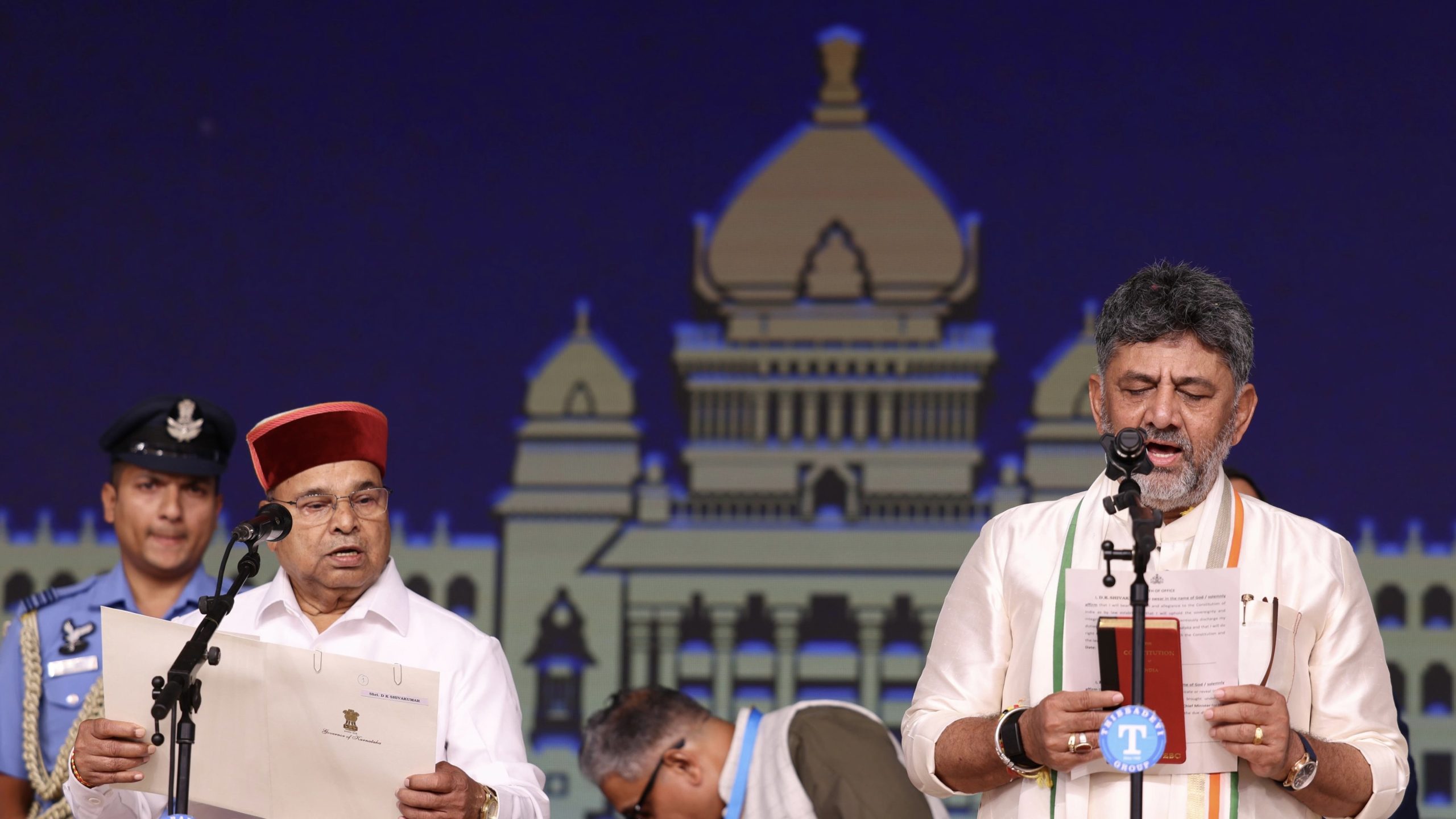
DK Shivakumar is administered the oath of office by the Governor.

Synopsis: DK Shivakumar was sworn in as the chief minister of Karnataka on Wednesday. Besides Shivakumar, 13 others took the oath as ministers. The Cabinet is likely to expanded soon to fill the vacant berths.
Senior Congress leader DK Shivakumar was sworn in as the chief minister of Karnataka on Wednesday, 3 June.
Governor Thaawarchand Gehlot administered the oath of office and secrecy to Shivakumar at the Lok Bhavan. Besides Shivakumar, 13 others took the oath as ministers.
G Parameshwara, KJ George, MB Patil, Satish Jarkiholi, Krishna Byre Gowda, UT Khader, Ramalinga Reddy, Priyank Kharge, Yathindra Siddaramaiah, Sharan Prakash Patil, Byarthi Suresh, KH Muniyappa and Eshwar Chandre were the ministers who were sworn in on Wednesday.
Shivakumar succeeds Siddaramaiah as the 18th chief minister and will be in office till May 2028. Siddaramaiah’s MLC son, Yathindra Siddaramaiah, was among the ministers who took charge on Wednesday.
The Cabinet under Shivakumar is likely to undergo an expansion in the coming days to fill in the remaining berths. The Cabinet has a sanctioned strength of 34 ministers.
Earlier, the AICC cleared the names of 13 ministers who assumed charge along with Shivakumar.
Parameshwara met and held discussions with Shivakumar at the latter’s residence on Wednesday morning. He will hold the office of the deputy chief minister in the new Cabinet, succeeding Shivakumar.
Earlier in the day, Shivakumar presented to Governor a list of ministers to be administered the oath on Wednesday.
Top Congress leaders Mallikarjun Kharge, Rahul Gandhi, KC Venugopal and Randeep Singh Surjewala were among the dignitaries who attended the swearing-in ceremony.
Also Read: Polls to four Rajya Sabha seats from Karnataka on 18 June
Shivakumar was born on 15 May 1962 in Dodda Alahalli, near Kanakapura in present-day Bengaluru South district, to a Vokkaliga family, the dominant landed community of the Old Mysore region and one of Karnataka’s two largest caste groups.
He spent his formative years attending the Rashtriya Swayamsevak Sangh’s Vittal Shakha in Rajajinagar. He holds a Master of Arts degree in Political Science from Karnataka State Open University, Mysuru (2006). He has 19 criminal cases pending against him.
After failing to secure a student election ticket from the National Students’ Union of India, he contested his first election in 1985 from the Sathanur Assembly constituency against former Prime Minister HD Deve Gowda—then a cabinet minister in the ruling Janata Party–and lost.
Four years later, in 1989, he tried again and won. Known as the “Kanakapura Bande” (Rock of Kanakapura), Shivakumar has earned the moniker by never losing an Assembly election since 1989.
He represented Sathanur continuously until 2008, when he shifted to the Kanakapura constituency. He has held the seat ever since.
During his second term as an MLA, he was appointed Minister of Prisons and Home Guards. In 1999, under Chief Minister SM Krishna, he was given the Urban Development portfolio.
Between 2008 and 2010, he served as working president of the Karnataka Pradesh Congress Committee (KPCC) under RV Deshpande.
After the Congress returned to power under Siddaramaiah in 2013, Shivakumar was entrusted with the Energy portfolio. In the Congress-JD(S) coalition government between 2018 and 2019, he served as minister for major irrigation and medical education.
In July 2020, Shivakumar was appointed president of the KPCC, replacing Dinesh Gundu Rao.
Together with Siddaramaiah, he led the Congress campaign in the 2023 Assembly election, securing a thumping majority and returning the party to power.
Following the victory, prolonged negotiations were held amid an internal tussle between Siddaramaiah and Shivakumar over the chief minister’s post. Eventually, Siddaramaiah became chief minister, while Shivakumar was appointed deputy chief minister and given responsibility for Bengaluru’s development.
But ever since, murmurs of a power-sharing arrangement between the two leaders have never ceased. Despite feverish speculation in late 2025 about a “November revolution”, Siddaramaiah was allowed to complete three years as chief minister.
Also Read: Shivakumar’s elevation forces BJP and JD(S) to rethink strategies
Shivakumar is among India’s wealthiest politicians. According to his election affidavits, his declared assets increased from about ₹251 crore in the 2013 Karnataka Assembly election to about ₹840 crore in 2018 and approximately ₹1,413 crore in 2023.
Despite limiting himself electorally to Karnataka, Shivakumar has distinguished himself as one of the Congress’s most trusted troubleshooters.
For more than two decades, he has been the go-to man for the party high command in efforts to protect Congress governments and legislators from defections and horse-trading.
He played a key role in safeguarding Congress legislators during political crises in several states, including Maharashtra in 2002 and Gujarat in 2017. A resort associated with him in Bidadi, in Bengaluru South district, has frequently served as a safe haven for legislators during periods of political uncertainty.
His reputation as a troubleshooter was cemented after the 2018 Karnataka Assembly election produced a hung verdict.
The BJP emerged as the single largest party and Governor Vajubhai Vala invited BS Yediyurappa to form the government, despite the Congress-JD(S) striking a post-poll alliance to arrive at a majority. Shivakumar worked to keep the Congress-JD(S) alliance intact and prevent defections to the BJP.
The BJP government collapsed within two days, paving the way for the Congress-JD(S) coalition to form the government. While the coalition government eventually fell in 2019, his standing within the Congress was significantly enhanced.
In 2017, the Income Tax Department conducted searches at more than 60 locations associated with Shivakumar and his associates in Karnataka and New Delhi.
The raids took place while 44 Congress MLAs from Gujarat were staying at the Bidadi resort to prevent poaching ahead of a crucial Rajya Sabha election in which senior Congress leader Ahmed Patel was contesting.
The IT Department said it had detected undisclosed income and seized cash and documents during the operation.
In September 2018, the Enforcement Directorate registered a money-laundering case against Shivakumar based on material arising from the Income Tax investigation.
The same month, the agency arrested him in New Delhi after multiple rounds of questioning. He spent nearly 50 days in Delhi’s Tihar Jail before being granted bail by the Delhi High Court.



