

Published Aug 01, 2026 | 11:00 AM ⚊ Updated Aug 01, 2026 | 1:10 PM

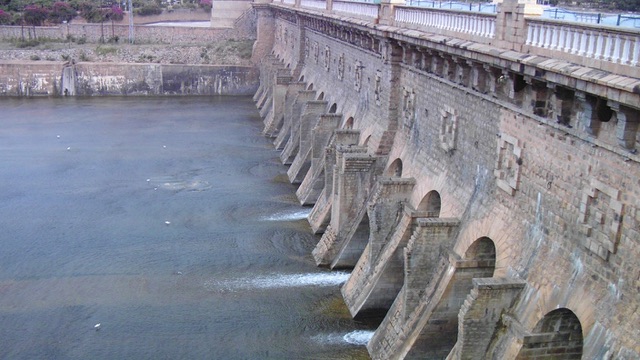
The Krishna Raja Sagara dam on the river Cauvery.

Synopsis: The Cauvery Water Management Authority has directed Karnataka to release 3,500 cusecs of Cauvery water a day to Tamil Nadu for 15 days. While the State has enough water to comply with the order for now, weak monsoon rainfall and low reservoir levels have clouded the outlook for water availability over the rest of the season, complicating the State’s decision.
The Cauvery water-sharing dispute has returned to the centre of Karnataka politics after the Cauvery Water Management Authority (CWMA) on Thursday, 30 July, directed the State to release 3,500 cusecs of water a day to Tamil Nadu for 15 days starting 29 July.
The authority rejected Karnataka’s plea to withhold the Cauvery Water Regulation Committee (CWRC) order. The directive comes as Karnataka grapples with a weak southwest monsoon, prompting concerns over drinking water supply, irrigation requirements and reservoir levels.
While the State has enough water in storage to technically comply with the order, officials and experts say the challenge lies in balancing immediate demands with uncertainty over the rest of the monsoon season.
The order, meanwhile, has triggered protests across Karnataka, with appeals to Chief Minister DK Shivakumar to refuse the release of water. The Chief Minister has, in turn, convened an all-party meeting on 2 August to discuss the State’s response to the CWMA directive.
Tamil Nadu Chief Minister Joseph Vijay had been expected to meet Shivakumar in Bengaluru on 3 August to discuss the issue. However, after pro-Kannada organisations called for a bandh on 13 August over the issue, Shivakumar urged Vijay to defer the meeting until the atmosphere is more conducive.
Also Read: Western Ghats draft ESA map returns after 13 years with new boundaries, old questions
As of 31 July, Karnataka’s four major Cauvery basin reservoirs—Krishna Raja Sagar (KRS), Kabini, Hemavathy and Harangi—together held 63.23 thousand million cubic feet (TMC) of water against a combined capacity of 114.57 TMC, or 55.2 percent of total storage, according to data from the Karnataka Water Resources Information System (KWRIS).
The CWMA order would require Karnataka to release about 4.54 TMC over 15 days, equivalent to roughly 7 percent of the water currently stored across the four reservoirs.
Among the reservoirs, KRS remains the principal concern. It is 34.5 percent full, holding 17.04 TMC against its full capacity of 49.4 TMC. On 31 July, inflows stood at 2,552 cusecs, only marginally higher than the 1,745 cusecs being released.
Hemavathy, the second-largest reservoir, is at 64 percent of capacity, storing 23.75 TMC, with inflows of 6,390 cusecs and an outflow of 500 cusecs.
Kabini is 73.9 percent full, storing 14.43 TMC, while Harangi is at 94.2 percent of capacity with 8.01 TMC in storage. However, combined storage across the four reservoirs is about 42 percent lower than on the corresponding date last year, when they held nearly 108.7 TMC, according to KWRIS data.
Also Read: Dharmasthala mass burial case: DNA matches skeletal remains to three men missing from 2013 to 2024
Officials said Karnataka’s concern is not the immediate availability of water, but whether current reservoir storage will be sufficient to meet drinking water and irrigation requirements if the southwest monsoon remains weaker than normal.
The Cauvery reservoirs are the primary source of drinking water for Bengaluru, Mysuru and Mandya, besides supporting irrigation during the ongoing kharif season.
At the same time, the State is facing a significant rainfall deficit.
According to the India Meteorological Department (IMD), Karnataka has recorded an overall rainfall deficit of 27 percent, while South Interior Karnataka, which includes much of the Cauvery catchment, has received 35 percent below-normal rainfall.
With reservoir levels well below those of last year and uncertainty over future rainfall, releasing additional water now could reduce the State’s buffer if monsoon conditions do not improve.
Although rainfall is expected over the next two days in the Malnad and coastal regions, forecasts indicate that rainfall activity will weaken again during the following week.
“The monsoon current has weakened due to El Nino conditions. There is insufficient moisture availability and inadequate wind convergence, especially over South Karnataka, limiting rainfall activity,” said Puviarasan M, Head of IMD Bengaluru.
The rainfall outlook is expected to be central to Karnataka’s case if it seeks a review of the CWMA order.
(Edited by Dese Gowda)



