

Published Nov 28, 2026 | 8:21 PM ⚊ Updated Nov 28, 2026 | 8:21 PM

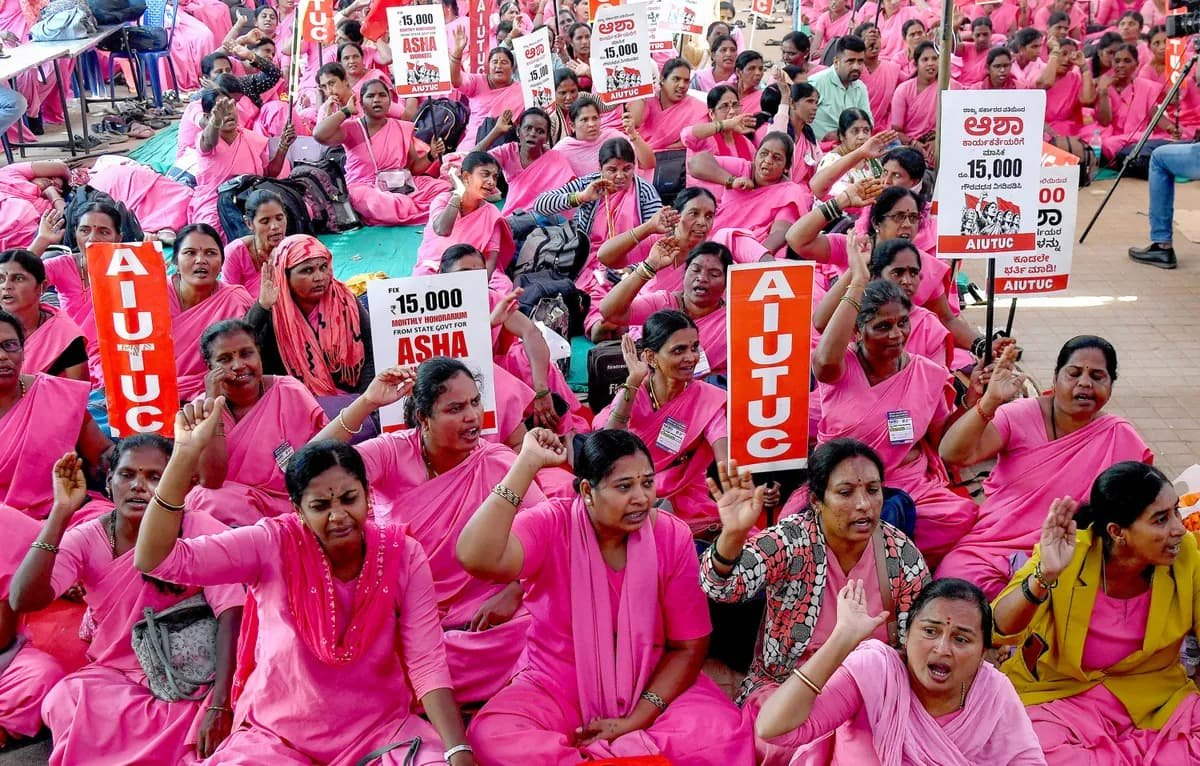
Since 2005, when ASHA workers were introduced under the National Rural Health Mission, their role has evolved into a cornerstone of public health.

Synopsis: After 12 days of protests at Bengaluru’s Freedom Park, ASHA workers have secured a Rs 2,000 hike in their monthly remuneration following negotiations with the Karnataka government. The victory, which takes their total monthly payments to Rs 10,000, including the existing central share, is a significant outcome of their sustained agitation, even as it falls short of their demand for a fixed Rs 15,000 honorarium.
After 12 days of protests at Bengaluru’s Freedom Park, Chief Minister D.K. Shivakumar on Saturday announced a hike of Rs 2,000 in the monthly remuneration of ASHA workers, bringing their agitation to an end.
The hike will take effect from January 1, 2027, increasing the ASHA workers’ fixed monthly remuneration to Rs 10,000, including the Centre’s contribution and the state’s existing incentive. Performance-linked payments will remain additional and vary according to the work completed.
The hike, however, remains below their demand for a fixed monthly honorarium of Rs 15,000.
The government initially resisted giving the workers a written assurance. After ten days of protests at Freedom Park, Shivakumar on November 26, acknowledged that the workers’ demand was justified but stopped short of committing to a timeline or giving them a written assurance.
“I appeal to the ASHA workers. Thinking that you can succeed by blackmailing the government is not possible. No one can succeed by blackmailing any government,” he told reporters, ruling out a written assurance to increase honorariums. “Whom should I give a written assurance to? If we start doing things this way, it will become a practice across the state?” he said.
He also questioned why the workers were not seeking a written assurance from the Centre, which appoints them. The CM asked the workers to press the Union government to increase its contribution to their honorarium.
On the same day, Health Minister UT Khader’s remarks that Karnataka’s healthcare system could function effectively without ASHA workers drew criticism from the protesters. The workers questioned how the government could acknowledge their expanding responsibilities while suggesting that the health system did not need them.
On Saturday, Khader held negotiations with a delegation of ASHA workers and said the government had agreed to increase their monthly remuneration by Rs 2,000. The delegation initially pressed for a higher amount, with the additional demand for a Rs 1,000 incentive also remaining under discussion.
Following further talks with the Chief Minister, the government announced the Rs 2,000 hike, to take effect from January 1, 2027. The workers accepted the increase and called off their 12-day agitation.
The announcement brings the protest to an end, but the larger question raised by the workers remains: whether an honorarium can adequately compensate women whose work has expanded far beyond the part-time community service originally envisaged.
Also Read: The ‘last mile’ has a human cost: Why Karnataka’s ASHAs deserve more than volunteer status
Since 2005, when ASHA workers were introduced under the National Rural Health Mission, their role has evolved into a cornerstone of public health.
The ASHA worker was initially conceived as a community volunteer, a bridge between medical professionals and rural populations. The role itself was meant to supplement regular employment, requiring at most two to three hours of work a day.
Over the years, their responsibilities have grown exponentially, with nearly 40 nationally approved tasks now forming part of their work, as the National Health Mission’s 2019 document, ‘An Update on ASHA Programme’, notes.
Manjula, an ASHA worker from Kalaburagi district told South Frist, “Every time there is a need for some kind of survey, we are involved. The quantum of work is so much that we are on our feet on a daily basis.”
There is no concept of days off either.
“If there is a delivery or any kind of check-up, we have to accompany the woman; if there is an emergency, we cannot decline,” she said.
For instance, with the introduction of non-communicable disease services at the primary healthcare level in 2017, ASHA workers took on the responsibility of enumerating populations, assessing NCD risks among people above 30 years and mobilising communities for screening for hypertension, diabetes and common cancers.
Following the pandemic, and particularly with the introduction of app-based reporting, ASHA workers said they are working up to seven to ten hours every day.
The workers’ demand for a fixed monthly honorarium of Rs 15,000 raises questions about why their remuneration remains below the minimum wage prescribed for unskilled workers in Karnataka.
In May 2026, Karnataka revised minimum wages across 81 scheduled employments, fixing the monthly minimum wage for unskilled workers at Rs 23,376 in Zone 1, which includes Greater Bengaluru, and Rs 19,319 in Zone 3, covering rural areas and smaller towns. The Rs 15,000 demanded by ASHA workers falls considerably short of these rates.
The distinction lies in how ASHA workers are classified. They are treated as community health activists and paid an honorarium rather than being recognised as regular employees. This classification raises questions about whether workers who put in seven to ten hours a day, perform nearly 40 nationally approved tasks and remain available during emergencies should continue to be treated as volunteers.
The minimum-wage notification does not automatically extend to ASHA workers, given their classification. However, the comparison highlights the disparity between the work they perform and the compensation they receive.
Also Read: ‘Professional’ cheating operation: Inside the alleged KPSC Veterinary Officers’ recruitment scam
The question of remuneration has been at the centre of repeated protests by ASHA workers in Karnataka.
In January 2025, following an indefinite agitation at Freedom Park, then Chief Minister Siddaramaiah assured them of a fixed monthly honorarium of Rs 10,000 from April 2025. The workers called off their protest following the announcement.
However, the workers say the assurance was not fully implemented. They also pointed to a Rs 1,000 increase announced in the state Budget, which they said had not been extended to them.
The issue resurfaced in subsequent protests, with workers demanding a fixed monthly honorarium of Rs 15,000, clearance of pending incentives and better retirement benefits. They have also raised concerns about delays in payments, including central incentives and the state honorarium.
Their grievances extend beyond remuneration. They are seeking retirement benefits of Rs 5 lakh, clearance of pending lump-sum payments to retired workers and better medical and accident-related support.
The growing burden of digital reporting has also emerged as a major concern. ASHA workers are required to upload information through applications such as Samasta, in addition to maintaining physical records. They say this adds to their workload without adequate support for mobile phones, internet access or data expenses.
(Edited by Fayisa CA)



