

Published Nov 28, 2026 | 9:30 AM ⚊ Updated Nov 28, 2026 | 9:30 AM

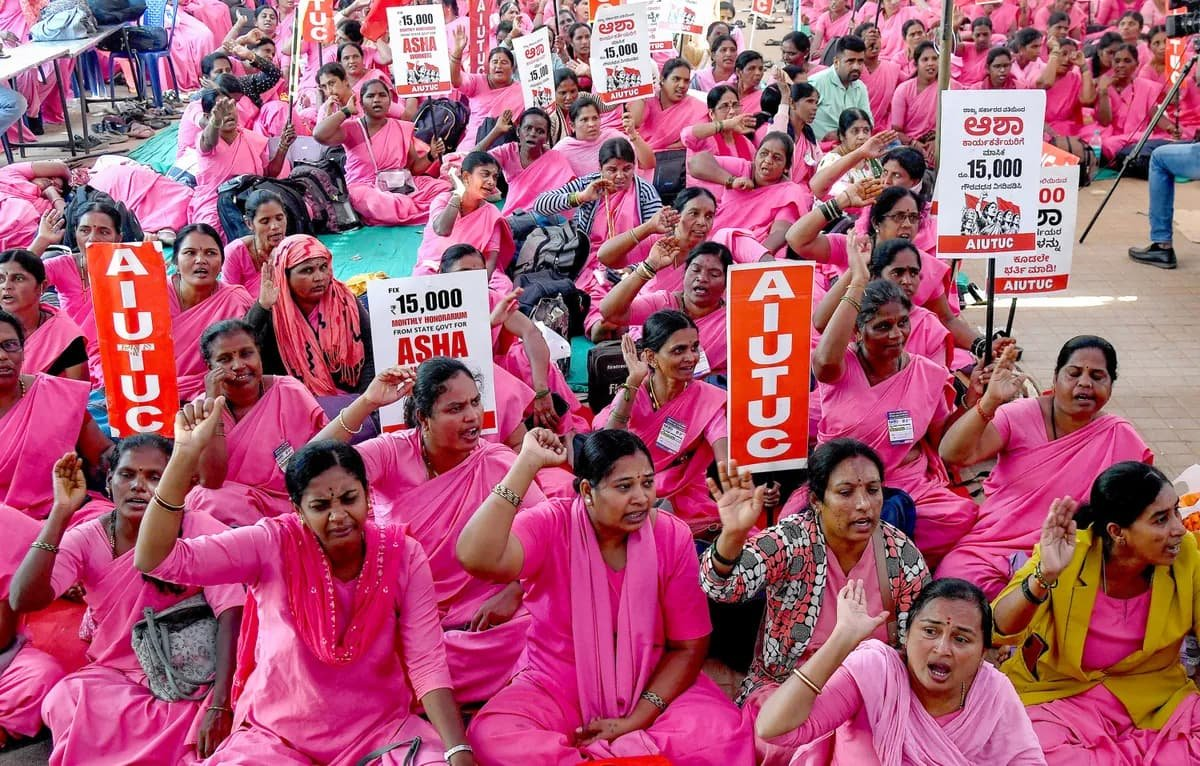
Karnataka has almost 42,000 ASHAs in Karnataka, each catering to 250 to 300 families.

The “last mile” in India’s public health system is where a scheme turns into a clinic visit, an immunisation schedule turns into a completed card, and prevention turns into a conversation at the doorstep. The final mile is not a figment of imagination, however. It is walked daily by women who are paid poorly, despite the vital importance of their work.
Many of these Accredited Social Health Activists (ASHAs) have been camping at Bengaluru’s Freedom Park since November 17, protesting for a fixed monthly stipend of ₹15,000, pending incentives and improved retirement benefits.
The protest did not end after talks were held with Health Minister UT Khader. Nor were the workers persuaded by the appeal of Chief Minister DK Shivakumar, who, through a video call from Japan on November 24, sought time to discuss their demands with the Finance Department during the coming Assembly session. The workers are instead asking for a written guarantee.
This clearly reflects their lack of trust in the very institutions that are expected to stand by them.
Karnataka has almost 42,000 ASHAs in Karnataka, each catering to 250 to 300 families and undertaking dozens of health initiatives under the National Health Mission. They receive a fixed payment of ₹5,000 per month from the state, as well as incentives based on their performance.
The minimum wages for different categories of labour are set by the state’s own Labour Department, ranging from ₹19,319 to ₹23,376 per month. According to ASHAs, in neighbouring Kerala, the honorarium is ₹12,000 and in West Bengal, ₹11,250.
This is the same issue that was raised during a previous protest.
In January 2025, the ASHAs called off a planned four-day strike after then Chief Minister Siddaramaiah announced that their fixed honorarium would be raised to ₹10,000 per month from April.
Having called off an earlier agitation on the basis of a promise, the workers say they are unwilling to repeat that mistake.
The definition of their role is another key factor. ASHAs were introduced under the National Health Mission as community volunteers who are paid fixed amounts and activity-based incentives to engage with communities in areas where health services are not available. However, their tasks have expanded considerably.
ASHAs assist families in disease surveillance and link them to government clinics; they push for institutional deliveries and immunisation; they make home visits for maternal and child health. It is not just a transfer of information. The work involves building trust, maintaining multiple contacts and assisting households in addressing social and economic obstacles to care.
This requires considerable time, mobility, availability and accountability. However, the framework still does not consider it employment. The state is looking for continuity and responsibility without the protections that usually go hand in hand with them. If the labour is regular, measurable and part of the service, the “volunteer” designation is difficult to justify.
The Samasta application, launched in August 2026 in Karnataka, has been a cause of concern for workers, who see it as administrative work being thrust on them.
Technological platforms play a key role in India’s health vision and, in theory, are effective tools for tracking, monitoring and reporting. However, the challenges of digitisation do not necessarily translate into improved working conditions.
ASHAs need to upload records of household health, maternal and child health, and immunisation to the app, while also maintaining physical registers.
They complain about technical problems, lack of training, and phone and internet expenses that they have to cover personally. Several incentives rely on the successful uploading of data; without it, workers may be ineligible to receive payment for work completed.
Visiting households and gathering data, then entering it into an app, troubleshooting errors and maintaining parallel paper records have not decreased a worker’s workload, but rather increased it. When devices, connectivity and technical support are lacking, the worker has to bear the cost of digital governance.
The effectiveness of digital health systems should be measured not by the amount of information collected, but by the value it adds to healthcare delivery. Before undertaking a new reporting duty, its time, cost and infrastructure requirements need to be assessed.
India is not alone in grappling with the challenge of sustaining a community health workforce.
The Family Health Strategy in Brazil has been built on linking households to primary care through the work of Community Health Agents.
The duties of these health agents were enshrined in law by Law 11,350 of October 5, 2006. This was given a further boost by the Constitutional Amendment of May 5, 2022. This Amendment guaranteed them at least two minimum wages, which currently amount to R$2,424 per month (₹38,491 as of November 26). The Union was made a guarantor, while additional pension benefits and an allowance for unhealthy working conditions were included.
India does not need to replicate Brazil’s wage structure. The lesson to draw is that Brazil transitioned from using these workers as an arm of government programmes to acknowledging their place in the formal health system.
Implementation has not been smooth, and deputies were still pleading for adherence months after the amendment was passed. But the concept is straightforward. There is no conflict between community roots and professional recognition.
Thailand’s Village Health Volunteer programme offers another example.
It is still an official volunteer force of more than one million members who are trained and connected to local primary care systems. They receive a monthly allowance of 2,000 baht, which was doubled to 4,000 baht (almost ₹11,000) by the Cabinet in 2023 because of an increased workload. The amount is small, and even the Thai authorities have called the rewards obtained by the volunteers ‘meagre’. Even in countries that continue to maintain volunteerism, the state recognises that consistent support needs to be increased in line with its expanding responsibilities.
All these examples point to the fact that it is not a question of choosing between participating in the community and being recognised as a professional. It is about creating a structure that enables health workers to remain in their communities, be paid fairly, and receive proper training and protection.
An increased honorarium will only help ease the current protest, but will not address the flaws that are driving ASHAs back onto the streets. Meaningful reform would involve:
The reliability of the system
The demands of the women at Freedom Park amount to more than just ₹15,000 per month. They are testing the assumptions underpinning India’s last-mile system. There is no way a public health system can count on the “goodwill” and economic sacrifice of these women forever to provide the critical services they are expected to deliver.
Recognising their role by fairly rewarding their vital service is an investment in the credibility of public healthcare.
Also Read:
Ground Report: ASHAs in Kerala deserve dignity, not to be caught in political crossfire
(Edited by R Rajesh Kumar.)



