

Published Nov 26, 2026 | 8:07 PM ⚊ Updated Nov 26, 2026 | 8:08 PM

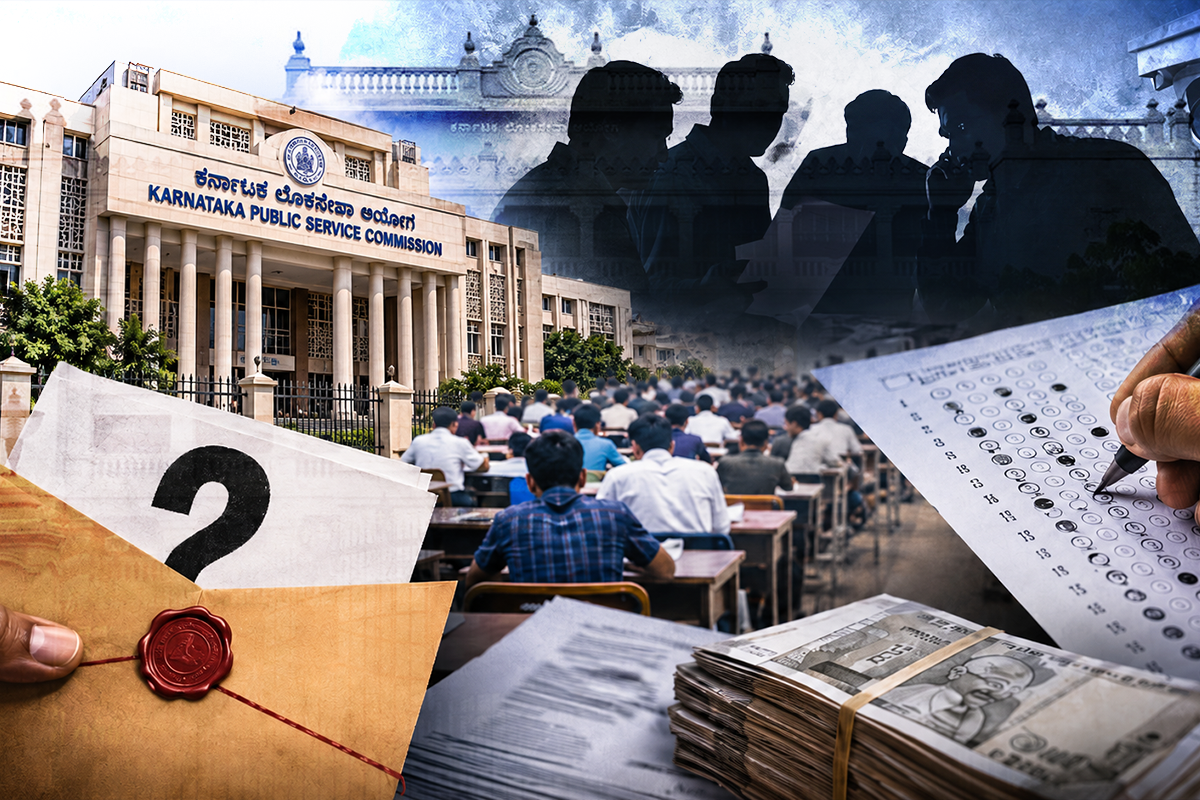
The ED's prosecution complaint claims the prime accused targeted gullible candidates identified through the eligibility list published in February.

Synopsis: A recruitment scam allegedly involving KPSC officials, Controller of Examinations and middlemen compromised the safeguards around the Veterinary Officers’ examination, with leaked question papers and answer keys used by 29 candidates. The ED alleges that Rs 4.1 crore was demanded in bribes, with advances collected from candidates and proceeds routed to mask the origin.
The controller of examinations for the Karnataka Public Service Commission (KPSC) uses a double-blind system to protect question papers and answer keys. Vetted subject experts prepare multiple sets under non-disclosure agreements, with the CoE randomly selecting the final version in CCTV-monitored strong rooms.
Papers are serialised and sealed in tamper-proof packaging before being transported under armed security to district treasuries. Packets are opened on schedule under live surveillance, in the presence of witnesses, with signal jammers in place. To the unacquainted, this system seems tamper-proof.
However, as the Enforcement Directorate’s prosecution complaint against former KPSC chairman Shivashankarappa Sahukar, former CoE Gyanendra Kumar Gangawar and KPSC member Geetha BV claims, those entrusted with protecting the integrity and confidentiality of the examinations were themselves allegedly instrumental in undermining them.
The ED’s prosecution complaint claims the prime accused targeted gullible candidates identified through the eligibility list published in February and offered leaked question papers and answer keys in return for money.
According to the ED, a total of 29 candidates were found to have used the leaked question papers and answer keys. In its complaint, the ED establishes how Sahukar, Gangawar and Geetha reached out to 16 candidates. According to evidence gathered by the central agency so far, Rs 4.1 crore was allegedly demanded as a bribe by the KPSC officials and their associates, out of which Rs 1.5 crore was collected from 12 candidates.
In February this year, the KPSC had published a 1:3 eligibility list for 400 Veterinary Officer posts. For each post, there were three shortlisted candidates. The list contained only the candidates’ names and registration numbers, without addresses or phone numbers. Yet, according to the complaint, middlemen were able to contact the eligible candidates.
The marks scored by each candidate in the preliminary rounds were known only to the officials. According to depositions to the ED, KPSC members exploited this confidential information, identified candidates who had scored lower marks and demanded bribes to help increase their chances of selection.
The targeted candidates met the qualifying cutoff for the final list but were at risk of missing out to higher-scoring applicants.
Over a week before the January exam, former chairman Sahukar allegedly noted down the registration numbers of six candidates. During a search at his home, the ED recovered a notebook containing KPSC registration numbers sorted by exam centre, though it remains unclear how he obtained the details.
According to the ED complaint accessed by the South First, a few days before the exam, Sahukar had video-called the then Controller of Examinations, Gangawar, seeking his help in the selection of these candidates. Three to four days later, a palm-sized chit with the registration numbers of the six candidates was allegedly carried by KPSC member Geetha to Gangawar.
The second round of recruitment exams involved two different subjects – general science and specific papers. The question booklets were divided into A, B, C and D for the General Science paper, and P, Q, R & S for the Specific Paper. Although the question papers were issued in four different series, the questions remained identical across all series, with only the sequence rearranged. This was to ensure that each student’s OMR would look different and a single answer key would not work.
A day before the exam, Gangawar used his access to candidate seating information to figure out which series the targeted candidates would get and then provided specific answer keys for 80 questions to Geetha, the ED alleged.
He also allegedly leaked the question paper to his associate Basavaraj Kannale, who used his network to target 10 more candidates who had scored lower marks in the screening exams.
One such candidate, approached by an associate of Kannale a week before the exam, said in the deposition, “(They)…convinced me that it was my last chance as there was no information on when they would notify the next exam… this exam was called after 8 years. They told me, ‘Almost all your friends have booked their seats; you will feel jealous after their selection. In KPSC, without giving a bribe, selection is very difficult. ‘
Candidates who had paid an “advance” towards the bribe were picked up by Kannale’s associates in white cars, on the night before the examination, and taken to Orchid Nirvana, a villa complex near the airport.
There, they were given two sets of printed, bilingual question papers with the correct answers marked in pen and asked to practise and memorise them, while Kannale’s aides kept watch.
The candidates were instructed not to ask one another’s names, speak among themselves or disclose the location to anyone. They were also warned against discussing the paper leak and told to pay the balance of the bribe after securing appointments, as the money had to be passed on to senior KPSC officials, according to the ED.
Kannale also allegedly arranged cars for the candidates to be escorted to the exam halls the next morning.
The revision of the answer key following the leaks helped the ED identify several other candidates who had used the leaked question papers. Because the initial key contained errors, investigators found that certain candidates had marked the same incorrect answers in a pattern consistent with the unrevised key, indicating they had accessed and relied on the leaked material.
Kannale also allegedly helped Gangawar process the proceeds of the crime. Having demanded Rs 3.5 crore, he collected Rs 1.2 crore as an advance from the 10 candidates.
The proceeds from the alleged scam were routed through a cooperative society in Bhalki, Bidar, before being diverted to other accounts and used for purchasing jewellery worth Rs 52 lakh for Gangawar’s fiancée.
According to the prosecution complaint, Om Laxmi Souharda Sahakari Sangha Niyamita, a cooperative society, on the instructions of accused Kannale, received Rs 70 lakh from the bank accounts of candidates’ family members between January and February 2026.
Omkar, the vice-president of the bank, allegedly concealed the source of these funds by routing them through fictitious savings accounts maintained in the names of individuals in the society’s books.
The remaining two in the trio, Sahukar and Geetha, allegedly demanded Rs 60 lakh from each candidate and had received half of that as advance.
While bribes paid by two of the six candidates have been established, the ED said Sahukar and Geetha did not disclose how much they received from the remaining four, despite being confronted with material evidence during questioning. Based on evidence gathered so far, the agency estimates the duo collected around Rs 1.8 crore from the six candidates, with beneficiaries of the question paper and answer key leaks paying an average of Rs 30 lakh each.
Sahukar had told investigators that his earnings came from his KPSC salary and agricultural income. However, the agency noted that the Rs 3.99 crore in cash transactions he handled was disproportionate to his known sources of income, linking the funds to illegal gratification in KPSC recruitments.
The ED also recovered bank deposit slips from Sahukar’s KPSC office showing cash deposits of Rs 6.75 lakh and Rs 10.86 lakh into the accounts of BV Geetha Shivamurthy and her daughter, Sheethal Patil, respectively, between February 2022 and June 2023.
Geetha alleged these were hand loans provided by Sahukar when she was facing financial difficulties after her daughter had joined a medical course, which she dropped out of. Geetha claimed she was unaware that the deposits were made in cash.
The agency also traced Rs 1 crore transferred to Geetha and her daughter through the bank accounts of the family of KPSC member H S Narendra.
The ED also examined plans for a school, a convention or wedding hall with at least 30 rooms, a restaurant and shops on about seven acres of Sahukar’s land in Madraki, Shahpur, in Yadgir district. The project’s estimated cost was Rs 10 crore to Rs 13 crore.
The money trail, however, remains incomplete. The exact amount and its further trail remain under investigation.
(Edited by Fayisa CA)



