

Published Nov 03, 2026 | 7:30 AM ⚊ Updated Nov 03, 2026 | 7:30 AM

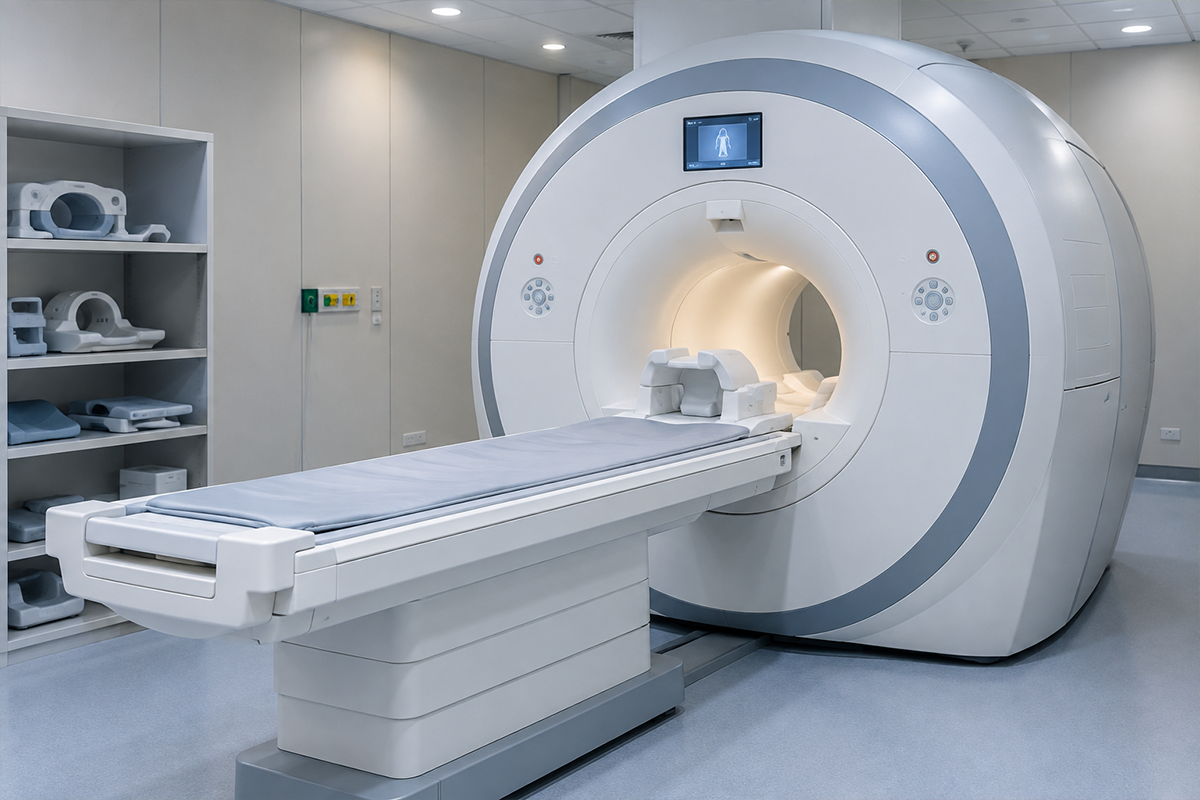
Telangana runs nine government MRI machines for a population projected at 3.87 crore, and 29 of the state’s 33 districts have none.

Synopsis: Telangana plans to expand free MRI services across government general hospitals through a PPP model, beginning with Mahabubnagar GGH. The move comes as 29 of the state’s 33 districts lack government MRI machines. Officials estimate the model could reduce expenditure by 20%, with statewide coverage targeted within two years.
Telangana plans to expand MRI services in government hospitals through a Public-Private Partnership (PPP) model, beginning with a pilot project at the Government General Hospital (GGH) in Mahabubnagar. The move comes at a time when 29 of the state’s 33 districts have no government MRI machine, leaving patients in most districts dependent on private diagnostic centres or requiring them to travel elsewhere for scans.
Health Minister Damodar Raja Narasimha directed officials to implement the model across the state, while assuring that MRI scans would remain free for patients referred by doctors in government hospitals.
“Even under the PPP model, MRI scans will remain completely free of charge for patients visiting government hospitals,” the minister said, according to a Health Department statement issued on 31 October.
The announcement follows a Legislative Council disclosure in September that Telangana had only nine government MRI machines across eight institutions, concentrated in four districts i.e., only 1 government MRI machine per 43 lakh people.
Hyderabad accounted for six machines, while Warangal, Adilabad and Jayashankar Bhupalpally had one each.
The remaining 29 districts, including Mahabubnagar, Nizamabad, Nalgonda, Karimnagar and Khammam, had no government MRI facility.
Also Read: Cancer drug price cuts average 50.8%, but reduction is just 13.8%, say access groups
At a review meeting with senior Health Department officials at the Telangana Medical Services and Infrastructure Development Corporation (TGMSIDC) office in Koti on Friday, 31 October, the minister examined the findings of a study conducted by a team of doctors and officials who had visited other states to understand their MRI service models.
The team studied PPP arrangements, including those implemented in Tamil Nadu, before submitting its recommendations to the government.
Officials told the minister that adopting the model would reduce government expenditure by approximately 20% compared with the existing system.
They said the arrangement would also address recurring problems associated with the procurement, operation and maintenance of MRI machines.
“This approach would not only resolve existing challenges in maintaining MRI machines but also ensure uninterrupted service for patients,” officials told the minister.
Under the proposed arrangement, private partners will manage MRI services, while patients referred from government hospitals will continue to receive scans free of cost.
The minister directed officials to prepare agreements and operational guidelines to ensure service quality, regular maintenance of equipment and timely delivery of reports. He also instructed them to ensure that patients do not face disruptions because of technical problems.
The latest proposal comes after the government announced plans to procure nine advanced 3-Tesla MRI machines and eight additional CT scan machines.
In a Legislative Council reply on 10 September, Narasimha said the new MRI machines would be installed at Nizamabad, Siddipet, Suryapet, Nalgonda and Mahabubnagar, besides Niloufer Hospital in Hyderabad. Additional machines were also planned for Gandhi and Osmania hospitals to address increasing patient numbers.
If implemented, the procurement would double the existing government MRI capacity from nine to 18 machines.
However, the latest announcement does not clarify whether the earlier procurement plan will continue independently or whether the proposed PPP model will also cover those machines.
Mahabubnagar is particularly significant in this context. The district was among the locations identified for a new MRI machine in September, and its GGH has now been selected as the pilot site for the PPP initiative. The government has not specified whether the pilot will use the machine announced earlier or involve a separate arrangement.
Also Read: Girls in families that prefer sons have higher anaemia rates, but poverty and education matter too
The shortage of MRI facilities has also affected medical education.
South First reported in September that Government Medical College, Nizamabad, was conducting its postgraduate MD Radiodiagnosis programme without an MRI machine on its campus.
The college had entered into an arrangement with a nearby private diagnostic centre, Indur CT & MRI Centre, to provide students with practical exposure to MRI investigations. Students also accessed imaging cases through the Picture Archiving and Communication System (PACS).
The National Medical Commission’s MD Radiodiagnosis curriculum mandates a two-month MRI posting during the three-year postgraduate course. Students are expected to acquire practical skills in planning and performing MRI studies.
The arrangement at Nizamabad illustrated how gaps in public diagnostic infrastructure can extend beyond patient access to affect the practical training of postgraduate medical students.
The minister has directed officials to launch the pilot at Mahabubnagar GGH and assess its implementation before extending the model to other government general hospitals.
The government has set a two-year target for making MRI services available across all GGHs in Telangana.
During the review, Narasimha emphasised that advanced diagnostic facilities should be accessible to every patient visiting a government hospital.
“State-of-the-art medical diagnostic tests must be accessible to patients visiting government hospitals, ensuring that no one is denied these services due to financial constraints,” he said.
He further directed officials to ensure that private management did not compromise service standards.
“Special attention” should be paid to “the quality of services, the maintenance of equipment, and the prompt delivery of diagnostic reports,” the minister instructed.
(Edited by Fayisa CA)



