

Published Sep 11, 2026 | 12:22 PM ⚊ Updated Sep 11, 2026 | 12:26 PM

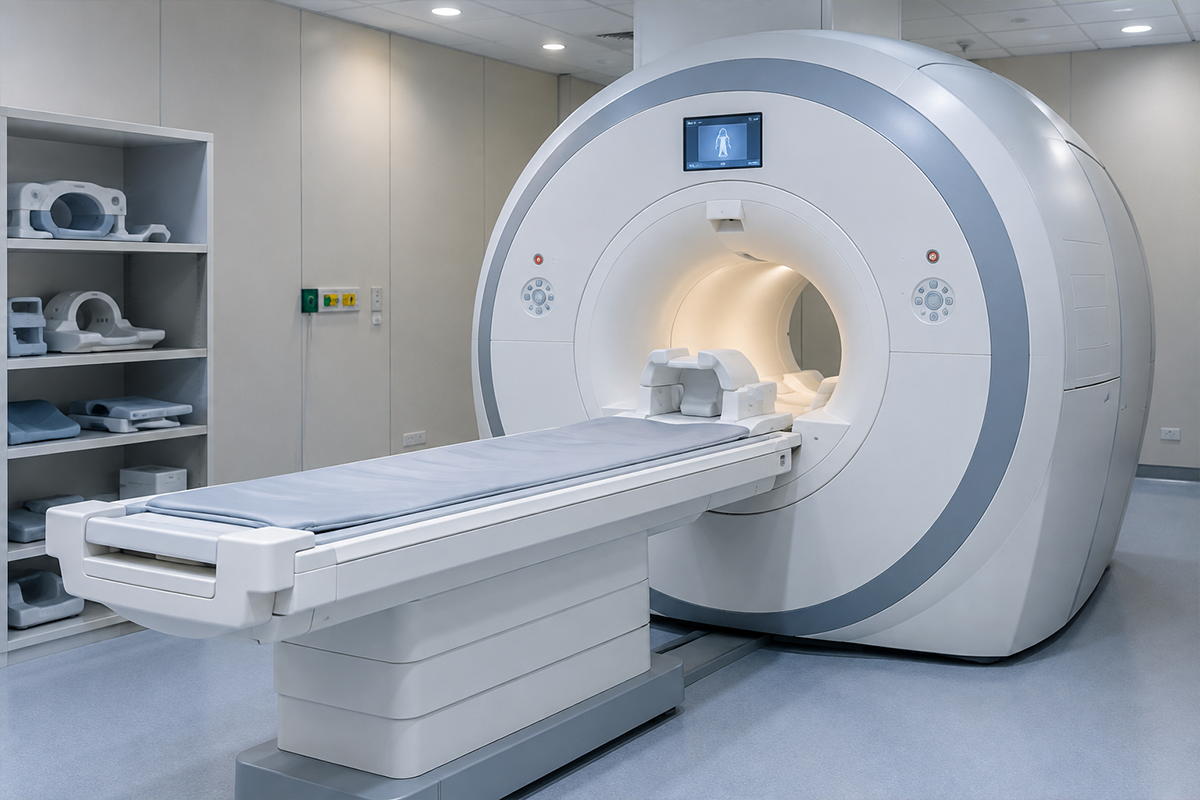
Telangana runs nine government MRI machines for a population projected at 3.87 crore, and 29 of the state’s 33 districts have none.

Synopsis: Telangana has just nine government MRI machines for a projected 3.87 crore population, leaving 29 of 33 districts without one. The government plans nine more MRI and eight CT machines, potentially doubling MRI capacity. But doctor shortages in several districts raise questions about staffing and operational capacity as diagnostic infrastructure expands.
Telangana runs nine government MRI machines for a population projected at 3.87 crore, and 29 of the state’s 33 districts have none, according to a Legislative Council answer given on 10 September.
The reply, given to a question by MLC S Vani Devi, sets out the status of diagnostic equipment across government hospitals as of August 31.
The state also runs 50 CT scan machines. The health department stated that no MRI or CT scan service stands suspended due to a shortage of technicians or radiologists.
The nine MRI machines sit across eight institutions, all located within four districts. Hyderabad holds five machines: two at NIMS, and one each at Osmania General Hospital, TIMS Sanathnagar and MNJ Hospital. Gandhi Hospital, Secunderabad, falls within Hyderabad district too, adding a sixth machine to the capital’s tally.
The remaining three machines sit one each at MGM Hospital, Warangal, RIMS Adilabad, and Government General Hospital, Jayashankar Bhupalpally.
Every other district, including Nizamabad, Khammam, Nalgonda, Karimnagar and Mahabubnagar, runs zero government MRI machines. A patient in any of these 29 districts needing an MRI must travel to another district or turn to a private centre.
Set against the Registrar General of India’s population projection of 3.87 crore for Telangana in 2026, the state runs one government MRI machine for roughly every 43 lakh people.
A resident of any of the 29 uncovered districts has zero access to a government MRI within their own district, regardless of what the state total shows.
CT scan machines reach further, present at 48 institutions across a larger number of districts. Most run 16-slice scanners, the entry-level tier of CT capacity.
Higher-end 128-slice and 64-slice machines cluster in Hyderabad, at Osmania, Gandhi Secunderabad, NIMS, TIMS Sanathnagar and MNJ Hospital.
Outside Hyderabad, every listed CT scanner runs at 16-slice capacity, including at large district hospitals such as GGH Nalgonda, GGH Khammam, GGH Karimnagar and RIMS Adilabad. Asifabad, a district flagged in earlier staffing data for carrying the state’s highest doctor vacancy rate at its medical college, does not appear anywhere in the CT scan list either.
Responding to questions in the Legislative Council, Health Minister Damodar Rajanarsimha said Telangana “is expanding MRI and CT scan services in government hospitals.” The government is installing nine new MRI machines and eight new CT scan machines, he said.
The new units carry upgraded specifications. The state is “procuring a total of nine advanced 3-Tesla MRI machines,” the minister said.
The minister named the districts set to receive new MRI machines: Nizamabad, Siddipet, Suryapet, Nalgonda and Mahabubnagar, along with Niloufer Hospital in Hyderabad. On the two Hyderabad hospitals already running above capacity, he said “the number of patients visiting Gandhi and Osmania hospitals has increased,” and additional MRI machines are being installed there to meet that load.
If installed as announced, the expansion would double government MRI capacity, from nine machines to 18. CT scan capacity would grow by 16%, from 50 to 58 machines.
The government is also procuring 485 ventilators to add to the existing 1,770 already installed across government hospitals, the minister said.
Several of the districts named for new MRI machines carry the state’s widest doctor vacancy gaps, based on staffing data placed before the Legislative Council in a separate answer on the same day.
Nizamabad’s secondary hospitals run a vacancy rate of 56.1%, the highest among Telangana’s 33 districts. Mahabubnagar’s teaching hospital carries a vacancy rate of 52.8%, among the six worst in the state. Nalgonda’s secondary hospitals run at a 30.7% vacancy.
Installing MRI machines in these districts extends diagnostic access to areas that currently have none. Whether the existing medical staff can operate and read the new machines, given the vacancy levels already recorded, remains a separate question the current data does not answer.
The minister said the government uses e-Upakaran, a “web-based equipment inventory and maintenance system,” to track equipment purchase, supply and repair. A Project Monitoring Unit at the Telangana Medical Services and Infrastructure Development Corporation audits equipment performance on a regular basis.
The government has appointed “more than 1,500 technicians on a regular basis over the past two and a half years,” the minister said, with further technicians engaged through contractual and outsourcing arrangements where required. The government is also appointing biomedical engineers to carry out repairs promptly.
Also Read:
Ageing India, faster-ageing Telangana: Opportunity or trouble?
Vitamin D2 and D3 have the same impact on bones – but not on muscle and heart, Hyderabad study finds



