

Published Sep 17, 2026 | 7:00 AM ⚊ Updated Sep 17, 2026 | 7:00 AM

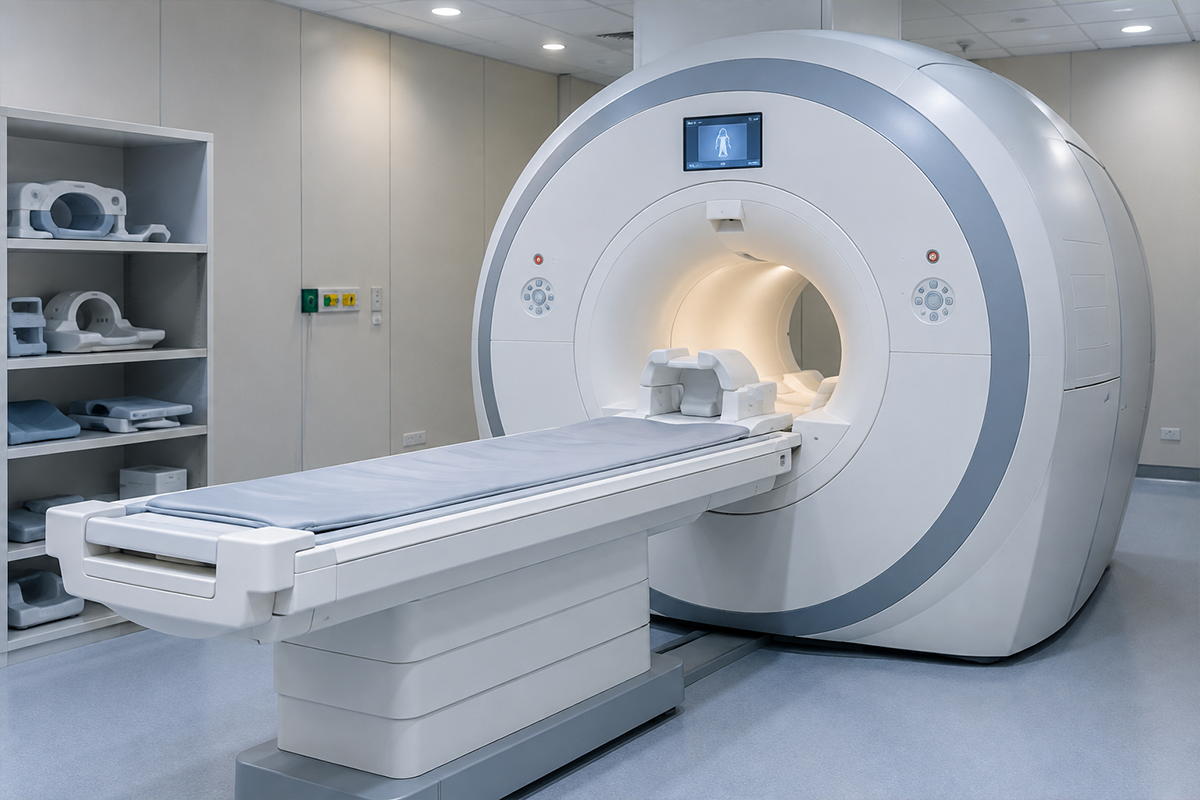
Telangana runs nine government MRI machines for a population projected at 3.87 crore, and 29 of the state’s 33 districts have none.

Synopsis: Government Medical College, Nizamabad, teaches MD Radiodiagnosis without an MRI machine on campus. Instead, the college has a tie-up with a private centre nearby for student training. State records show nine government MRI machines across Telangana, none in Nizamabad, though the health minister has announced a new machine for the district.
Government Medical College in Telangana’s Nizamabad trains postgraduate students in MD Radiodiagnosis without an MRI machine on its own campus, according to government records and a source at the college.
Telangana’s government hospitals run nine MRI machines in total, according to a Legislative Council answer given on 10 September. The reply lists the location of each machine as of 31 August. None sits at Nizamabad.
The nine machines span eight institutions across four districts. Hyderabad holds six, counting Gandhi Hospital in Secunderabad: two at NIMS, and one each at Osmania General Hospital, TIMS Sanathnagar, MNJ Hospital and Gandhi Hospital. The remaining three sit at MGM Hospital, Warangal, RIMS Adilabad, and Government General Hospital, Jayashankar Bhupalpally.
Twenty-nine of Telangana’s 33 districts run no government MRI machine. Nizamabad falls among them.
GMC Nizamabad carries a postgraduate intake of 73 seats across 15 disciplines, including MD Radiodiagnosis, according to government data on medical college PG intake in Telangana.
The National Medical Commission’s curriculum for MD Radiodiagnosis sets a mandatory two-month posting in MRI during the three-year course. The curriculum requires students to “plan and perform MRI studies of whole body” and lists MRI-related content across all four written examination papers.
Also Read: Cooking may keep ageing brains active, but new recipes matter more than routine work
Asked whether the Radiodiagnosis course can be taught without an MRI machine, a source at the college said no, and explained the alternative in place.
“We have a tie-up with another MRI centre, which is just opposite the college,” the source told South First. “The MRI machine will be installed in the college itself. The facility is being prepared. In the meanwhile, we have tied up with the centre for the MRI requirements.”
The facility is Indur CT & MRI Centre, the source said, naming it when asked directly.
Students travel there for practical exposure, and the arrangement extends beyond physical visits. “We also have PACS software,” the source said. “We get cases from there through the system,” describing a setup where the college draws imaging data from the centre digitally, alongside students attending in person.
The programme currently runs two active batches, admitted in 2024-25 and 2025-26. “We have two batches, one for 2024-25 and another for 2025-26,” the source said. “This year, we have a total of 10 students.”
Neither batch has reached its final examination. “We recently got the PG second-year batch,” the source confirmed.
MRI teaching begins early in the course, though theory and practical training follow different schedules. “We start from the beginning itself,” the source said of the theory component. The practical rotation, by contrast, comes later and runs for a fixed stretch: “It depends on the rotation. Usually, it is for one or two months,” with students attending the tie-up centre for that period.
Also Read: The flu is spreading. But why now? What is driving India’s latest surge
Responding to a separate question in the same Legislative Council session, Health Minister Damodar Rajanarsimha said Telangana “is expanding MRI and CT scan services in government hospitals.” The minister said the government is installing nine new MRI machines across government hospitals.
The minister named the districts set to receive new MRI machines: Nizamabad, Siddipet, Suryapet, Nalgonda and Mahabubnagar, along with Niloufer Hospital in Hyderabad. His statement names “Nizamabad Government General Hospital” as the recipient site.
No installation date was given.
The National Medical Commission’s guidelines describe the MRI rotation as part of a wider aim to make postgraduate students “fully competent to practise, teach and do research” in ultrasound, CT and MRI. The same guidelines state that “provision of skills laboratories in medical colleges is mandatory,” with training expected to move from models to supervised practice before independent work.
At GMC Nizamabad, the supervised practical component currently runs through a private facility rather than the teaching hospital’s own department, an arrangement that meets the rotation requirement on paper while placing part of a government-funded medical education programme inside a private diagnostic centre’s premises.



