

Published Jun 11, 2026 | 7:00 AM ⚊ Updated Jun 11, 2026 | 9:11 AM

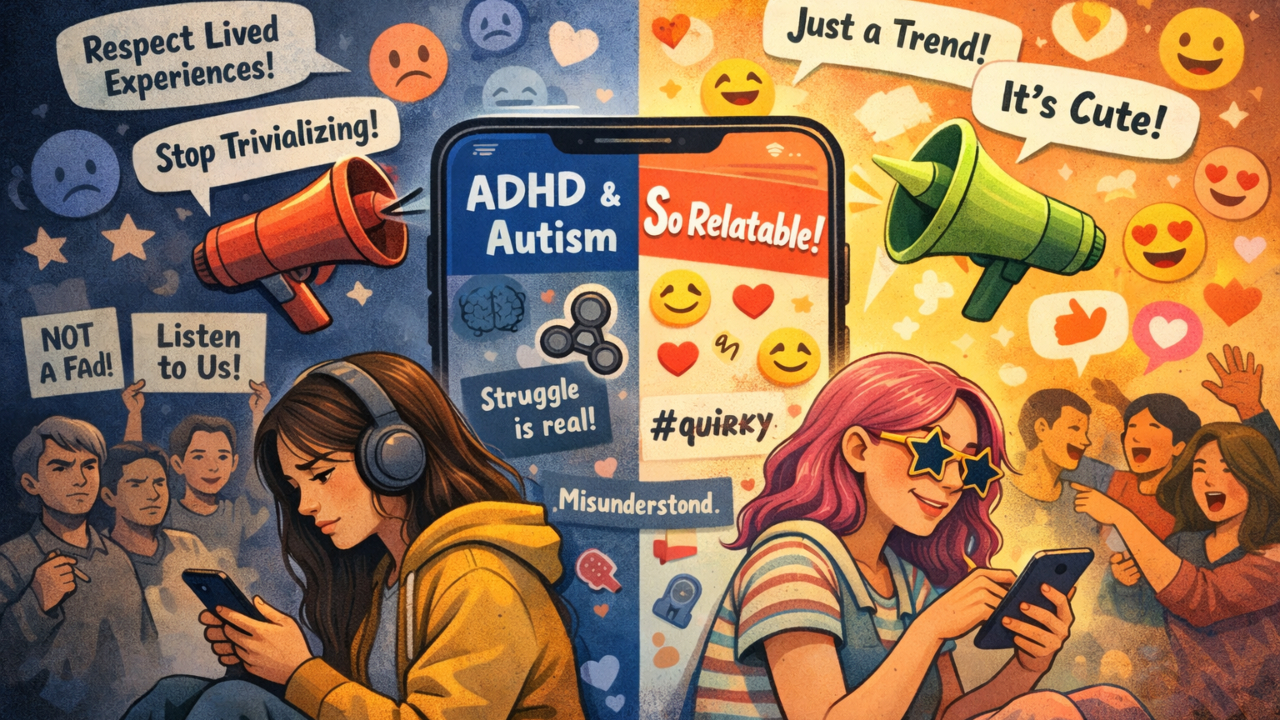
AI-generated representational image.

Synopsis: Social media has amplified awareness of neurodivergence, offering safe spaces for ADHD and autism communities. Yet advocacy is increasingly overshadowed by “quirky” trends that trivialise serious struggles. Experts warn oversimplification misrepresents lived realities, while youth note masking and misdiagnosis persist. Critics urge mindful engagement with authentic neurodivergent creators to avoid romanticisation and preserve genuine representation.
“There have been times where I’m just lying in bed and screaming in my head to get up, but I’m physically not able to get up or move. I know what I want to do and care about it. I have been wanting to do it for a while now. But my body just wouldn’t get started or co-operate,” says Srinidhi, a college-going student diagnosed with Attention Deficit Hyperactivity Disorder (ADHD).
“Before my diagnosis, I thought this was what everyone’s version of being lazy looked like,” she told South First.
Like Srinidhi, many neurodivergent individuals have been on the receiving end of these stereotypes and judgments. “Lazy,” “scatter-brained,” “awkward,” were only the few labels attached to many people growing up undiagnosed.
However, conversations around differing neurodevelopmental conditions have shed light on matters of such.
“Neurodivergence” is an umbrella term to describe individuals whose cognitive processing, sensory processing, social communication, and learning styles differ from what is considered “typical” by societal standards. It is the idea that people experience and interact with the world in different ways — there is no “right” way of thinking, learning or existing. More importantly, these differences are not deficits.
The neurodiversity movement, started in the 1990s, aimed to advocate for the inclusion of all people. One of the very first means of this advocacy was through social media — as it has been for many revolutions in history.
In recent years, neurodivergence has become more visible in mainstream media with the help of platforms like Instagram, X, and TikTok. Social media has provided a source of awareness and community by encouraging conversations around autism, ADHD, and specific learning disorders.
Through these online spaces, many neurodiverse individuals have found safe communities to share their personal experiences and achieve collective validation.
However, what was once a safe space has now become increasingly problematic — with neurodivergence becoming “trendy” in the last year. What started as advocacy is now teetering the edge of misrepresentation. It is now being repackaged as “cute” and “quirky,” in the form of viral 30-second reels that reduce complex neurodivergent experiences into bite-sized, digestible buzzwords.
Many individuals claim this trend “flattens” debilitating neurodivergent experiences. It has sparked debate from both virtual and physical neurodivergent communities, centering around one major question — does this really hold true to neurodivergent individuals and their experiences?
Also Read: Indians pay more for pink salt social media influencers promote, ignores cheaper, healthier products
Social media platforms have always been the place younger audiences go to for a sense of collective identity. From Facebook posts to Tumblr blogs, teenagers have always sought after these mediums to crowdsource coping mechanisms, find support groups, or simply to find a judgment-free space to connect over their shared experiences.
This slowly became a means of identity affirmation.
The post-pandemic era, however, has seen many changes, especially in online spaces and the way people interact with them.
“I believe the increased exposure just helps more people realise that they aren’t neurotypical. Especially for girls and women, who tend to be underdiagnosed compared to boys and men. They’re more likely to be diagnosed with anxiety or depression since ADHD shows up differently for women,” said Srinidhi.
She recalled how it was actually an online bingo on Pinterest for “burnt out gifted kids” that made her realise that she could have had ADHD.
Many studies show that neurodivergent kids often tend to “mask” — suppressing aspects of one’s identity to “appear normal,” either consciously or unconsciously — in schools and around their peers offline. It stems from the desire to “fit in” or even to avoid bullying. Online spaces provide them with a safety net, which is why they tend to mask less online.
A recent study, titled “Scrolling for support,” showed that many Facebook-based ADHD support groups for adults have helped in the informational, emotional, and social growth of these individuals.
Moreover, online content and communities help people who are unable to get a formal diagnosis due to social or economic barriers. Many individuals who felt misunderstood and invisible in their offline circles seeked belonging in the virtual world.
It also serves as a helpful means of understanding the experiences of other neurodivergent people across the world, from different cultural backgrounds.
Also Read: From students to older adults, India’s screen addiction is taking toll on eye health
“I’m really happy that people are recognizing that there is this thing called autism, and that people with autism exist. But when they oversimplify this condition and say this is ‘light’ or ‘cute’ or ‘ oh, nothing much’… it invalidates the actual experience,” says Dr Raghuveer Raju Boosa, Assistant Professor of Psychiatry at Institute of Mental Health (IMH), Hyderabad told South First.
“The actual clinical realities get replaced with these simplified takes.”
These trends going around on the internet, around the subject, have been reported to be ignorant and insensitive.
It started with creators sharing candid glimpses of their daily lives — like talking about their “hyperfixations,” or sharing their journey as individuals with undiagnosed ADHD/autism. Harmless relatable memes became viral sensations.
As the content became widespread, many of these debilitating experiences were simplified into palatable, “adorable” aesthetics. Suddenly, common human experiences — like being overwhelmed or distracted — began being labelled as specific neurodivergent traits.
For instance, younger individuals online mislabelled even a slight interest in a niche subject as “autistic.” Not only is it misrepresenting the condition, but also minimising experiences of individuals with autism.
“Language matters because words shape how society understands people’s lived experiences. Terms like ‘stimming,’ ‘meltdown,’ or ‘executive dysfunction’ are not simply internet slang; they describe very real neurological and emotional experiences that can affect someone’s wellbeing,” says Kushal Roy, a clinical psychologist and mental health advocate.
“When neurotypical individuals casually use these terms to describe ordinary experiences, it can minimize the struggles of people who genuinely live with these conditions every day.”
Srinidhi, recalling a personal experience with dating apps, said: “I would find so many profiles with prompts like, ‘looking for a girl with ADHD’ or ‘looking for a girl with zero sense of direction’. And while it would mean the world to anyone neurodivergent to have a partner who understands them and is accepting of them — me included — I highly doubt the people putting these things on their profile actually wholly understand or want to deal with having a neurodivergent experience.”
The symptoms, according to her, do not always show up in cute or adorable ways.
A research study titled “Comparing the portrayal of autism and neurodiversity on Tiktok” conducted a research analysis on 100 TikTok videos: the top 50 under autism, and the other top 50 under neurodiversity. Results showed that videos under the autism sample mostly comprised of entertaining content, whereas videos under the neurodiversity sample were more informational. Researchers concluded that most of these videos — under both the tags — lacked educational value, and often portrayed humorous scenes that could perpetuate misconceptions and stigma.
Along with the romanticisation, another question rises: what gets left behind in these online portrayals?
According to Arya, a 20-year-old student who believes she has ADHD, it is: “For me, it is the days when I’m at my absolute lowest. The days when I can barely get out of bed because I’m so overstimulated by everything and just want to stay away from people in general. That part usually gets left behind or utterly misrepresented.”
Dr Boosa recalled how there has been an uptick in the number of people visiting him for an ADHD diagnosis. According to him, people nowadays mistake shorter attention spans for having ADHD.
He explained how feeding shorter media content to the brain naturally takes a toll. “What is happening is… it is harder to read and focus on something because social media has decreased your expectations of attention. Secondly, just because what you’re reading is complex does not mean you have a lesser attention span, it basically means you need more time to understand what it is,” he says.
Similarly, a lot of the murkier aspects of the neurodivergent experience are overlooked in online content. Despite it emerging from the neurodiversity movement, somewhere along the way, advocacy has taken a backseat. What gets represented also falls under the socially acceptable bracket.
Many neurodivergent individuals believe they cannot unmask unless they are “palatable” for the society. Trends that treat serious disabilities as something “quirky” and conveniently omit any raw and vulnerable aspects, make the matter worse.
Instead of this romanticisation that can seem insensitive, better alternatives would include: being mindful of consuming content from actual neurodivergent creators, and reading books on the subject to understand it better. “Creators like @ADHD_Alien post comics that are relatable to the ADHD experience, and Rox and Rich, of @ADHD_Love_, talk about how neurodivergence shows up in relationships,” Srinidhi recommended.
The neurodivergent community has been a target of stereotypes for the longest time. Internet culture, which was once a safe space, is now slowly turning problematic. And although representation does not have to be serious all the time, it is important to not teeter the edge of disrespect and ignorance by making them a casual trend.



