

Published Jun 08, 2026 | 7:00 AM ⚊ Updated Jun 10, 2026 | 10:36 AM

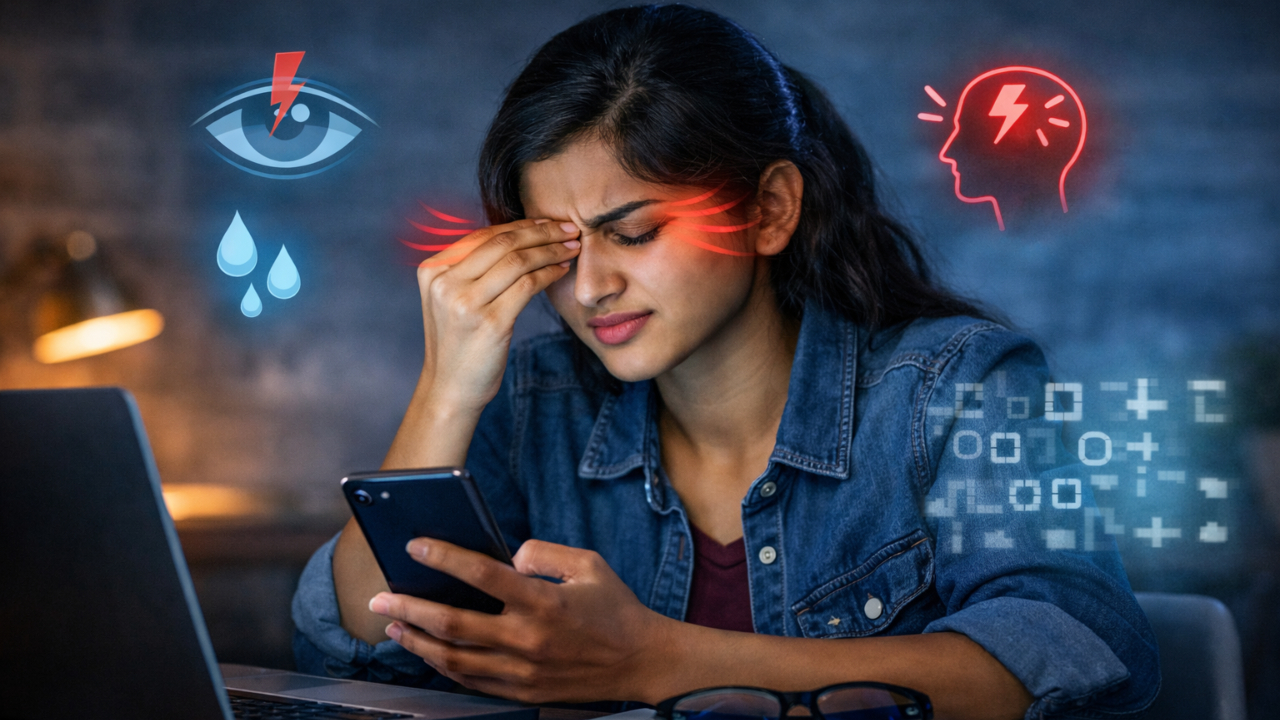
AI-generated representational image

Synopsis: Screens cut across age and habit, shaping work, rest and play. Doctors warn of rising digital eye strain, with symptoms like dryness, headaches and blurred vision. Children face delayed language, poor sleep and obesity risks. Experts urge moderation, outdoor activity, and the 20‑20‑20 rule to protect eye health as prolonged screen use quietly reshapes daily life.
“Screen-time this week?” Mishti, a 20-year-old college student, asks, averting her eyes and smiling. She goes on her phone and scrolls till she finds her screen time for the week and then stops, her eyes widening in surprise.
She turns the phone, 11 hours flashing across it. “I think recently, it’s very high because of summer break, but during normal college days it’s six hours max,” she tells South First.
She uses her phone mostly to “doomscroll” when she burns out from college. “Most of the time I don’t even wanna be on my phone, even when I’m in the middle of using it, but I’m so tired that I can’t bring myself to do anything but that.”
Raghavan, a security guard, clocks close to seven hours a day, mostly on Spotify. Music, he says, makes his job bearable. He started watching reels after he moved to a workplace where he stands guard alone. “There is no one to speak to, and it gets a bit lonely,” he admits.
Aria, a commerce student, puts it plainly. “Picking up a book and reading it feels more draining than scrolling on my phone for hours. The screen is literally my window to relaxation and information. Maybe that’s why my screen time is so high.”
Emmanuel, a Class 12 student, says he uses his phone mainly for knowledge, even as he acknowledges what prolonged use does to the eyes. Meanwhile, Vanisha, a 50-year-old language trainer, describes the screen as her gateway to staying connected with the world.
At the other end sits Manjunathan, a 70-year-old who works at a publication house. He frowns at the question. “I don’t spend time on my phone except for checking my mail. I prefer reading newspapers or having them read to me. Besides, I don’t really like using the phone and social media,” he says.
These voices cut across age, profession and habit. What connects them is that screens now shape how they work, rest and move through the day.
Also Read: Screens, fast food, shrinking playgrounds: How South India is raising an obese generation
Dr Ravindra Mohan, Senior Ophthalmologist at Gleneagles Global Health City, Chennai, tells South First that device use surged after COVID-19 pushed work and education online. “Everything going online has seen a dramatic increase in the frequency of computer vision syndrome,” he says.
Research supports this. A study on Digital Eye Strain found that it affected between 5 and 65 percent of people before the pandemic. During COVID-19, that figure climbed to between 80 and 94 percent. The study describes the rise as an “augmented growth pattern” and calls on eye care professionals to lead awareness efforts among teachers, young people and those who spend long hours before screens.
Eye strain, or asthenopia, sits at the centre of this. Dr Ravindra describes how a person may start the day working at a screen without difficulty, but by the afternoon, the letters begin to blur. Discomfort builds.
“Some people may even want to discontinue the work or even leave the job completely when the symptoms are very severe and not addressed at the right time,” he tells.
Dryness, redness, watering and grittiness follow.
The reason lies in how the eye is built. Ravindra explains that the human eye evolved for distance. When ancestors hunted and gathered, the eyes looked far ahead, the muscles rested, and the two axes ran parallel. A person can look into the distance indefinitely without strain.
Reading or using a device changes all of that. At 35 to 40 cm for a book, or 65 to 75 cm for a laptop, both eyes converge inward to focus on the same point. The muscles work continuously. Over hours, they tire, much like an arm holding a weight.
Blinking compounds the problem. Normally, a person blinks between 10 and 15 times a minute. That rate drops by half when staring at a screen. “When you look at a child watching television, the child blinks virtually like a crocodile, they just keep their eyes open,” Dr Ravindra says. Tears evaporate. Dry eyes develop.
Screens also disturb sleep. Blue light from phones and laptops interferes with melatonin production and disrupts the body’s circadian rhythm. Dr Ravindra advises cutting screen exposure after sunset and in the hours leading up to sleep. He notes that anti-glare screens and blue-blocking filters remain subjects of ongoing research, with no firm consensus yet on their effectiveness.
Also Read: Designed to keep them scrolling: The hidden algorithm behind teen screen time
Working adults in their 30s and 40s, Ravindra tells, carry the heaviest symptom load. Tear secretion drops naturally after 40, more so in women. This coincides with the years when people sit before computers for 10+ hours, moving between research tabs and online meetings. “The age group most affected are either young adults in their 30s or 40s. Of course, no age group is completely free from it,” he says.
The elderly, he observes, tend to use devices for shorter periods and show fewer clinical symptoms as a result.
Children occupy a separate and pressing category.
9-year-old Anshika says that she reaches for her phone when she has no friends to play with. Her mother observes that headaches and irritability follow when the screen time climbs.
Meanwhile, 6-year-old Aradhya struggles to explain her attachment to phone. “I like seeing ‘Cocomelon’, ‘Chhota Bheem’ and killing soldiers. It’s fun,” she says, giggling. Her mother notes she has lost interest in books and toys. Aradhya says she would like to spend more time with her puppy and read books, but ‘Cocomelon’ is just more interesting.
Dr Santosh Tamagond, senior paediatrician at BIMS Belagavi, noted that children get conditioned to find cartoons more attractive than outdoor play.
Prolonged screen time, he says, delays language development, reduces attention span, drives obesity, disrupts sleep and diminishes social interaction. “In fact, the American Academy of Pediatrics has recommended zero screen time for children below two years,” he states.
A systematic review on screen time among under-five children in India, published in a peer-reviewed journal, found that usage already exceeds prescribed limits across the country. It links excess screen time to slower cognitive development, hampered language acquisition and disturbed sleep patterns.
Dr Ravindra tells that children present with headaches, but he urges caution. Before attributing the symptom to screen time, he says, it is important to rule out refractive errors with a full eye examination. A child who needs spectacles may carry undiagnosed strain that screens only worsen.
He also points out that children sit at damaging angles. Lying on the stomach in a poorly lit room, head bent toward a phone, intensifies both eye strain and headache.
Also Read: How Indian parents are fighting back against kids’ screen obsession
Dr Ravindra acknowledges the bind parents find themselves in. Cartoons hold the attention of young children in a way that makes feeding and settling easier.
“The child doesn’t eat and then once you show the cartoons, the child opens the mouth and finally eats,” he says. Mothers, he notes, find devices genuinely useful in moments of daily necessity.
But he urges moderation. He recommends that parents keep total weekday device use under one hour, set fingerprint locks if needed, and hold firm even when the child pushes back. He adds that daylight and outdoor activity can slow the progression of myopia, and encourages cycling and play over video games for children already diagnosed with the condition.
“Some amount of device use is essential, the child should learn to be competitive as it is a very competitive world, but the parents should hold autonomy for both their eye-health and well-being,” he tells .
The damage accumulates quietly, across age groups and across hours. Doctors who spoke to South First agree that awareness alone does not fix behaviour, but it opens the door.
Dr Ravindra recommends the 20-20-20 rule for anyone who works long hours at a screen: every 20 minutes, look at something 20 feet away for 20 seconds. A window or the far end of a hallway works. He also suggests retraining the blink reflex, aiming for a deliberate blink every four seconds, taking short breaks to stretch and move, and stepping away from all screens after sunset.
These are small adjustments. Doctors say they matter.
(Edited by Amit Vasudev)



