

Published Jul 27, 2026 | 7:00 AM ⚊ Updated Jul 27, 2026 | 7:00 AM

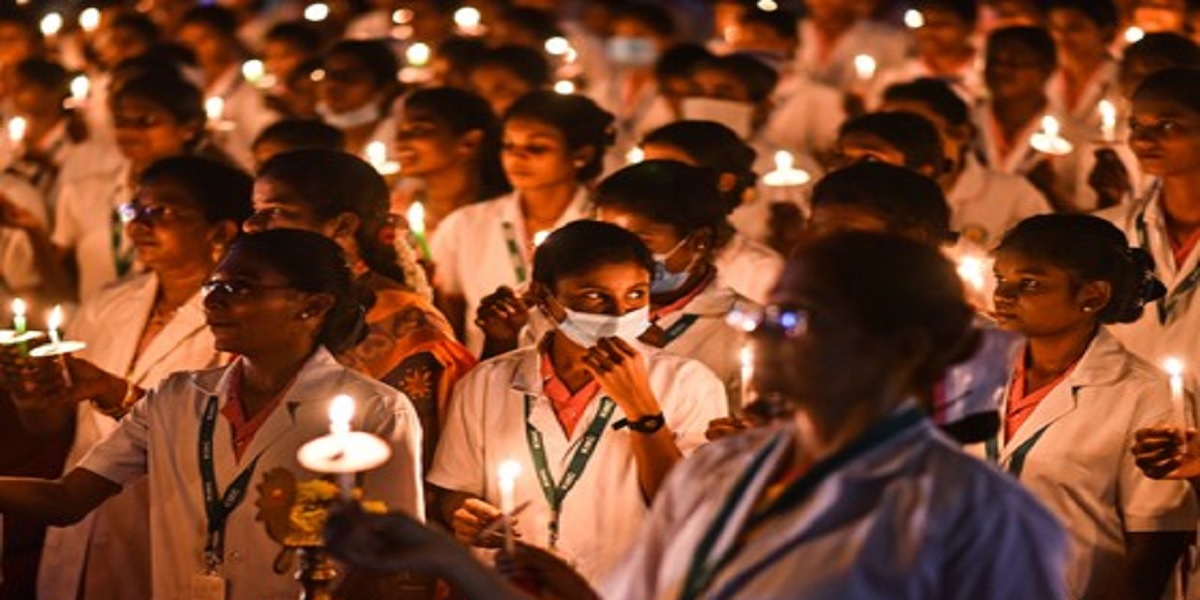
Telangana needs around 1.16 lakh registered nurses and midwives for its projected 2026 population of 3.86 crore.

Synopsis: Despite recruiting around 10,000 Nursing Officers and launching foreign language training to boost global employment, Telangana’s nursing workforce remains 47% below the WHO benchmark. Parliamentary data show that the state has the lowest nurse-to-population ratio among southern states, highlighting the need for sustained recruitment, education, and retention to strengthen public healthcare.
Telangana has embarked on one of its largest public healthcare recruitment drives, appointing around 10,000 nursing officers and introducing structured induction training for recruits.
The state government has also announced plans to equip nursing students with Japanese, Korean and German language skills to help them secure jobs overseas.
Yet, despite these initiatives, Telangana continues to have one of the weakest nursing workforces in South India.
Data Union Health Minister JP Nadda tabled in the Rajya Sabha revealed that Telangana has 60,919 registered nurses and registered midwives (RN & RM) against a projected 2026 population of 3.86 crore, translating to 1.58 nurses per 1,000 population.
The figure is nearly 47% lower than the World Health Organisation’s benchmark of three nurses per 1,000 population, and significantly behind neighbouring southern states.
Kerala has 10.47 nurses per 1,000 people, Karnataka 7.69, Andhra Pradesh 5.72, and Tamil Nadu 5.09.
Based on the WHO benchmark of three nurses per 1,000 population, Telangana would require around 1.16 lakh registered nurses and midwives for its projected 2026 population of 3.86 crore. With 60,919 registered nurses and midwives, the state faces an estimated shortfall of nearly 55,000 nurses.
The data tabled in Parliament underscored the scale of the challenge facing Telangana even as the government expands recruitment and training.
Also Read: South India leads India’s nursing workforce
At the inauguration of the third state-level induction training programme for newly appointed nursing officers, Director of Medical Education Dr Narender Kumar said that Telangana had regularly recruited around 10,000 nursing officers, calling it “a new chapter in the history of the state’s healthcare sector.”
He said the government’s investment in skilled nursing personnel would strengthen public hospitals and improve the quality of healthcare delivered to people.
The Directorate of Medical Education (DME) organised the induction programme for around 150 newly appointed nursing officers from government medical colleges, teaching hospitals, district hospitals and area hospitals across the state.
The day-long programme trained recruits in government service rules, professional ethics, patient safety, infection prevention and control, emergency care, communication skills, medico-legal responsibilities and evidence-based nursing practice.
Calling nurses “the backbone of every hospital”, Dr Kumar said doctors prescribe treatment. Still, nurses are responsible for continuously monitoring patients, administering medicines, providing bedside care, identifying complications early, educating families and offering emotional support throughout recovery.
“Nursing is not merely a job but a profession dedicated to human service,” he told the recruits, urging them to uphold compassion, discipline, integrity and professionalism while treating every patient with dignity and respect.
The DME described the induction programme as the first state-level initiative of its kind in the department’s history and said it would continue to organise similar programmes to strengthen nursing leadership, improve patient safety, and build a patient-centred public healthcare system.
Also Read: Five women critically ill after C-sections at Telangana hospital
Alongside strengthening its domestic workforce, Telangana is also looking beyond its borders.
Chief Minister A Revanth Reddy recently announced that the government will establish facilities to teach Japanese, Korean and German to nursing students aspiring to work abroad.
Addressing students at a nursing college in Khammam, the chief minister said countries such as Japan, South Korea and Germany face a growing shortage of nurses and offer significant employment opportunities.
He said the language training programme would help Telangana’s nursing graduates compete internationally while noting that during his recent overseas visit, several people praised the services of Indian nurses, particularly those from Telangana.
The initiative reflected the state’s attempt to improve both the employability and global competitiveness of its nursing graduates.
Also Read: Why India’s silent liver epidemic is also a cardiovascular crisis
Despite these efforts, the parliamentary figures indicate that Telangana still has a relatively small nursing workforce compared with other southern states.
The state’s 60,919 registered nurses and midwives are substantially fewer than those of Andhra Pradesh (3.06 lakh), Tamil Nadu (4.14 lakh), Kerala (3.84 lakh), and Karnataka (5.30 lakh), even after accounting for population differences.
The result is a nurse-population ratio that not only falls below the national RN & RM average of 2.45 per 1,000 population, but also places Telangana at the bottom among the five southern states.
Health experts have long argued that adequate nursing strength is central to quality healthcare because nurses spend the most time with patients, monitor treatment, detect deterioration early, prevent infections and coordinate care across hospital departments.
A shortage of nurses can affect patient outcomes, increase workloads for existing staff and reduce the quality of care, particularly in government hospitals that handle large patient volumes.
Also Read: DCGI approves India’s first dengue vaccine Qdenga for people aged 4 to 60 years
The low nurse density also cannot be explained solely by overseas migration.
According to data placed before Parliament by the Ministry of External Affairs, Telangana recorded 194 nurse emigration clearances in 2023, 140 in 2024 and 94 in 2025.
These figures are significantly lower than those of Kerala and Tamil Nadu, which continue to send thousands of nurses abroad every year while maintaining some of the country’s highest nurse-to-population ratios.
The comparison suggests Telangana’s challenge lies less in losing nurses overseas and more in expanding the overall size of its nursing workforce through education, recruitment and long-term retention.
The recruitment of 10,000 nursing officers marks one of the largest investments in Telangana’s public health workforce in recent years. Coupled with structured induction training and plans to prepare students for international careers, the government has signalled that nursing is becoming a key pillar of its healthcare strategy.
However, the latest parliamentary figures indicate that recruitment alone may not be enough.
(Edited by Majnu Babu).



