

Published Aug 15, 2026 | 11:00 AM ⚊ Updated Aug 15, 2026 | 11:00 AM

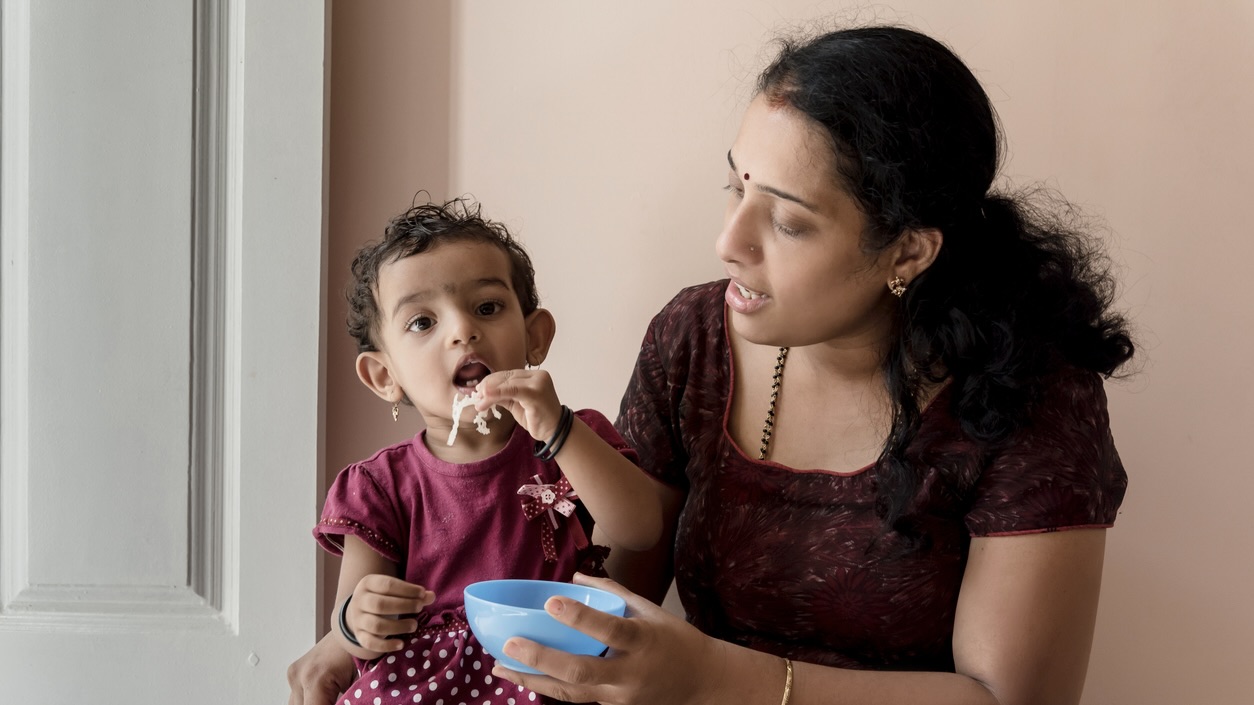
According to the Centre’s own number 2.13 percent, or 9,32,322 of the 4.37 crore active eligible THR beneficiaries, were not e-KYC and face matched.

Synopsis: Nearly 98 percent of beneficiaries had completed Aadhaar e-KYC and facial verification for Take-Home Ration by June 2026, a year after digital checks became mandatory under Mission Saksham Anganwadi and Poshan 2.0. However, the Women and Child Development Ministry did not provide data on beneficiaries whose nutrition was delayed or denied because of failures in the Poshan Tracker, facial recognition, Aadhaar e-KYC or OTP verification.
A year after the Union government made Aadhaar e-KYC and facial matching mandatory for Take-Home Ration (THR) distribution under Mission Saksham Anganwadi and Poshan 2.0, nearly 98 percent of beneficiaries had completed the verification by June 2026, according to data tabled by the Union Ministry of Women and Child Development in Parliament.
The data was presented in response to two separate questions — one in the Rajya Sabha by Congress MP Mansoor Ali Khan and another in the Lok Sabha by Congress MP Priyanka Gandhi Vadra — seeking the number of beneficiaries whose supplementary nutrition was delayed or denied because of problems with the Poshan Tracker, Facial Recognition System (FRS), Aadhaar e-KYC or OTP verification.
Gandhi also sought State- and Union Territory-wise details of eligible beneficiaries who had not received THR since FRS and OTP verification became mandatory in July 2025.
The Ministry did not provide those figures. Instead, Minister of State for Women and Child Development Savitri Thakur said that all beneficiaries registered under Mission Poshan 2.0 were Aadhaar-verified, and cited the 97.87 percent e-KYC and face-matching rate for THR distribution.
According to the Centre’s own number 2.13 percent, or 9,32,322 of the 4.37 crore active eligible THR beneficiaries, were not e-KYC and face matched in June.
Khan said the response did not establish whether people who could not be digitally matched still received their nutrition entitlement.
“Those safeguards matter, but where is the outcome data? Did every eligible beneficiary still receive nutrition? If the Union government uses digital verification for nutrition delivery, it must track who could not be matched and tell Parliament whether they still receive nutrition,” he said.
“In the next Parliament session, I will ask again. When digital verification fails, does nutrition still reach every eligible child and mother? The government cannot hide that responsibility behind a percentage.”
Mission Poshan 2.0 aims to improve nutrition outcomes, particularly among children, pregnant women and lactating mothers. Its services include supplementary nutrition and THR, hot cooked meals, growth monitoring, early childhood care and education, and nutrition counselling and related Anganwadi services.
The Poshan Tracker, rolled out on 1 March 2021, is the Centre’s digital platform for monitoring Anganwadi Centres, Anganwadi Workers and beneficiaries.
The e-KYC process is a beneficiary-verification mechanism introduced through the Poshan Tracker. It uses Aadhaar-based identity verification, OTP and, for beneficiaries covered by the FRS, facial authentication or face capture to establish that the person receiving the benefit is the registered beneficiary.
The Centre introduced FRS on a pilot basis in August 2024 in Andhra Pradesh, Gujarat, Haryana, Odisha, Uttar Pradesh and Chandigarh and expanded it across India in December 2024. FRS and OTP verification for THR were mandated in July 2025.
The Aadhaar-based tracking, according to the government, is intended to prevent duplicate and ghost entries, improve beneficiary identification, and reduce leakage and duplication in supplementary nutrition distribution.
Also Read: India’s 400-million-strong missing middle: Uninsured and one illness away from financial ruin
The extent of unmatched beneficiaries varied across States.
West Bengal had the largest absolute difference, with 1,77,178 beneficiaries not e-KYC and face matched. Uttar Pradesh followed with 1,56,235, Madhya Pradesh with 1,31,498, Bihar with 1,11,996 and Gujarat with 1,06,911.
The next largest gaps were in Kerala at 69,191, Assam at 65,533, Punjab at 36,375, Jharkhand at 32,528 and Haryana at 26,639.
Kerala had 7,61,139 active eligible beneficiaries, of whom 6,91,948 were e-KYC and face matched, giving it a matching rate of 90.91 percent. Karnataka, by contrast, reported a matching rate of 99.94 percent. Of its 23,14,434 active eligible beneficiaries, 23,12,930 were e-KYC and face matched, leaving a difference of 1,504.
Arunachal Pradesh had the lowest matching rate among States at 74.99 percent, followed by Sikkim at 78.54 percent and Nagaland at 88.92 percent.
The figures show the extent of unmatched beneficiaries, but the Ministry’s replies do not establish what happened to them — whether they received THR through another route, received it late, or did not receive it.
Also Read: Can lenses slow a child’s worsening eyesight? Experts say yes, but with limits
The Ministry said the Poshan Tracker has reduced the workload of Anganwadi Workers by replacing manual entries in 11 physical registers with digital reporting.
Daily activities, including opening of Anganwadi Centres, children’s attendance, THR and hot cooked meal distribution, and pre-school education activities, can also be recorded offline. Data entered offline can be synchronised within five days.
Anganwadi Workers, Block Coordinators and Supervisors are provided smartphones for service reporting and programme monitoring, while Anganwadi Workers receive funds for internet connectivity.
The Ministry said the Poshan Tracker monitors activities at nearly 14 lakh Anganwadi Centres and permits face matching in offline mode in areas with low or no internet connectivity.
“To address network-related issues such as low or no internet connectivity in some areas while conducting e-KYC and Face matching under Facial Recognition System (FRS) on Poshan Tracker for Take-Home Ration (THR) distribution, the application provides functionality to conduct face matching in offline mode,” Thakur said.
“OTP for e-KYC and Aadhar face matching has to be taken ONCE in entire life cycle of the beneficiary.”
The Ministry said a Nominee Module had been introduced for pregnant women, lactating mothers and adolescent girls. If a registered beneficiary cannot visit an Anganwadi Centre to receive THR through FRS, she can nominate another person to receive it.
It also listed training and technical support, including learning videos and awareness material on the Poshan Tracker, cascading training under Poshan Bhi Padhai Bhi, field-level support from Block and District Coordinators, daily virtual classroom sessions, training whenever new versions of the application are introduced, and a Poshan Helpline at 1515.
The helpline operates from 9 am to 6 pm in 17 languages, the Ministry said. Anganwadi Workers can also raise tickets through the application.
The Ministry also cited community mobilisation and nutrition-awareness activities. States and Union Territories conduct activities during Poshan Maah and Poshan Pakhwada, while Anganwadi Workers are required to conduct two Community Based Events every month.
It further noted that 10.5 crore such events had been conducted from 2018 to June 2026 and more than 150 crore Jan Andolan activities since 2018.



