

Published Aug 12, 2026 | 7:00 AM ⚊ Updated Aug 12, 2026 | 7:00 AM

AI-generated image referenced from NITI

Synopsis: 400 million Indians are without health insurance at a time when healthcare costs, particularly in private hospitals, have shot up. We need a low-cost health insurance plan for this segment of the population, and a plan to strengthen public healthcare.
India’s middle class earns too much to qualify for government-sponsored health insurance but too little to afford private healthcare, especially during emergencies.
The numbers from the National Statistical Office’s Health Survey published towards the end of April 2026 underline the stark divide in healthcare costs in our country: the average spend per hospitalisation in public hospitals, excluding childbirth, was ₹6,631, compared with ₹50,508 in private hospitals.
Understandably, there is a distinct, silent panic that grips a family when a doctor’s report brings alarming news. It isn’t just about survival rates or treatment options—it’s the sudden, crushing arithmetic of staying alive. For the middle class, a catastrophic diagnosis immediately converts years of hard-won progress into a rapid drain on family reserves. We often assume that devastating medical debt is a tragedy that only affects others—until we witness our own life savings vanish in a hospital corridor.
For nearly 400 million Indians, a single critical illness threatens to erase decades of hard-won financial security.
Consider the case of a 55-year-old sole breadwinner who was suddenly admitted to the ICU. With his income vanishing overnight, a family that had done everything “right,” saved diligently, lived modestly, and planned for the future, found itself suddenly drowning in bills through no fault of their own. This family’s crisis is not an anomaly.
India’s government spending on health, at 1.5% of GDP, is among the lowest in the world.
In its broader push towards universal health coverage, the central government’s flagship programmes like Ayushman Bharat-Pradhan Mantri Jan Arogya Yojana and state health insurance schemes like Arogyasri in Andhra Pradesh provide comprehensive hospitalisation to the bottom 50% of the population.
Table: Number of individuals and families eligible or covered, by health insurance scheme type
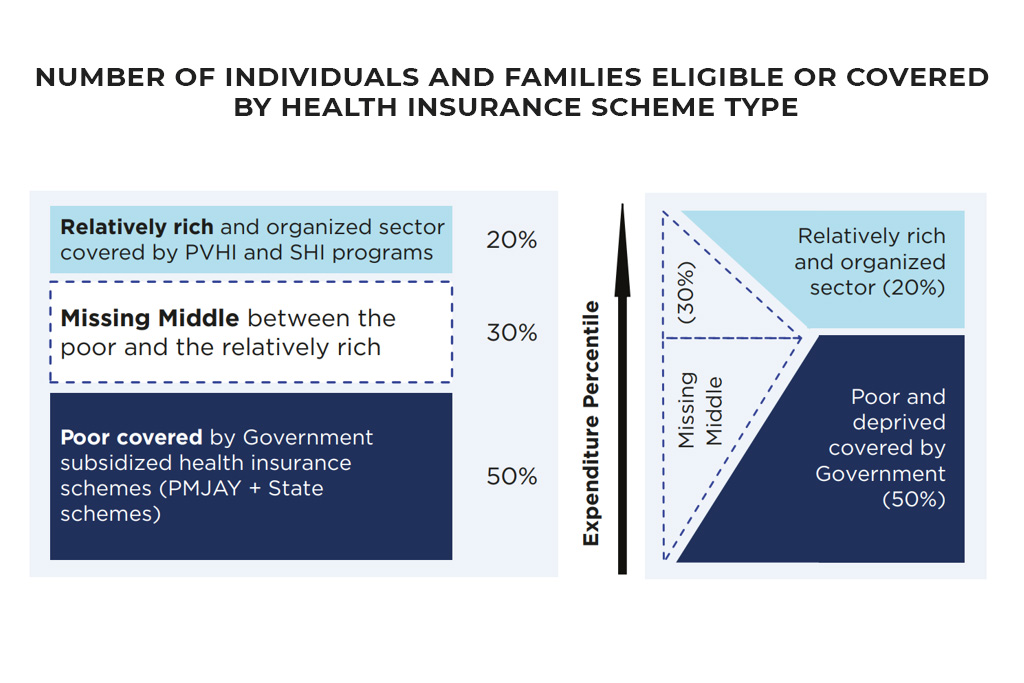
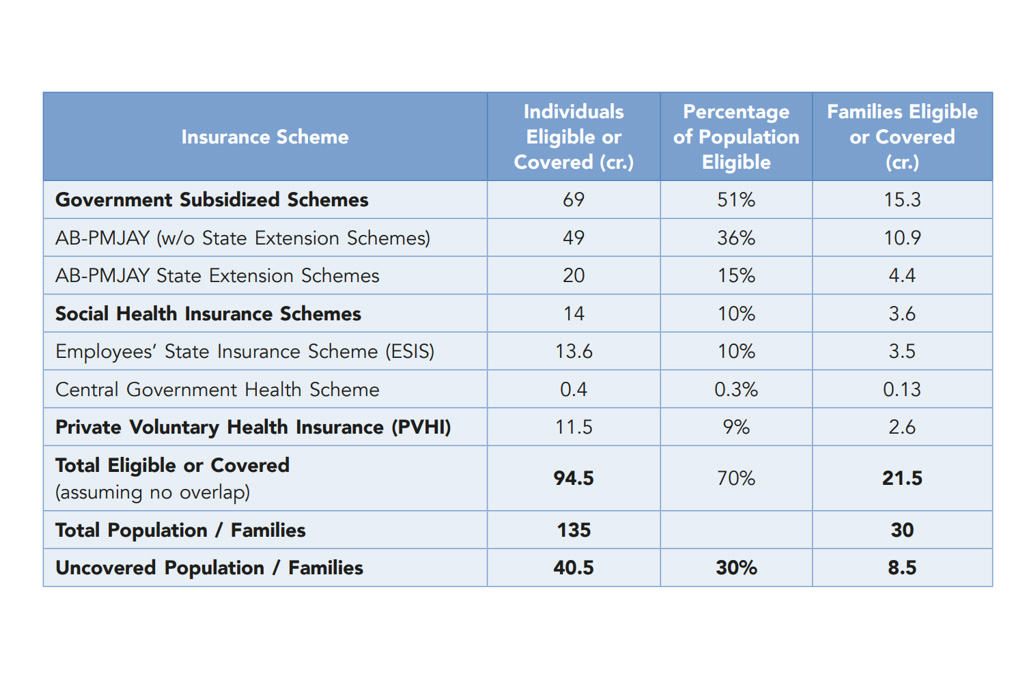 NITI Aayog estimates show that higher-income individuals, who make up around 20% of the population, are covered by social health insurance and private insurance. Such families can at least absorb a ₹15-lakh private hospital bill in the event of a temporary setback. But even they often discover the gaps in high-cost insurance plans when it is too late—while standing at the billing counter facing room-rent caps, co-pay clauses, disease-specific sub-limits, and non-payable expenses.
But the same estimates highlight a massive coverage black hole: nearly 30% of India’s population, the roughly 400 million people mentioned above, are without health insurance, a group termed the “missing middle.” They earn too much to qualify for public welfare but nowhere near enough to comfortably afford private healthcare. There is a need for a low-cost health insurance plan to cater to this segment, and the Arogya Sanjeevani Policy is a first step in that direction, but it does not cover outpatient costs. This is an illusion of protection and an out-of-pocket reality.
According to National Health Accounts (NHA) data, 43% of India’s total health expenditure is still paid directly out of pocket by households. In most developed nations, out-of-pocket spending stays below 20%. In India, personal savings remain the primary insurance policy. The system effectively punishes recovery, forcing families to liquidate retirement funds, sell property, or take high-interest loans just to settle discharge summaries.
This demographic pays taxes, buys homes, and drives national consumption. Yet, a single prolonged ICU stay can wipe out years of carefully accumulated wealth in a matter of weeks. A family’s survival should not rely on everyone staying healthy. When illness strikes, a family ought to focus on care and recovery—not sitting in hospital waiting rooms frantically evaluating home equity or deciding which parent’s retirement nest egg can be drained first. Addressing the coverage gap for the missing middle is not an unattainable aspiration or a charitable act. It is an economic and social imperative, which requires the following:
• Regulated Risk Pools: Creating affordable, standardised public-private insurance products for middle-income segments.
• Transparent Pricing: Making sure private healthcare providers follow strict, standardised billing practices to avoid hidden costs.
• Consumer Protection: Simplifying claim settlements and reducing fine-print exclusions that leave policyholders stranded when they need them the most.
“Health is a human right. No one should have to choose between good health and other life necessities,” the World Health Organisation had noted.
Until we treat healthcare access as a fundamental right rather than a high-stakes financial gamble, getting sick will remain a quiet, terrifying threat to millions of families who are doing everything else right.
Also Read:
India thinks Ayurveda and other traditional medicines are cheap. The numbers say otherwise
Why does Parliament want Indians to start kidney tests at 20, and repeat them every six months?
(Edited by R Rajesh Kumar.)



