

Published Jul 17, 2026 | 7:00 AM ⚊ Updated Jul 17, 2026 | 7:00 AM

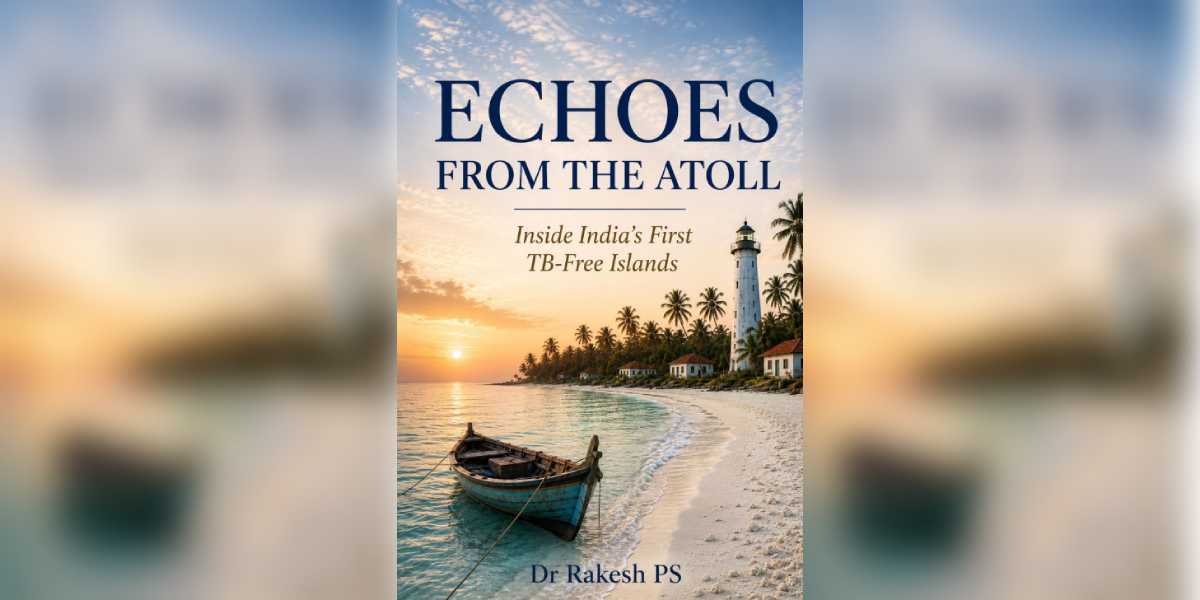

Synopsis: A new book, ‘Echoes from the Atoll: Inside India’s First TB-Free Islands’ by Dr Rakesh PS, chronicles how Lakshadweep became India’s first TB-free geography. The memoir reveals how community participation, empowered ASHAs, local leadership and island-specific strategies overcame daunting logistical challenges, offering a rare behind-the-scenes account of a landmark public health achievement.
When Lakshadweep was declared India’s first tuberculosis (TB)-free geography in 2021, it marked a significant moment in the country’s ambitious goal of eliminating TB ahead of the global target.
Yet, beyond the official announcement lay a remarkable story of health workers navigating rough seas, women knocking on every door, village leaders rallying entire communities, and a health system that chose to adapt itself to the realities of island life rather than force a mainland model onto it.
That story now finds its most detailed account in Echoes from the Atoll: Inside India’s First TB-Free Islands, a memoir by Dr Rakesh PS, a public health specialist and former World Health Organization (WHO) consultant who worked with India’s National TB Elimination Programme (NTEP) in Lakshadweep between 2018 and 2022.
Part memoir, part public health narrative, the book reconstructs the four-year journey that transformed one of India’s most geographically isolated regions into a model for tuberculosis elimination. It argued that the achievement was less about medical technology and more about community ownership, local leadership and adapting national policy to local conditions.
Also Read: Many moves to strip Lakshadweep of its identity
From the mainland, Lakshadweep appears deceptively simple. The Union Territory has just over 69,000 people spread across 10 inhabited islands in the Arabian Sea. Such a small population could easily suggest that TB elimination would be easier here than elsewhere.
According to Dr Rakesh, the opposite was true.
The islands are separated by hours of sea travel. The southernmost island, Minicoy, lies nearly 16 hours away by ship from Kavaratti, the administrative headquarters.
During the monsoon, rough seas frequently halt inter-island transport for months, making even routine programme supervision uncertain. Transporting sputum samples for advanced laboratory testing could take weeks and, during the rainy season, become impossible altogether.
“The islands were so isolated that many officials involved in the programme at the Central TB Division in New Delhi had never physically seen the geography they were managing,” Dr Rakesh wrote.
He added that “even sending a sputum sample for advanced testing could take weeks. During the monsoon, it became impossible altogether. The sea cut the islands off completely for almost five months a year.”
Despite these challenges, the TB programme operated with a remarkably small team. A single treatment supervisor, laboratory supervisor, communications officer and accountant coordinated activities across the islands, while a doctor simultaneously managed the TB programme alongside routine hospital responsibilities.
Also Read: Lakshadweep land amendment triggers fears over tribal land
One of the strongest themes running through the book is that Lakshadweep’s success came when tuberculosis stopped being viewed as the health department’s responsibility alone.
Instead, the programme deliberately built a community movement.
The administration formed island-level task forces bringing together panchayat representatives, women’s groups, youth clubs, religious leaders and government officials under a single campaign.
“The message driving the movement was simple: ‘My TB-Free Island,'” Dr Rakesh noted.
These task forces organised volunteers for house-to-house screening, supported families facing financial hardship due to TB and persuaded patients to continue treatment when they considered stopping medicines midway.
“It was remarkable to watch how seriously the community took ownership of the effort,” the author said.
Rather than viewing patients merely as beneficiaries, the programme turned every resident into a stakeholder in eliminating the disease.
Also Read: The anthropology of death in Lakshadweep
The book repeatedly returns to one factor that Dr Rakesh believed fundamentally changed the course of the programme: Lakshadweep’s women.
Unlike many parts of India, Lakshadweep retains elements of a matrilineal social structure, where women often exercise considerable autonomy within families.
According to the author, this cultural reality became one of the programme’s biggest strengths.
“When we began working toward TB elimination, we knew a traditional top-down medical approach would never be enough here,” he wrote.
“Instead, we built the strategy around the island’s natural strength: its women.”
Accredited Social Health Activists (ASHAs), already trusted within their communities, spent four years visiting homes across every inhabited island, identifying people with symptoms, encouraging testing and helping reduce the stigma surrounding tuberculosis.
“For four years, these women went door to door across the islands, searching patiently for even the smallest symptoms of TB,” the book said.
“What truly made the difference was that women in each household were empowered enough to make their own health decisions. They did not have to wait for permission to undergo an X-ray or get tested.”
The author argued that this autonomy allowed health interventions to reach nearly every household in the archipelago.
Also Read: Lakshadweep’s compulsory retirement order leaves 47 government employees in limbo
Another lesson emerging from the book is that Lakshadweep rejected the idea that one programme design could work everywhere.
Instead of following a standard operating manual, the TB team adapted interventions to suit the social realities of each island.
In Andrott, where religion plays a central role in public life, Friday sermons in mosques became an important platform for spreading TB awareness.
In Kalpeni, the programme first screened the village’s most respected elder, knowing the rest of the community would follow his example.
Meanwhile, in remote islands such as Chetlat and Bitra, success depended almost entirely on personal relationships and repeated physical visits by programme staff.
“That diversity was exactly why we abandoned rigid one-size-fits-all program manuals,” Dr Rakesh recalled.
“Instead, we empowered island-level task forces and allowed each island to shape TB interventions around its own social reality.”
The memoir also challenged conventional ideas of public health administration.
Many of the programme’s crucial decisions, the author said, emerged not in government offices but on beaches, in tea shops and at informal evening meetings where health workers, administrators and local leaders discussed problems.
“We brought together panchayat leaders, government officials, youth club members, women’s groups, and religious leaders into a single network,” the author wrote while describing the formation of island-level task forces.
Elsewhere, he recalled how strategy discussions often continued late into the night on Kavaratti beaches.
“Our discussions often stretched late into the night. Sitting on this beach, we mapped the strengths and weaknesses of every island, debating what might work, what would fail, and where resistance could appear.”
The programme later brought ASHAs from all 10 inhabited islands together for training, culminating in a pledge that symbolised the campaign’s community spirit.
“I can still hear the voices of those ASHAs echoing across the shore as they stood together… taking a pledge to make their islands TB-free,” Dr Rakesh wrote, before recalling the chorus:
“My TB-free Agatti… My TB-free Chetlat… My TB-free Minicoy… My TB-free Amini…”
The author argued that effective public health began with understanding the geography rather than trying to overcome it through paperwork.
Reflecting on repeated journeys between islands, he wrote that many visiting officials misunderstood Lakshadweep because they experienced it only through helicopters, meetings and reports.
By contrast, travelling by sea fundamentally changed their understanding.
“Over time, I made it a personal rule: every officer visiting the islands with me had to travel at least once by sea.”
“The difference in their attitude before and after the journey was always remarkable.”
The sea, he said, was not merely a physical barrier but the defining force shaping every aspect of governance, healthcare and daily life.
The book stated that Lakshadweep’s success cannot simply be replicated elsewhere. Its small population, tightly connected communities and unique social structure make the islands unlike most districts in India.
Yet Dr Rakesh argued that several principles behind the campaign are universally applicable: strong local leadership, empowered frontline workers, active community participation, flexible implementation and health policies that adapt to local realities instead of imposing uniform solutions.
Looking back on the achievement, he wrote that the movement succeeded because the islands themselves took ownership of the goal.
(Edited by Majnu Babu).



