

Published Jun 08, 2026 | 8:00 AM ⚊ Updated Jun 18, 2026 | 12:05 PM

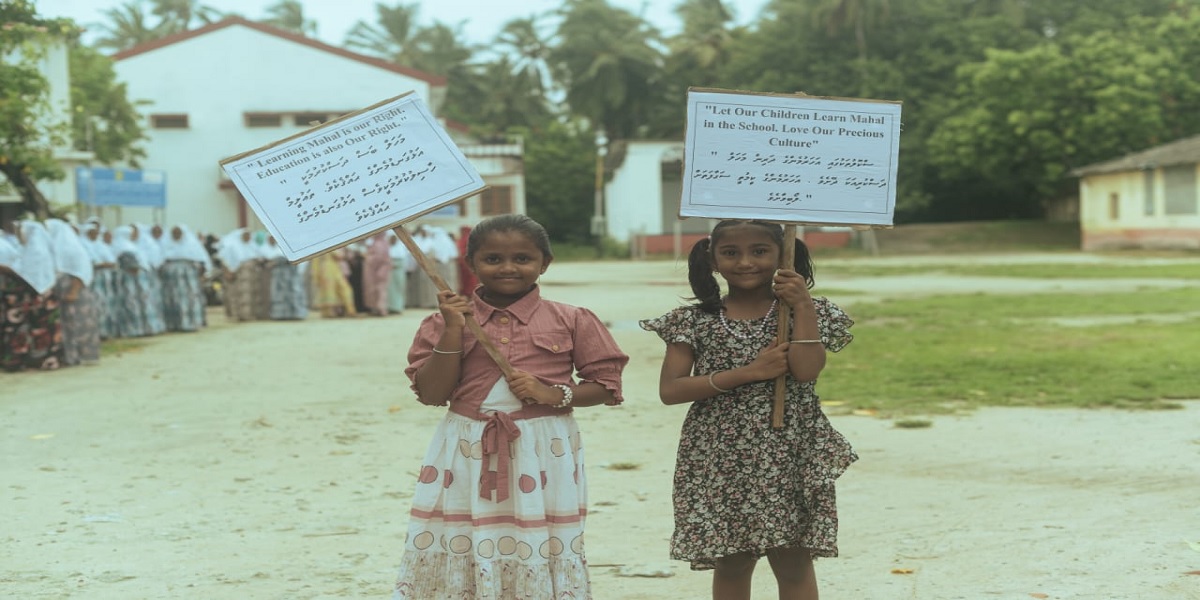
Primary school students in Minicoy took to the streets, demanding the inclusion of Mahal in their school curriculum.

Synopsis: Lakshadweep has recently been witnessing a series of controversial policy changes, many introduced without broad public consultation. From land and language issues to regulations affecting daily life, islanders have repeatedly protested to defend their identity, culture, and rights.
Minicoy resident Barkath is a worried father. He is unsure if his daughter will be able to write in Mahal, the language his ancestors have been speaking for centuries.
Just months ago, thousands protested against the Lakshadweep administration’s proposal to replace Mahal and Arabic with Hindi under the National Education Policy 2020.
For now, when schools reopen on 10 June, children will continue studying Mahal and Arabic in primary classes, thanks to the intervention of the Kerala High Court, which protected the linguistic heritage.
But for many islanders, the fear of losing the language close to their hearts has not faded. Mahal, also known as the Maliku dialect, is a variant of Dhivehi, the official language of the Maldives.
Advocate Ajmal Ahmed barely gets a break. He has spent years challenging policies and amendments that islanders believe, threaten their rights. He is now closely tracking the controversial proposal to amend Lakshadweep’s land laws.
Tour operator Sabith PK is struggling to keep up with a stream of new regulations. One among them is the changes to the archipelago’s liquor policy that went against the Lakshadweep society’s tradition of keeping alcohol away from the islands.
Researchers like Benna Fathima are fighting for better healthcare systems. Many islanders are often unable to be with their loved ones during their final moments due to inadequate medical facilities and transport.
Meanwhile, ordinary residents are confused about whether they can freely pluck a coconut from their own land or ride a two-wheeler without fear of violating any new rule. The residents of Bitra still do not know when they may have to give up their homes in the name of national security.
For many in Lakshadweep, every day has become a struggle to protect what makes the islands their own. A quieter battle is unfolding: a battle to save their land, language, culture and identity before they are gradually taken away.
Also Read: The anthropology of death in Lakshadweep
Muslims account for 96.58% of Lakshadweep’s population and the archipelago has long remained a dry region under a strict alcohol prohibition policy introduced in 1979. The prohibition was meant to preserve the cultural and social fabric of its predominantly Muslim society.

R. Giri Sankar, Lakshadweep’s District Magistrate, Collector and Excise Commissioner, issued an order permitting alcohol on select islands.
According to Lakshadweep MP Muhammed Hamdulla Sayeed, alcohol addiction and related social issues remain relatively low in the islands. Lakshadweep records the lowest prison occupancy rate in the country at around 6%, which many islanders attribute to the region’s dry status.
However, in February 2026, the Lakshadweep administration issued an order permitting the serving of liquor in eight government guest houses located in Kadamat, Agatti, Kalpeni, Kiltan, Chetlat, Amini, Andrott and Bitra islands.
Traditionally, alcohol has been served only at Bangaram Island, an uninhabited tourism destination where a resort operated by CGH Earth under a long-term lease caters primarily to visitors.
Many islanders say they have no objection to liquor being served in such non-inhabited tourist zones.
While the new policy exists on paper, the ground reality appears different.
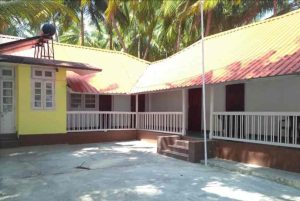
Dak Bungalow in Kalpeni.
Speaking to South First, Sabith said alcohol is currently being served mainly through Dak Bungalows (government-owned guest houses).
He noted that such facilities exist across the islands and that liquor is already available in places such as Kavaratti despite the islands having significant local populations.
“Most tourists come to Lakshadweep knowing it is a dry region and they respect the norm. Only a few ask for alcohol. The majority visit the islands for marine adventures and local culture. As a tour operator, I don’t think supplying alcohol will boost tourism. Instead, it risks damaging our culture,” Sabith said.
Also Read: Discontent brews as Lakshadweep administration plans to allow alcohol
Yaseen OC, a resident of Bitra Island still does not know whether he and his family will be able to continue living on the island in the future.
For the people of Bitra, this is not just about land, it is about legacy, identity, and survival.
Bitra, the smallest inhabited island in Lakshadweep, is proposed to be acquired by the central government for defence and strategic purposes.
The island is home to around 105 families.
The acquisition process remains incomplete with development plans progressing slowly amid local resistance. Meanwhile, residents are facing growing uncertainty. Many are hesitant to expand, renovate or even maintain their homes because they do not know how long they will be allowed to stay on the island.
In 2025, the Lakshadweep Revenue Department initiated a Social Impact Assessment (SIA) to transfer Bitra Island to defence agencies, citing its strategic and national security importance.
Yaseen told South First that islanders often learn about major developments affecting Bitra only through media reports or alerts from activists and political leaders. He said a lack of proper communication between the administration and local residents remains a persistent issue across Lakshadweep.
Without prior discussions on rehabilitation, resettlement or fair compensation, such announcements shock residents, forcing them to protest. The issue remains unresolved, leaving the future of Bitra’s residents uncertain.
Also Read: Indigenous residents face displacement
Schools in Minicoy Island are set to reopen on 10 June but for Adheema K, a Mahal language teacher, this year’s opening day will be different. On maternity leave and preparing to welcome her newborn, she will miss the excitement of the first day of school.
Mahal text book
While she is happy about the new chapter in her personal life, she is also sad that she will not be there to greet her students.
A year ago, Adheema was carrying a different kind of anxiety.
She was uncertain whether she would be able to continue teaching Mahal, the mother tongue of Minicoy.
Speaking to South First she said, “Mahal and Arabic will continue in the new academic year. But it is painful that people have to fight simply to protect their mother tongue.”
The concern arose after the Lakshadweep Education Department issued an order implementing the three-language formula under the 2023 National Curriculum Framework, part of the NEP.
The directive introduced Hindi as the third language in schools and removed the optional teaching of Mahal and Arabic.
The move triggered widespread protests across the islands. Many residents viewed the decision as an attempt to weaken the cultural identity of Lakshadweep, particularly in Minicoy, where Mahal is the native language spoken by the community.
A major turning point came when the Kerala High Court intervened following a PIL filed by student leaders.
The court stayed the administration’s order, observing that curriculum changes affecting local languages and culture required proper consultation with stakeholders and a careful assessment of their impact on educational and cultural interests.
As schools prepare to reopen, Mahal and Arabic remain part of the curriculum.
Yet some concerns persist. Adheema pointed out that the textbooks have still not been distributed, despite the academic year being only days away. Questions also remain about the quality of the printed Mahal textbooks, something teachers had raised repeatedly last year.
For now, there is relief that children in Minicoy will continue learning their mother tongue. For teachers like Adheema, the struggle showed how fragile cultural protections can be and the need to safeguard them.
Also Read: It’s nuts! Lakshadweep administration’s bizarre new order
The concerns in Lakshadweep extend beyond language and culture to issues of land rights and local participation in policymaking.
A proposed amendment to the Laccadive, Minicoy and Amindivi Islands (Protection of Scheduled Tribes) Regulation, 1964, has sparked protests across the islands, with residents fearing that it could dilute long-standing safeguards protecting tribal land ownership and transfer.
Adv Ajmal also raised concerns about the consultation process. He noted that the draft amendment and the public consultation notice were released only in English, despite Malayalam and Mahal being the primary languages spoken in Lakshadweep.
He opined that the absence of translations prevented many residents from fully understanding the proposed changes and limited their ability to participate meaningfully in the consultation process by submitting objections.
Apart from major policy changes and protests, even daily life has become uncertain for many residents of Lakshadweep. Islanders have found themselves asking simple questions: Can I ride my vehicle today? Can I pluck a coconut from my own land?
In late 2025, the administration required prior notice before harvesting coconuts from roadside trees and introduced a weekly “No Vehicle Day.” Both measures drew strong public opposition. The order restricting vehicles was later deferred.
On 5 June, Prime Minister Narendra Modi inaugurated and laid foundation stones for projects worth ₹22,655 crore across Gujarat, Dadra and Nagar Haveli and Daman and Diu and Lakshadweep. The schemes included ₹885 crore port and maritime infrastructure projects in Kalpeni and Kadmat.
Many islanders said development cannot be separated from the concerns of the local residents.
Before investing thousands of crores in new projects, they said, policymakers should listen to the voices of the islanders. After all, development is meaningful only when the land and its people remain at its centre.
(Edited by Majnu Babu).



