

Published Jun 23, 2026 | 8:00 AM ⚊ Updated Jun 23, 2026 | 8:00 AM

Anirudh Gupta (South First)

Synopsis: A 15 June FSSAI advisory against rusted, painted and damaged cutting equipment has drawn attention to a little-known four-year campaign by Hyderabad food safety activist Anirudh Gupta. Through RTIs, regulatory representations and public advocacy, Gupta pushed authorities to examine bread slicer blades and food-contact equipment, raising questions that now echo in the regulator’s latest guidance.
On 2 June, the Food Safety and Standards Authority of India (FSSAI) uploaded an Instagram reel promoting its Eat Right Street Food Hub initiative. The video assured consumers that certified street food hubs could serve “safe, hygienic food” and highlighted the regulator’s efforts to improve food safety standards across the country.
As the video played, a knife with a visible pink-coloured section on its blade briefly appeared on a food preparation counter.
View this post on Instagram
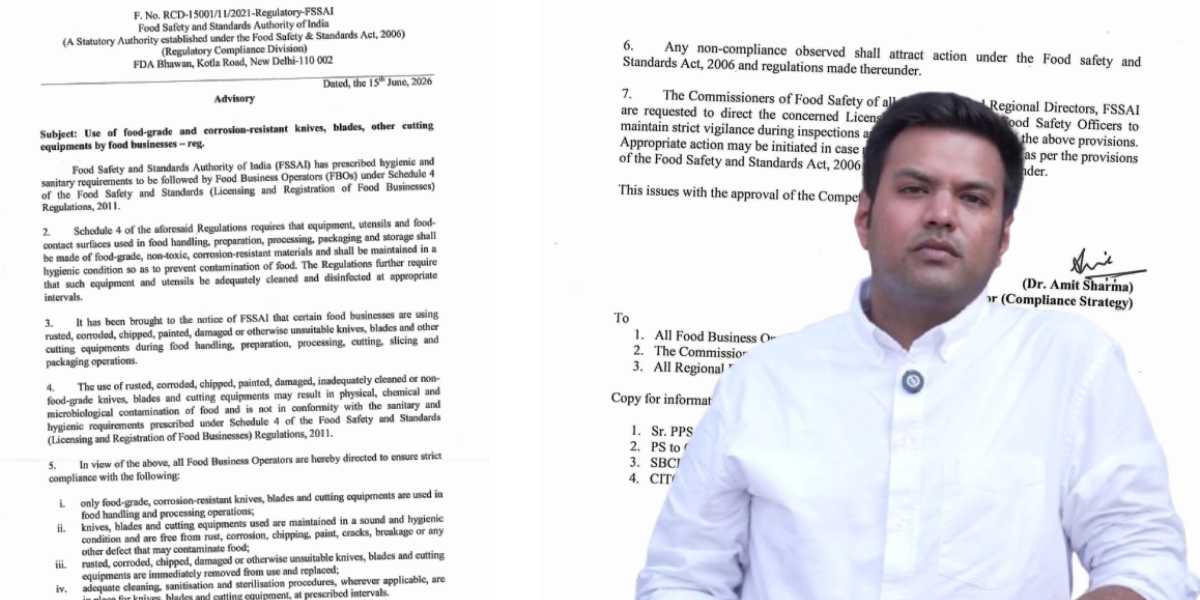
Less than two weeks later, on June 15, FSSAI issued a nationwide advisory directing food businesses to stop using rusted, corroded, chipped, painted and damaged knives, blades and cutting equipment.
The regulator warned that such equipment could lead to physical, chemical and microbiological contamination of food and ordered businesses to replace unsuitable tools with food-grade, corrosion-resistant alternatives.
The same agency had earlier used a coloured knife for promoting one of its initiatives.
Also Read: FSSAI orders food businesses to replace rusted knives, blades to curb contamination
For Hyderabad man Anirudh Gupta, the sequence captured the very issue he had spent nearly four years trying to highlight.
“The issue was so overlooked that even official food safety messaging was not paying attention to it,” Gupta told South First.
Long before FSSAI issued its advisory, Gupta had been writing letters, filing Right to Information (RTI) applications, approaching ministries, meeting regulators and documenting what he believed was a hidden food safety issue inside India’s bakeries and food-processing units: the blades used to cut bread consumed by millions every day.
What began as a simple question about bread slicer blades eventually became a four-year campaign involving ministries, regulators, industry associations and hundreds of pages of correspondence. Along the way, Gupta transformed himself from a businessman with a niche concern into one of the country’s most persistent voices on food-contact equipment safety.
He runs an Instagram Page foodsafetywar with some more than 46 thousand followers.
Gupta’s journey began in 2022 when he noticed what he believed were poorly maintained blades being used in food operations. At the time, he knew little about food-contact materials, food-grade standards or regulatory frameworks.
“I was starting from a clean slate,” he recalled. “I wasn’t planning a campaign, I wasn’t trying to change policy, I just wanted to know whether there were rules.”
His search for answers took him to institutions such as the Bureau of Indian Standards (BIS) and the Shriram Institute in Delhi. According to Gupta, officials explained that food-contact equipment should ideally be made from stainless steel and maintained in hygienic condition.
The conversations sparked more questions. As Gupta learned more about cutting equipment and food-contact materials, he became convinced that the issue extended far beyond a handful of bakeries.
The more facilities he examined, the more he believed there was a broader industry-wide problem. The earliest substantial document in Gupta’s campaign is a representation sent to FSSAI on October 6, 2022.
Its subject line was unambiguous:
“Attention Required To The Safety of Bread Slicer Blades Throughout India.”
Also Read: Karnataka HC temporarily stays FSSAI ban on ashwagandha leaves
In the letter, Gupta alleged that bread manufacturers across the country were using low-grade carbon steel blades and urged FSSAI to investigate.
“Almost all of the bread being produced throughout India is sliced with inferior quality or rusted low-grade recycled carbon steel blades,” he wrote.
He requested surveys, inspections, laboratory testing and a health advisory for bread manufacturers.
More importantly, he posed a long list of questions to the regulator.
At the time, Gupta was not asking for a nationwide advisory.
He was asking for answers.
In retrospect, many of those questions mirror themes contained in FSSAI’s June 2026 advisory, which emphasised food-grade materials, corrosion resistance and contamination prevention.
The campaign could easily have ended with an unanswered email.
Instead, it gained momentum.
Among the documents reviewed by South First is correspondence showing that the Ministry of Food Processing Industries (MoFPI) forwarded Gupta’s concerns to FSSAI and sought a response.
According to Gupta, that moment changed everything. “When a ministry writes to FSSAI asking for an investigation, it gives you confidence that maybe your concern is legitimate,” he said.
The ministry’s intervention encouraged him to pursue the issue more aggressively. He began writing to additional government departments, filing RTIs and seeking meetings with policymakers.
He approached FSSAI repeatedly, contacted ministries, documented responses, and kept records of meetings and inspections. What started as a question about bread slicer blades gradually evolved into a meticulously documented campaign.
The scale of Gupta’s documentation is remarkable.
His dossier includes emails, letters, photographs, regulatory representations, RTI responses, meeting records and technical questions submitted to multiple authorities.
The material spans several years. Among the documents are representations to ministries, communications with food safety officials and records of interactions with policymakers.
One of the recurring themes throughout the correspondence is Gupta’s insistence that food-contact equipment deserves greater attention within India’s food safety ecosystem.
He repeatedly questioned why cutting equipment remained largely invisible within public discussions about food safety despite being directly involved in food preparation.
Over time, Gupta’s campaign became increasingly adversarial.
He says he spent years writing letters and seeking meetings with regulators.
One interaction in particular left a lasting impression. In April 2024, Gupta secured a meeting with then FSSAI CEO G Kamala Vardhana Rao.
He arrived carrying bags of documents, samples and correspondence that he hoped would support a detailed discussion. According to Gupta, the meeting lasted barely a minute.
“He told me that if I wanted information, I should file an RTI,” Gupta recalled.
The experience frustrated him but did not deter him. Instead, he continued collecting documents, filing applications and raising the issue with other authorities.
Also Read: Food safety violations in South India at 13.2 percent, below national average of 27.5 percent
By 2024, Gupta had moved beyond official correspondence.
Following a series of encounters during field visits and inspections, he launched a social media initiative called Food Safety War.
The page was initially created to draw attention to bread slicer blades and cutting equipment. Over time, it evolved into a broader food safety platform.
His videos examined food handling practices, hygiene standards, cross-contamination risks and other food safety concerns.
Some attracted millions of views. One video highlighting vegetarian and non-vegetarian cross-contamination reportedly crossed 30 million views.
Another focused on access to drinking water and consumer rights. For Gupta, the objective was simple: create awareness first.
“Awareness first. Enforcement where necessary.”
Gupta has written to the All India Bread Manufacturers Association (AIBMA), urging the industry to voluntarily disclose the type of cutting equipment used during production.
“The demand should not simply be that companies install stainless steel blades,” he said.
Instead, he wants consumers to know whether food-grade equipment was used. “My proposal is that bread manufacturers should start printing on their packaging that their bread was cut using food-grade tools.”
According to Gupta, such disclosures would encourage accountability while helping consumers make informed decisions.
He argues that the issue should not be framed as a battle between regulators and industry. Rather, he sees it as an opportunity for manufacturers to demonstrate transparency and commitment to food safety.
The blade issue may have started the journey, but Gupta’s ambitions now extend far beyond bakery equipment.
He speaks frequently about broader food safety reforms.
Gupta praises Hyderabad’s H-FAST (Hyderabad Food Adulteration Surveillance Team), describing it as a model that should be replicated nationwide. He wants stronger collaboration between regulators, scientists, auditors, doctors, industry representatives and citizens.
He believes food safety improvements require both public awareness and institutional reform. Most importantly, he wants ordinary consumers to become active participants rather than passive observers.
“FSSAI cannot do everything alone,” he said. “The public has to help.”
It would be inaccurate to claim that Gupta alone caused FSSAI’s June 15 advisory.
Regulatory decisions rarely emerge from a single complaint. Inspections, internal assessments, stakeholder consultations and enforcement priorities all contribute to policy action.
Yet it would be equally inaccurate to dismiss his role. Documents reviewed by South First establish that Gupta had been raising concerns about bread slicer blades, corrosion, food-grade materials and contamination risks since at least October 2022.
Those concerns overlap significantly with themes that eventually appeared in the June 2026 advisory.
The advisory itself makes no mention of him.
When FSSAI finally issued its June 15 advisory warning against rusted, painted and damaged cutting equipment, it closed a chapter that Gupta had started writing nearly four years earlier.
For him, however, the campaign is far from over.
“The blade issue was just the beginning,” he said.
“There are many more food safety issues that still need attention.”
(Edited by Sumavarsha)



