

Published Aug 18, 2026 | 1:14 PM ⚊ Updated Aug 18, 2026 | 1:14 PM

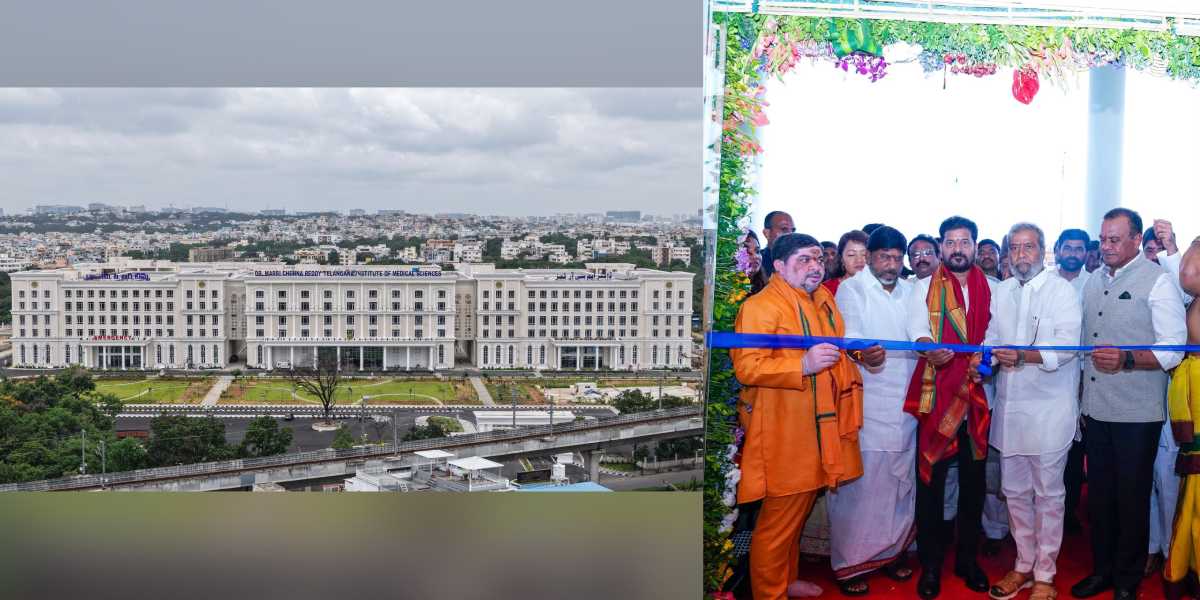

Synopsis: Four years after its foundation stone was laid, Sanath Nagar TIMS has opened, ending a long political tug-of-war over credit. Conceived and initiated under KCR, completed under Revanth Reddy, the 1,082-bed hospital now faces its real test: staffing, services and whether it can deliver advanced public healthcare to patients.
Four years after the foundation stone was laid, the Dr Marri Channa Reddy Telangana Institute of Medical Sciences (Dr MCR TIMS) at Sanath Nagar opened its doors to the public on Monday, 17 August. The institute was inaugurated by Chief Minister A Revanth Reddy in the presence of Health Minister Damodar Rajanarsimha, other ministers and public representatives.
According to Rajanarsimha, the 1,082-bed hospital will offer cardiac, renal, transplant, trauma and other super-speciality services
Like other infrastructure projects that have spanned multiple years and different governments, the institute is also witnessing a tug-of-war between the Congress and the Bharat Rashtra Samithi (BRS), with both parties claiming credit for building the hospital.
The hospital spans two phases of Telangana’s political history. The BRS government conceived the idea, planned the project and laid the foundation stone. Congress took over construction after the transition and pushed the project through to completion.
Both parties, however, tell the story differently. BRS credits former Chief Minister K Chandrashekar Rao with building large, government-run institutions that deliver corporate-level healthcare to the poor. Congress credits itself with reviving and finishing projects it says the previous government announced and abandoned.
For the people who use it, the only thing that matters is whether the hospital functions effectively.
The pandemic exposed the limits of Hyderabad’s public healthcare system and pushed TIMS onto the drawing board.
On 26 April, 2022, then Chief Minister K Chandrashekar Rao laid foundation stones for three TIMS hospitals at Sanath Nagar, Alwal and LB Nagar. The state sanctioned ₹2,679 crore for the three projects combined.
The plan gave each hospital 1,000 beds. It promised 200 faculty members, 500 resident doctors, multiple operation theatres, intensive care units, diagnostic services, and postgraduate and super-speciality medical courses.
The government modelled the institutions on AIIMS, combining medical education, research and advanced clinical care under one roof.
At Sanath Nagar, the state sanctioned ₹882 crore and placed the project on the existing Government Chest Hospital campus.
The foundation stone ceremony announced a large expansion of government healthcare in Hyderabad.
But the hospital took years to rise.
Authorities issued administrative sanction on 21 April, 2022, and construction began on 8 February, 2023. Between February and December 2023, the agency completed work worth ₹120.89 crore. Physical and financial progress reached only 13.14%.
Then the project crossed a change of government.
Congress took power in Telangana in December 2023 and completed the remaining construction. That transition now sits at the centre of the political fight over the hospital.
BRS leaders argue that Congress claims credit for a project their party conceived, sanctioned and started.
On inauguration day, BRS working president K T Rama Rao welcomed the opening but framed it as the delayed completion of his party’s project.
“The hospital built by KCR in Sanath Nagar, with the noble objective of providing completely free, corporate-level healthcare even to the poor, finally becoming accessible to the public is a welcome development,” KTR said.
He said KCR envisioned TIMS hospitals across Hyderabad, laid the foundation stones and drove construction during the BRS government’s tenure.
“The Sanath Nagar TIMS will serve not only Hyderabad residents but also patients from the districts who come to the capital in critical condition, providing them with a lifeline,” he said.
Former Health Minister T Harish Rao pushed the BRS argument further.
“It appears that when the idea and execution belong to KCR, the publicity belongs to the Congress,” he said.
He accused Congress of claiming credit for projects the BRS government started.
“You may change the name as easily as you want, but you cannot change the history of who built these hospitals,” he said.
Harish Rao pointed to the 26 April, 2022 ceremony as proof of the project’s origins.
“On April 26, 2022, KCR created history by laying the foundation stones for three government multi-speciality hospitals on the same day. The plan was KCR’s. The foundation stones were laid by KCR. The funds were released by the KCR government,” he said.
He alleged that construction slowed once Congress took power and accused the government of stalling the projects for political reasons.
“After three-and-a-half years, the TIMS Sanath Nagar hospital is being inaugurated today merely for publicity, without providing complete facilities,” he alleged and questioned whether a hospital this size can call itself operational when it hasn’t rolled out every service yet.
BRS also objected to charging patients, pointing to KCR’s original pledge of free, corporate-level healthcare for the poor.
CM Revanth Reddy said his government prioritised healthcare and pushed forward projects that had stalled while mocking the BRS for allegedly abandoning them after announcements.
Naming the different hospital projects initiated by the BRS but allegedly stalled, Reddy said mockingly, “At Sanath Nagar, we (BRS) broke the coconut and sanctioned funds, but then forgot about the construction. At Alwal, we broke the coconut for TIMS and sanctioned funds, but forgot about the construction. At LB Nagar, we broke the coconut for the TIMS hospital and sanctioned funds, but forgot about the construction,” he said.
“In Warangal too, there were speeches about demolishing the existing facility and constructing a new large hospital, but that too was forgotten,” he mockingly added.
The CM also contrasted the alleged delay in initiating the construction of the projects announced during the BRS regime with the pace at which private properties linked to the former ruling party’s leaders went up.
“Did you build even one hospital for our poor people? Did you complete it? Did you inaugurate it? Did you provide healthcare to the poor?” he asked.
He claimed that the Congress allocated funds and sped up the projects after taking office.
“Therefore, after our government came to power, as part of our highest priorities, we have allocated funds and are rapidly completing the construction of Osmania Hospital, Sanath Nagar TIMS, Alwal TIMS, LB Nagar TIMS and the hospital in Warangal,” he said.
He framed the hospitals as part of a wider push to expand government healthcare.
“Once all these hospitals are completed, around 10,000 hospital beds will become available to poor people in Telangana. This will give the poor a sense of confidence,” he said.
He pledged that the new institutions would match standards set by leading private hospitals.
“We will appoint a director for each hospital, and under the supervision of those directors, these hospitals will provide services that compete with what NIMS provides today,” he said. “NIMS has earned recognition for providing services at a level that can compete with AIIMS. In the coming days, we will operate all these hospitals at that level.”
Health Minister Damodar Rajanarsimha said the completed facility cost ₹1,126 crore and covers 53.30 acres, with a built-up area of 11.68 lakh square feet. It holds 1,082 beds across 37 medical departments, including 300 ICU beds, 88 emergency beds, 30 dialysis beds, 400 general beds and 100 medical tourism beds. It has 16 major and five minor operation theatres. The diagnostic and treatment wing includes a 3-Tesla MRI, a 128-slice CT scanner, brachytherapy, CT simulation, endoscopy, bronchoscopy, medical laboratories and a blood bank.
The government positions the hospital as a Centre of Excellence in cardiac, renal, transplant and trauma sciences.
Rajanarsimha said the institution goes beyond treatment.
“Dr Marri Channa Reddy TIMS was not merely a hospital but a key institution aimed at strengthening Telangana’s public healthcare system,” he said. He added that the government wants public hospitals to deliver treatment that competes with corporate hospitals.
The hospital will also carry a medical education and research wing. Planners intend to establish a postgraduate medical college on the NIMS model.
The institute has set aside 100 beds for medical tourism. The government plans to run an International Medical Tourism Conference every year. Rajanarsimha said revenue from medical tourism will fund development at government hospitals.
Also Read: Weight loss drugs: Telangana raids 43 medical shops over prescription violations
TIMS Director Dr A Narendra Kumar said the government sanctioned 2,360 technical and medical posts for the institute.
“Usually, 60% are regular employees and 40% are on contract. The remaining positions are through outsourcing,” he said.
Regular recruitment has not started.
“The government has recently given 2,360 posts for this institute. Recruitment has not yet started because this is an autonomous institute, so there is a recruitment process similar to the NIMS Recruitment Board. First, we have to start the recruitment board and then take up the recruitment,” Kumar told South First.
Meanwhile, the government leans on redeployment to staff the hospital. “Till now, the government has given us a redeployment of almost 1,200 posts which are vacant in various colleges. They have been directed here and asked us to fill them on a contract basis,” he said.
Through this route, the hospital has recruited 144 medical officers and more than 80 laboratory and other technicians.
Another recruitment stream draws on posts originally set aside for NIMS expansion.
“One is regular recruitment, one is redeployment and one is NIMS recruitment,” Kumar said.
The hospital plans to scale up inpatient services gradually, too. “Inpatient services will start immediately after two days,” he said.
But the hospital won’t run at full scale from day one.
“We have to go in a stepwise manner. Initially, we wanted to run it like an extension of NIMS. NIMS has a large volume of patients and does not have enough beds, so the government will utilise this as an extension of NIMS services,” Kumar said. “Gradually, we will build up the inpatient services. Initially, there will be daycare services. Slowly, we will build up the inpatient services.”
The hospital’s design gives it capabilities that go beyond a standard government hospital.
Engineers installed modular operation theatres and a pneumatic tube system that links different parts of the hospital.
Kumar said staff will use the pneumatic system to move laboratory samples, medicines, blood during emergencies, and paperwork such as discharge summaries.
“There are around 24 stations across the entire hospital, so we can send materials from one station to another,” he said.
The modular operation theatres install faster than conventional theatres, improve sterility and hold pressure better, Kumar said.
“The second advantage is sterility. They are easy to clean and are made of stainless steel or a special type of iron with an antibacterial coating. There are no joints or connections between the panels, which helps reduce bacterial growth,” he said.
The theatres also run an anaesthetic gas scavenging system.
“A lot of gases are released during anaesthesia, and some of these gases or their products can be toxic in the long term. This OT has an anaesthetic gas scavenging system, or AGSS, which removes these toxic gases,” Kumar said.
The Telangana Institute of Medical Sciences Act, 2024 sets up autonomous institutions with governing and executive councils, medical education, research powers and independent recruitment.
The Sanath Nagar institute will follow a structure similar to another government institution Nizam Institute of Medical Sciences(NIMS). But the government hasn’t finished building that structure yet.
“The governing council is still to be formed. The governing council will be headed by the Chief Minister. Next is the executive council, which will be headed by the Health Minister. Then there will be the directors, with medical and non-medical representatives,” Kumar said.
Group One administrative officers haven’t taken up their posts either. “Officially, I am the first person to be posted, and through me the superintendent post, along with the medical superintendent, will be appointed,” he said.
That leaves TIMS with a second task ahead: building the administrative machinery that keeps the hospital running once the inauguration fades from the news cycle.
Another chapter in the TIMS story offers a caution. The first TIMS facility rose at Gachibowli during the pandemic.
In April 2020, the state converted a Sports Hostel building into a dedicated COVID-19 hospital under the TIMS name. The government sanctioned 662 personnel for a year to run it.
The hospital admitted its first patient on July 12, 2020. During the pandemic, it treated more than 12,000 outpatients and 9,500 inpatients.
Once the crisis passed, its activity dropped sharply. And no one knows when the institute disappeared and was replaced with the previous sports hostel.
That history matters because Sanath Nagar carries a far bigger scope.
The real test for a hospital this size starts after construction ends. Infrastructure needs upkeep. Staffing needs continuity. The government needs to fund operations for years.
The political question asks who deserves credit for TIMS. The administrative question asks whether recruitment, autonomy and budgets keep pace with the buildings. The medical question asks whether the hospital can attract and hold onto specialists who can operate the equipment now going in. And the human question asks whether a poor patient can walk in and receive treatment that would otherwise mean an expensive trip to a private facility.
(Edited by Fayisa CA)



