
Published Sep 20, 2026 | 9:40 AM ⚊ Updated Sep 20, 2026 | 9:40 AM

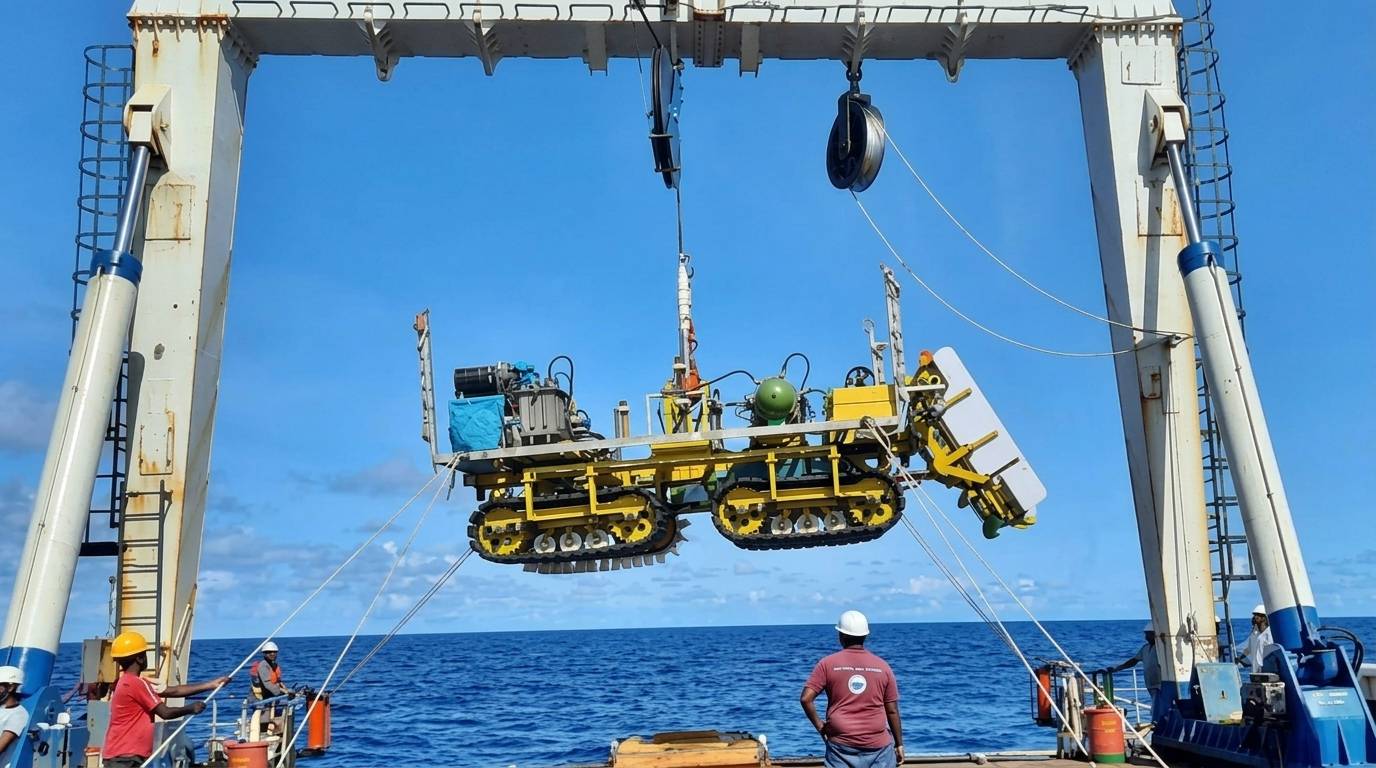
India's seabed mining machine Varaha-3. (Photo: NIOT)

This note is in response to reading two documents separated in time by a decade—Adam Jadhav’s 2016 monograph Minerals from the Sea and P Ragavan’s recent article in The Hindu of 19 September 2026, “Balancing deep-sea discovery with environmental stewardship.”
Ten years separate these two texts, yet they converge on a single, unsettling question.
Jadhav’s political-economic critique and Ragavan’s ecological caution both arrive at the same fundamental challenge: India stands at the threshold of a new frontier, but the most important question is not how deep we can go or how much we can mine, but whether everything that can be technologically exploited necessarily should be.
The decade between them has witnessed significant technological progress—India’s Deep Ocean Mission has tested mining systems at 5,270 metres, developed the MATSYA-6000 submersible, and surveyed 25 seamounts, documenting 195 deep-sea species. Yet the fundamental dilemmas Jadhav identified in 2016 remain unresolved. If anything, they have sharpened.
Jadhav’s central contribution was to name and dissect what he called the “development-minerals-ocean nexus”—a hegemonic logic that presumes economic growth requires relentless resource extraction, that scarcity is inevitable, and that the ocean must be enclosed and privatised to serve national development. This framing, crystallised in then Union Minister for Science and Technology and Earth Sciences Harsh Vardhan’s 2015 call to “grab India’s legitimate share” of ocean wealth, constitutes what Jadhav termed “problem closure”: a framing that restricts debate to how extraction should proceed, foreclosing the more fundamental question of whether it should proceed at all.
A decade later, this logic has only intensified. The Ministry of Earth Sciences and NIOT convened an Industry Outreach Workshop in September 2026 on “Deep Sea Mining—Business Opportunities and Strategic Importance”, explicitly framing the transition from exploration to commercial capability as creating an integrated “mine-to-metal” ecosystem. The language of “business opportunities” and “strategic importance” echoes the same developmental imperative Jadhav critiqued: extraction is presumed necessary, and the only question is how quickly India can position itself.
Jadhav also identified the neoliberal turn in ocean governance: public resources progressively privatised, the state transformed from resource guardian to enabler of private capital. The September 2026 workshop, bringing together “global and domestic policymakers, regulators, technology developers, research institutions, and financial leaders,” suggests this trajectory continues. The language of “bankable project roadmaps” and an upcoming White Paper on Deep Sea Mining to “guide India’s industrial integration” reveals a governance framework being constructed around private-sector participation rather than ecological precaution.
The decade since Jadhav’s monograph has produced significant new scientific evidence. The most consequential is the 2025 study of the NORI-D collector test in the Clarion-Clipperton Zone of the Pacific Ocean, the first full-scale contemporary mining trial to be scientifically assessed.
The findings are stark: macrofaunal density decreased by 37% directly within mining tracks, alongside a 32% reduction in species richness. In the areas affected by sediment plumes, while faunal abundance did not change, species dominance relationships were altered, reducing overall biodiversity.
These results confirm what Ragavan argues in 2026: we cannot confidently predict the consequences of large-scale seabed disturbance while our understanding of these ecosystems remains incomplete. The Clarion-Clipperton Zone alone is estimated to contain over 90% undescribed taxa (groups into which living beings with similar qualities, especially plants or animals, are organised).
As Ragavan notes, India’s own biodiversity surveys across 19 seamounts have studied around 1,300 deep-sea organisms, including nearly 23 species reported as new to science. Each new species discovered is a reminder of how much remains unknown.
Additional research has revealed that mining discharge plumes are nutritionally poor, with medium and large plume particles containing significantly lower amino acid concentrations than background particles. This suggests that sediment plumes may disrupt midwater food webs not merely through physical smothering but through nutritional deprivation—a mechanism entirely unforeseen before this research.
A decade after Jadhav documented the “nascent: state of seabed mining regulation, the ISA’s (International Seabed Authority) Mining Code remains incomplete. As of March 2026, the Council concluded Part I of its 31st Session having discussed 29 of 32 outstanding issues, with several agreed only “in principle.”
The Exploitation Code—which would govern commercial mining in international waters—does not yet exist. India’s own Parliament was informed in March 2026 that “commercial mining in international waters is as per the ISA Exploitation Code for polymetallic mining, which is non-existent as of date.”
The global consensus is shifting. As of August 2026, 46 countries—over a quarter of ISA member states—support a precautionary pause or moratorium. Six African nations have joined since May 2026, citing the lack of sufficient science and persistent governance gaps. The IUCN (International Union for Conservation of Nature) maintains that its six conditions for lifting a moratorium have not been met. This includes the demand that “the risks of mining are comprehensively understood, and effective protection can be ensured.”
The precautionary principle is not merely aspirational. It is embedded in international law through the Rio Declaration and affirmed by the International Tribunal for the Law of the Sea, which has established a direct nexus between human activity and marine pollution. In India, courts have interpreted the precautionary principle as “the law of the land,” placing the burden of proof on developers to demonstrate environmental benignity.
Ragavan’s argument that “necessity must be demonstrated, not presumed” aligns precisely with this legal obligation. The question should not be “How can we mine with minimum damage?” but “Do we need to mine at all?” This is not an argument against science, but for more science before potentially irreversible intervention.
India has the opportunity to lead a different model. Ragavan suggests India could recognise the deep ocean not merely as a mineral reserve, but as a precious ecological asset whose value may exceed that of its mineral wealth. This would reaffirm India’s long-standing civilisational tradition of living in harmony with nature.
The Deep Ocean Mission’s biodiversity vertical—with its surveys, microbial isolations, and species discoveries—already demonstrates a commitment to understanding these ecosystems. That knowledge could inform a decision that some frontiers are best left untouched. Jadhav’s analysis offers concrete strategies: an independent review body with monitoring and enforcement powers; earlier environmental clearance requirements before exploration contracts are awarded; and a recommitment to scientific capacity.
The deep ocean is not a warehouse for human wants. It is a complex, fragile, and largely unknown realm whose ecosystem services—carbon cycling, climate regulation, nutrient regeneration—sustain planetary life. The development-minerals-ocean nexus offers a familiar and seductive logic: scarcity demands extraction, technology will manage risk, and national interest justifies speed. But this logic has already been applied on land with devastating results. Extending it to the deep ocean, where our ignorance is profound, and recovery timescales are geological, would repeat the mistake on a scale from which there is no return.
India should formally endorse a precautionary pause. The question is not whether we can mine. It is whether we should—and that question deserves an answer grounded in science, not presumption.
Also Read:
Vizhinjam tango: Kerala footed the bill—the coast is paying the rest
A retrograde tide: Kerala’s 2026 budget and the betrayal of the sea
(John Kurien is a retired Professor of the Centre for Development Studies, Thiruvananthapuram and was also Vice-Chair of the UN/FAO Advisory Committee on Fisheries Research for over a decade.)



