

Published Nov 15, 2026 | 8:00 AM ⚊ Updated Nov 15, 2026 | 8:00 AM

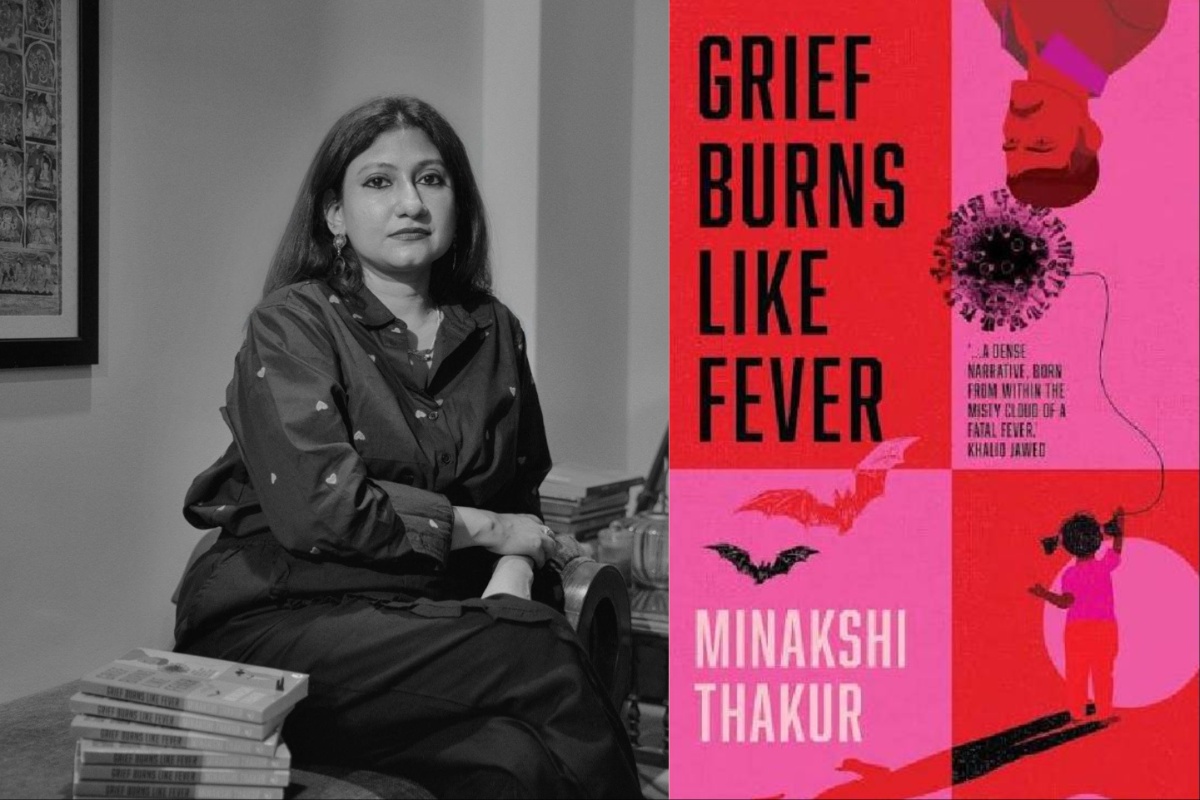
Minakshi Thakur’s Grief Burns Like Fever records the memory of an event that remains painfully real.

Synopsis: Minakshi Thakur’s ‘Grief Burns Like Fever’ revisits the devastating second wave of COVID-19 through an ambulance driver in Delhi and the lives he encounters. The novel explores grief, institutional failure, exploitation and solidarity, highlighting marginalised communities’ networks of care. The novel preserves the pandemic’s emotional history beyond the statistics, writes.
There are disasters that history records in numbers and those that memory preserves through faces. COVID-19 produced both. Infection rates, death counts and hospital statistics could measure the crisis, but not what it meant to wait outside a hospital with an oxygen cylinder, carry a body that could not be mourned, or hear a loved one’s last words through a phone outside an intensive-care ward.
Minakshi Thakur’s Grief Burns Like Fever returns to that terrible interval through fiction. Set in Delhi during the second wave, the novel moves through hospitals, cremation grounds, homes and informal settlements, with an ambulance driver at its centre, increasingly carrying the dead to makeshift crematoria. Around him gather mourners, caregivers, opportunists and survivors.
The novel’s achievement lies not in finding another language for death, but in asking what happens to ordinary relationships when death becomes routine, institutions begin to fail, and compassion exists alongside exploitation. Its title captures this condition: grief is not merely what follows death. It spreads through households, relationships, workplaces and memory, moving through the city like an infection.
Also Read: Howzatt!: Ducks, heroes, records, controversies and more—150 years of Test cricket
The ambulance is the novel’s most effective structural device, allowing Minakshi Thakur to turn Delhi into a moving map of the pandemic. Hospitals become destinations of uncertainty, crematoria become unavoidable stops, and roads become corridors between life and death. Covid redraws the city’s familiar geography while exposing the inequalities beneath it.
The driver carries his own losses, including his wife and his lover, Ruma. He is therefore not an impartial witness. Every body he transports intersects with his own grief.
Through his journeys, the pandemic emerges not as one vast catastrophe but as a series of human situations: a boy losing his mother, a nurse unable to mourn, a young man grieving his father, and sex workers and hijra communities creating fragile networks of care. Alongside them are oxygen hoarders and those who exploit vulnerability.
The city thus contains two pandemics: the biological crisis and the crisis of human behaviour it exposes.
Every pandemic novel inevitably enters into conversation with Albert Camus’s The Plague, where disease becomes a test of human behaviour, revealing denial, solidarity, selfishness and moral responsibility. Minakshi Thakur’s Grief Burns Like Fever, however, works from a different historical distance. Camus transforms plague into philosophical allegory. Minakshi writes from within the memory of an event that remains painfully real: overflowing hospitals, cremation grounds, oxygen shortages and families separated from their dying.
In the Indian context, the novel also belongs to a growing Covid archive. Raj Kamal Jha’s The Patient in Bed Number 12 revisits the pandemic through interconnected stories of illness, loss, isolation, migration and fractured relationships. Praveen Kumar’s Hindi novel Amar Deswa turns to the social devastation of the pandemic, particularly its impact beyond the metropolitan imagination. Jyoti Yadav’s Faith and Fury: Covid Dispatches from India’s Hinterland, meanwhile, approaches the same rupture through reportage and individual testimony.
What distinguishes Minakshi’s novel is its inward movement. These books document different dimensions of the catastrophe, but Grief Burns Like Fever asks how such an event continues to live inside households, relationships and memory. Its pandemic is not merely a historical episode. It is an experience that alters the emotional geography of a city long after the immediate crisis has passed.
Also Read: ‘Who Owns the Past?’ The battle for the nation’s archive
Some of the novel’s most affecting passages leave hospitals and crematoria for the domestic world.
A young mother, confined indoors with her husband and child, experiences postpartum distress as news of the pandemic filters into an already fragile household. Cooking, cleaning, medication and childcare become repetitive attempts to preserve a normality that has already disappeared.
Here the novel becomes more than a Covid narrative. Minakshi uses the pandemic to explore loneliness, marriage, motherhood and psychological disorientation. In this sense, the novel recalls Emily St. John Mandel’s Station Eleven, though from the opposite temporal position. Mandel asks what remains after catastrophe; Minakshi asks how people live when catastrophe is still unfolding.
The novel also resists dividing its world neatly between victims and villains. The pandemic creates both extraordinary care and ruthless exploitation: oxygen becomes a commodity, vulnerable families are manipulated, while marginalised communities build their own networks of survival.
Minakshi’s portrayal of sex workers and hijra communities is particularly significant. They are not merely victims of the crisis but active participants in caring for one another through food, medicine, information and companionship. The novel leaves us with a difficult question: when institutions fail, who assumes responsibility for those left outside them? Often, it is those with the least formal power.
Minakshi Thakur comes to fiction with the sensibility of a poet and translator, and her prose often carries that intensity. Images of heat, illness, exhaustion and decay recur throughout the novel, giving grief a distinct physical presence.
At its best, this language creates the novel’s emotional temperature. At times, however, the metaphors become excessive, while the shifts between characters and narrative registers can disorient the reader. Yet this fractured form also reflects the experience of a pandemic, where attention moves abruptly from hospital to home, crematorium to memory.
The question is not whether the fragmentation works, but whether each fragment earns its place. Some do more convincingly than others.
Also Read: La Grande Illusion: Why the greatest war films are the ones that reject battle
The most powerful passages in Grief Burns Like Fever are often those in which Minakshi Thakur does least: a person waiting for an ambulance, a nurse unable to pause for grief, strangers helping one another, a family trying to preserve ordinary routines as the world outside becomes incomprehensible.
These moments reveal what statistics cannot preserve. The pandemic has entered history through numbers and images of overflowing hospitals, oxygen shortages and cremation grounds, but its emotional history remains unfinished. Who answered the phone? Who brought food? Who shared a cylinder? Who stayed with someone who had no one?
This is where Minakshi’s novel finds its place in the growing literature of Covid. Like Camus, she is interested in human conduct during catastrophe; like Jyoti Yadav, she attends to lives obscured by statistics; like Emily St. John Mandel, she asks what catastrophe leaves behind. But her territory is more immediate: a city in crisis, its institutions failing and its people trying to hold one another together.
The novel is uneven. Some characters are more fully realised than others, some transitions are abrupt, and the prose occasionally explains what a scene has already conveyed. Yet its central achievement remains significant. Grief Burns Like Fever understands that a catastrophe is never one story. It is thousands of private catastrophes unfolding at once.
Delhi becomes, in these pages, a multitude of separate worlds: the ambulance, the hospital corridor, the locked apartment, the crematorium, the settlement and the room where someone waits for a phone call that may never come. The emergency ends, but grief does not. The city becomes recognisable again, while those who lived through those months carry another city within them. That is the human map Minakshi Thakur’s novel preserves.
Title: Grief Burns Like Fever
Author: Minkashi Thakur
Publisher: Tranquebar Westland
Price: ₹499.00
(Views are personal. Edited by Fayisa CA)



