

Published Nov 01, 2026 | 7:00 AM ⚊ Updated Nov 01, 2026 | 7:00 AM

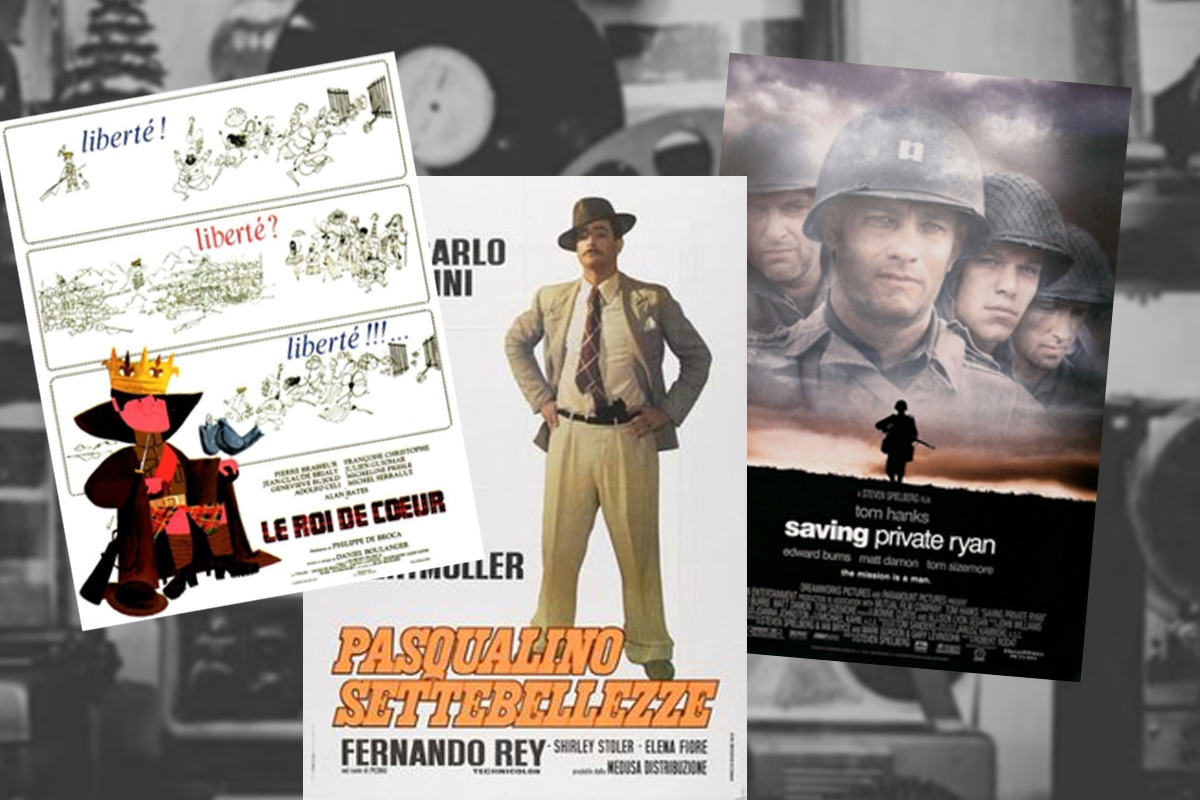

There may not yet be a world war, but the world is at war. Human history is continuous conflict with occasional, fragile periods of relative calm. As Tacitus wrote: “They make a wasteland and call it peace”.
Unsurprisingly, war is a frequent cinematic subject, offering action, drama, tragedy, and, as in Robert Altman’s 1970 M.A.S.H., black comedy. The films deal in friendship and enmity, heroism and cowardice, or cruelty and kindness. Many are ‘buddy’ movies. They can be intimate, closely observed pieces or vast historical panoramas of variable accuracy.
Most war films traffic in Manichean good and evil, featuring ridiculous caricatures of ‘baddies’ framed by prevailing geopolitics. Russians and Chinese are perennial villains for Hollywood, as Americans must be in their films. Much of this is propaganda designed to subtly condition audiences, particularly in times of geopolitical conflict.
English-language, Hollywood films frequently nominated as good war films include: The Bridge on the River Kwai (1957), Paths of Glory (1957), The Deer Hunter (1978), Apocalypse Now (1979), Platoon (1986), Full Metal Jacket (1987), Schindler’s List (1993), Saving Private Ryan (1998), The Hurt Locker (2008), and Inglourious Basterds (2009). Some are fine works with notable vignettes.
The Deer Hunter’s prisoner-of-war (POW) sequence set in a bamboo cage on a river and the brutal Russian roulette scenes are haunting.
The opening sequence of Apocalypse Now — Brando’s face upside down against a jungle on fire from napalm strikes with the soundtrack of helicopter blades and The Doors’ The End — remains hypnotic. The gunship attack on a coastal village, ushered in by Wagner’s Flight of the Valkyries and ending with Robert Duvall’s Colonel Bill Kilgore stating his love of the smell of “napalm in the morning”, is powerful.
Saving Private Ryan’s lengthy, blood-spattered, merciless carnage of the Normandy Beach landing is stomach-churning in its realism.
Despite their technical achievements, these films celebrate the horror, fury, pain, and terror of battle. They portray courage, heroism, sacrifice and suffering of wars without ever delving into the real purpose or ultimate meaninglessness of conflicts.
As technology allows greater immediacy and media streams real conflict to our devices, actual action-packed war films have lost their power. Audiences unconsciously distance themselves from the true dread and suffering. Quentin Tarantino’s Inglourious Basterds is the summation of these stylish synthetic portrayals — films about films of wars.
There are several notable films (presented in roughly chronological order) which offer a subtler perspective.
Lewis Milestone’s All Quiet on the Western Front (1930)
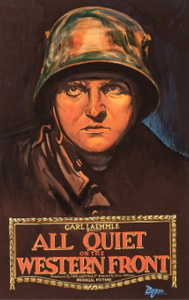
Adapted from Erich Maria Remarque’s 1928 novel, the film follows young German soldiers in World War I.
Gulled by an impassioned speech by their teacher about the glory of defending the fatherland, the boys volunteer. Their illusions are quickly shattered during training, which anticipates the memorable first part of Kubrick’s Full Metal Jacket of a marine boot camp where a foul-mouthed drill sergeant trains recruits with ultimately horrifying results. At the front, any remaining patriotism or humanity is destroyed by the deadly realities of trench warfare.
In one scene, after the company suffers heavy losses without any meaningful gain, each man receives double rations because of the reduced numbers. During a battle, the main character, Paul, stabs a French soldier and finds himself trapped in a shell-hole with the dying man. Distraught, he attempts first aid and begs for forgiveness. The wanton destruction and dehumanisation question the notion of war itself.
The opening caption is interesting: “This story is neither an accusation nor a confession, and least of all an adventure, for death is not an adventure to those who stand face to face with it. It will try simply to tell of a generation of men who, even though they may have escaped its shells, were destroyed by the war.”
Toward the end of All Quiet on the Western Front, a cold, exhausted young soldier, weary of death, rests in the trenches. In front of him, the arresting shot focuses on a butterfly in front of him.
With its then-innovative cinematography, sound and visual effects, the film remains influential.
Jean Renoir’s La Grande Illusion (1937)
Orson Welles stated that one of the films he would save for posterity was Renoir’s humanist drama La Grande Illusion.
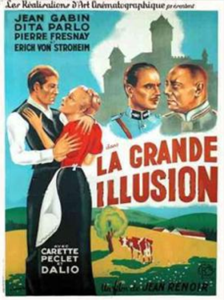
Set in prison camps rather than battles, it revolves around a captured French flying ace (De Boieldieu, played by Pierre Fresnay) and a wounded aristocratic German officer who now commands the POW facility.
Erich von Stroheim as the commandant von Rauffenstein, his rigid body held in a neck and back brace and his eye squinting through a monocle, is magnificent. The other main characters — Marechal (Jean Gabin), a workingman, and Rosenthal (Marcel Dalio), a Jewish banker — are excellent.
The film’s well-known sequences — the escape tunnel, the famous talent show scene where a man is costumed as a woman, and the singing of La Marseillaise to enrage the Germans — anticipate similar setups in The Great Escape and Casablanca.
But it is the exchanges between De Boieldieu and Rauffenstein that dominate. The French aristocrat is fatally shot by the German while distracting attention from Marechal and Rosenthal’s successful escape. The deathbed farewell between De Boieldieu and Rauffenstein and the scene where the German destroys a geranium flower, signifying the end of all joy and hope, remain iconic.
La Grande Illusion never lapses into clichés or nationalism. Its unusually fluid structure and narrative shifts allow Renoir to create contrasting moods.
The title is complex. There is an oblique evocation of Norman Angell’s false belief that the war was impossible. It mocks the belief among combatants that the war would be short-lived. Most of all, it refers to the passing of an age, the collapse of the old European order, which Renoir’s 1939 The Rules of the Game also explored. The ‘War to end all Wars’ destroyed the German, Russian, Austro-Hungarian, and Ottoman empires. As de Boieldieu tells Rauffenstein: “Neither you nor I can stop the march of time.”
The Best Years of Our Lives looks at three veterans returning from WWII trying to re-integrate back into society and their lives. While the war itself always remains in the background, it is a coruscating insight into the human cost.
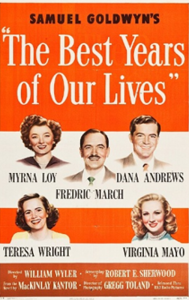
The movie crosscuts the stories of the three men: Al Stephenson (Fredric March), an infantryman, returning to his family and his pre-war banking career; Fred Derry (Dana Andrews), a crew member on a bomber; and Homer Parrish (Harold Russell), a Navy man who lost both hands and now uses steel hooks. Their anxious and tense reunion evokes the best of Eugene O’Neill and Edward Albee. All the characters and their families and friends that stayed behind are haunted by wartime experiences and adopt various coping stratagems ranging from avoidance, pity, kindness, and alcohol.
The Best Years of Our Lives revels in the ordinariness of its characters. The film is sparse, relying on the strength of the story and the dialogue for power. Watching Homer walk to the front door, Fred remarks: “You gotta hand it to the Navy, they sure trained that kid how to use those hooks.” Al’s acidic reply is: “They couldn’t train him to put his arms around his girl, or to stroke her hair.”
The striking visuals by cinematographer Gregg Toland, who worked on Citizen Kane, use deep focus instead of cutting or tracking to follow movement. There is a powerful sequence where Fred, waiting for his military transport flight, at the airport wanders into a vast graveyard of mothballed warplanes. He was once needed to fly these planes, but both are superfluous.
The film is a sober look at the real cost of war and the problems that soldiers face when they return home, a problem that has only become greater over time.
Set in the colonial war between the Pied-Noir settler class (backed by metropolitan France) and the Algerian Front de Libération Nationale, this is an uncompromising film. It centres on Paratrooper commander Colonel Mathieu, sent to squash the uprising, and Ali la Pointe, a former petty criminal now leading the Algerian Front de Libération Nationale (FLN). The narrative depicts the escalating guerrilla campaign and the ruthless French actions to eliminate the independence movement.
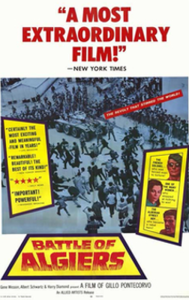
The FLN bombs civilian targets while their better-equipped opponents counter with a systematic campaign of isolating terrorist cells, torturing and eliminating them. One scene is of a press conference where a French journalist asks a captured FLN leader: “Do you not consider it cowardly to send your women carrying bombs in their handbags, to blow up civilians?” The reply is telling: “And do you not think it cowardly to bomb our people with napalm? … Give us your airplanes and we will give you our women and their handbags.” The torture of the FLN members, including blowtorching, waterboarding, and electrocution, is shown factually without dramatic emphasis. It is as if the young Italian Director is filming a training film.
The film’s graphic images are sometimes extraordinary: an old man being beaten by soldiers; a small Arab boy attacked by French civilians in the aftermath of a bombing; and a young Arab girl, selected because she can pass as French, planting a bomb in a cafe. The Battle of Algiers never minimises the horror of urban guerrilla war.
Filmed in stark black-and-white, as if to signify that you cannot remain neutral in this conflict, the film was shot in the actual cafes and casbahs of Algiers, giving it authenticity. The striking resemblance to a documentary forced Pontecorvo to announce at the start of the film that there is “not one foot” of documentary or newsreel footage in the work.
The film’s power comes from the cold realism about counter-terrorism and counter-insurgency. Its strength lies in its intensity but neutrality, as it does not argue for either side. While set in the Algerian War, it is universal in its study of similar conflicts everywhere.
Perhaps the most unusual work about war, Seven Beauties is Brecht-like in its ambiguity, mixing drama and comedy, kindness and cruelty, banality and wisdom. It divided critics and audiences.
The plot revolves around the dim-witted Pasqualino (played intelligently by Giancarlo Giannini, with whom Wertmüller made several films), a petty thief who considers himself a ladies’ man.
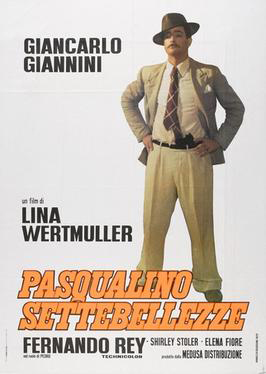
Before the Second World War, shown through flashbacks, he lives off his seven sisters (the ironic title refers to their homely appearance). Obsessive about his honour, when one of his sisters goes to work in a brothel, Pasqualino murders the pimp. Facing a long prison sentence, he pleads insanity and is transferred to a mental asylum where he rapes a female patient. To escape punishment, Pasqualino chooses military service. When the Italian front collapses, he deserts and is captured by the Germans and sent to a concentration camp.
Much of the film takes place in the camp. To survive at all costs, Pasqualino wants to seduce the obese, sadistic, whip-brandishing female camp commandant (well played by Shirley Stoler). He romances the commandant in one of cinema’s most grotesque seductions, whistling, singing, winking, and smiling to secure a private tryst. Their coupling is the most unerotic ever portrayed as the prisoner weakly crawls up the woman’s large body. Unable to perform due to malnutrition, the woman tells him: “First you eat, then you f**k. If you don’t f**k, then kaput.” Undeceived by his lies, the commandant forces him to select six fellow prisoners for extermination, and to personally kill his friend.
Against the odds, Pasqualino lives through the war and returns to Naples, a shell of a man. Wertmüller later told interviewers that Pasqualino would have been better off dead.
Seven Beauties has multiple levels. Wertmüller satirises the hypocrisy of males, a frequent theme in her work. She uses the narrative to suggest Italian complicity in the war and the Holocaust. The film exposes how ordinary people will sacrifice everything, including their ideas, beliefs and dignity (which in Pasqualino’s case was in short supply anyway) to live through disordered times.
Superbly acted, seductively beautiful in its cinematography, and full of precisely observed detail, the film is a harrowing depiction of the shallowness and hypocrisy of human beings.
Submarine warfare, with its anxieties and terrors, is a frequent subject for war films such as The Enemy Below, Run Silent, Run Deep, The Bedford Incident, and The Hunt for Red October. The standout is Das Boot, which portrays life onboard a German U-boat during World War 2.
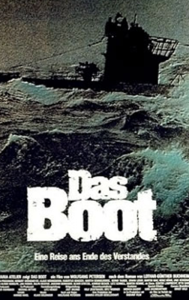
Resembling a documentary, it follows a single mission to attack Allied shipping in the North Atlantic. The central action is the attack when the U-boat torpedoes three ships, following the hunt, and then the long counterattack as destroyers search for the submarine, dropping depth charges. The switch from hunter to hunted is compelling.
The culmination of the encounter is when the U-boat, having escaped its pursuers, surfaces to sink a burning tanker. As the ship explodes after a torpedo strike, the captain realises that the crew have not been rescued as he assumed. Some swim towards the submarine hoping for rescue. The captain orders his boat to reverse at half speed, allowing the sailors to drown.
The difference between a ship seen at a distance through a periscope and the direct encounter with the drowning sailors whose cries can be heard is stark. There are few better films in capturing the tragedy, effects and emotions of war on those who must fight.
Das Boot’s strength is its technical brilliance. The film’s action takes place inside the cramped submarine or on the bridge, dominated by close-quarter shots. This and the fast, constant movement convey the visceral feel of war. Sound is central. The lengthy pursuit alternates between the threat from sonar pings and the depth charge explosions. The fear of the huddled crew, bound by helplessness, waiting to be blown up or crushed by water pressure, is terrifying.
The 1997 Director’s Cut is 45 minutes longer and supposedly closer to Petersen’s original vision. In reality, it adds little to the already magnificent original.
Unlike films which focus on world wars, No Man’s Land is set in the 1990s bloody, racially driven, nationalist Balkans war.
In thick fog near Tuzla in Bosnia and Herzegovina, a group of Bosniaks become lost and run into Serb forces. After a firefight, Bosnian Čiki (Branko Đurić), dressed in an incongruous Rolling Stones T-shirt, and Nino (Rene Bitorajac), a young Serb soldier, are trapped in a trench with Ćera, another Bosniak fighter. The complication is that Ćera is lying on a ‘Bouncing Betty’ mine, an anti-personnel ordnance which does not explode when you step on it, but when you step off it. A demining expert is needed to defuse the bomb.
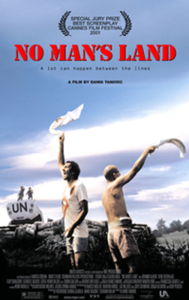
The action revolves around attempts to mobilise the combatants and UNPROFOR (the United Nations Protection Force) to resolve the situation. The officious and unctuous British military commander leading the UN force (Simon Callow), complete with a sultry translator, is cynically incompetent. A French officer (Georges Siatidis) tries unsuccessfully to defy the idiotic rules which prevent the protectors from doing anything. There is a TV reporter (Katrin Cartlidge) reporting on the incident in a familiar over-dramatic fashion.
The film relies on the interaction and verbal exchanges between the main characters. The British military commander mouths inane clichés, hiding behind the mission’s restrictions to avoid involvement. The reporter fails to grasp any of the complexities of the conflict. The combatants, who both speak Serbo-Croatian, heatedly discuss the origins of the war and its rights and wrongs.
No Man’s Land’s strength is the dramatic situation and its drift to its inevitable conclusion. It is a bleak, funny parable of the ridiculousness of war. The central metaphor of individuals trapped and the lack of movement to a resolution is tragic.
Francois Truffaut argued that he had never seen an anti-war film: “Every film about war ends up being pro-war.”
The statement probably refers to the exciting spectacle of combat films that inadvertently glorify war. But all the films mentioned make overwhelming statements about the futility and waste of wars. The greatest evidence against Truffaut’s assertion is Philippe de Broca’s 1967 King of Hearts, which flopped at the box office and is rarely seen today.
The setting is World War I France. When retreating German soldiers abandon a town after mining it with explosives, the inhabitants flee, leaving behind the inmates of the insane asylum. A Scottish regiment despatched Charles Plumpick (a superb Alan Bates) to defuse the bomb even though he is a pigeon trainer, not a munitions expert.
He finds the town taken over by happy and blissful inmates who greet Plumpick as their returned King of Hearts, offering an inmate (played by a very attractive Genevieve Bujold) as his consort. Plumpick does not initially realise that the people are “insane” and tries unsuccessfully to get them to help him locate the bomb. His search is interrupted by German soldiers who are chased from the town after their tanks are stolen by the lunatics. “Let’s go… they’re all crazy!” screams a German officer as they retreat. Several British Army Scotsmen arrive and flee equally disconcerted by the strange goings-on, which is nothing more than the inmates sitting around playing cards, talking, but introducing themselves as nobility.
Charles finds and disarms the bomb. Eventually, the British army arrives and joins in the festivities, mistaking the inmates for regular townspeople. The next morning, just as the regiment is about to pull out, a German regiment marches into town, and their set-piece battle results in all of the soldiers on both sides being killed. Following the battle, the townspeople return, and the inmates retreat to the asylum, rejecting the bloody sane world. Charles decides to join his amusing and eccentric mad friends, walking completely naked through the town to the asylum.
Beautifully performed and full of exquisite scenes (the battle scene is shown as children playing with toy soldiers), it is a meditation on war. It is a stunning indictment of the “normality” that allows people to kill each other. There is nothing like King of Hearts and its carnival of surreal craziness, which is the only sane way to respond to the insanity of kinetic conflict. The film asks us to choose between different forms of madness.
Our age considers itself advanced. Nothing undermines the claims of progress more than our continued embrace of war. Will Rogers’ caustic judgement remains true: “You can’t say civilisation don’t advance…for in every war they kill you in a new way.”
Also Read:
From Being There to Wag the Dog: When cinema gets political without saying so
On Cinema: Political films from All The President’s Men to The Manchurian Candidate
(Satyajit Das is a former banker and author of numerous technical works on derivatives and finance. His latest book, The Everything Bubble: A Guide to the New Age of Financial Speculation and Phantom Wealth, will be released in 2027. He has also written on ecotourism – In Search of the Pangolin (2006) (with Jade Novakovic) and Wild Quests: Journeys into Ecotourism and the Future for Animals (2024). This piece is also being published in Naked Capitalism.)
(Edited by R Rajesh Kumar.)



