
Published Sep 13, 2026 | 11:35 AM ⚊ Updated Sep 13, 2026 | 11:35 AM

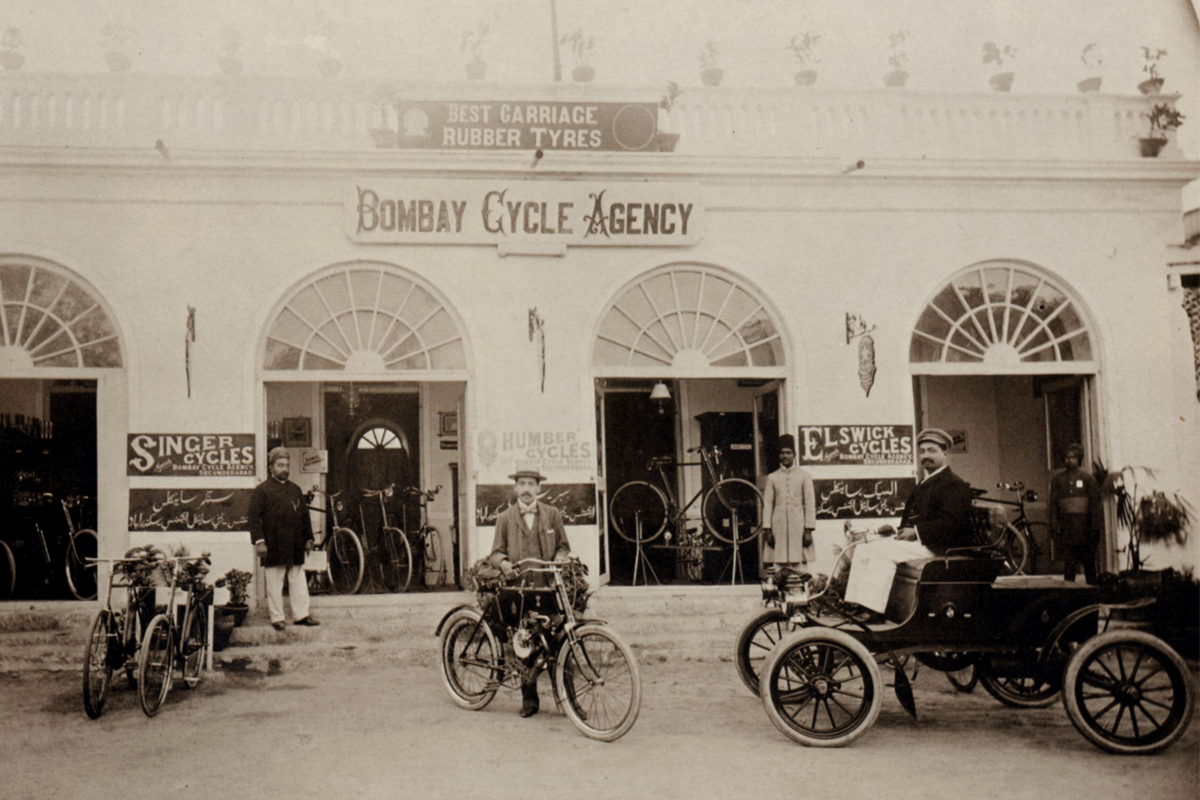
First cycle showroom of Hyderabad in year 1904, located at James Street, Secundrabad. (Photo | wikimedia.org)

Synopsis: The Nizam’s ‘Bicycle Boys’ are an unusual reminder of how early bicycles entered Hyderabad’s public life. In subsequent decades, cycling became embedded in the everyday rhythm of urban existence until scooters and motorcycles took off after economic liberalisation and the subsequent IT revolution made cars commonplace. But Hyderabad’s next achievement should not be measured by how many more vehicles its roads can accommodate.
Softly, O softly we bear her along,
She hangs like a star in the dew of our song;
She springs like a beam on the brow of the tide,
She falls like a tear from the eyes of a bride.
Lightly, O Lightly we glide and we sing,
We bear her along like a pearl on a string.
The lines are from Palanquin Bearers, by one of Hyderabad’s and India’s famous icons, Sarojini Naidu.
She could well have been writing of her home city, where she was born on February 13, 1879. Before Hyderabad learnt to race against the clock, it was a city with time that moved gently and with the gentleness that Naidu evoked in her immortal poem.
Two years before she was born, in 1897, the city had seen its first public procession of bicycles by the Nizam’s “Bicycle Boys”. Seven years later, in 1904, the first cycle showroom, Bombay Cycle Agency, opened on James Street, Secunderabad. And the following year, Hyderabad’s policemen were on their bikes.
The city began to move at the pace of a bicycle soon. Morning streets were marked by the rhythm of pedals rather than impatient honking. Students rode to colleges, clerks cycled to offices, workers travelled to factories and traders moved through bazaars on two wheels.
The bicycle was not a hobby, a fitness choice or an environmental statement. It was simply how Hyderabad moved. To understand the city’s remarkable transportation transformation, one must first remember that Hyderabad was once, in essence, a city of bicycles.
That culture had deep roots. The Nizam’s ‘Bicycle Boys’ are an unusual reminder of how early bicycles entered Hyderabad’s public life. In subsequent decades, cycling became embedded in the everyday rhythm of urban existence. The old city, Abids, Koti, Sultan Bazaar, Nampally and Secunderabad were connected by distances that could comfortably be negotiated on a bicycle. It required no fuel, occupied little road space and demanded almost no supporting infrastructure.
The bicycle was also remarkably democratic. The student, teacher, clerk, artisan and small businessman could all travel on essentially the same machine. Mobility was a necessity rather than a declaration of purchasing power.
That Hyderabad began disappearing as the city acquired a new economic geography. Changes that began in the 1980s gathered extraordinary momentum after economic liberalisation in the 1990s. Population increased, residential colonies spread outward, and new employment centres emerged. The rise of information technology transformed the western part of the city. HITEC City, Madhapur, Kondapur and Gachibowli became symbols of a Hyderabad whose economic activity was increasingly distant from the traditional urban core.
The bicycle began losing its greatest advantage: practicality over distance. A journey that was once five kilometres could become 15 or 20. Time became more valuable, speed became essential, and the two-wheeler emerged as the natural compromise.
Motorcycles and scooters became the bridge between old Hyderabad and the automobile metropolis. They retained the flexibility of the bicycle while offering speed and range. Their affordability made them accessible to the expanding middle class. The bicycle was gradually displaced, not initially by the car, but by the motorised two-wheeler.
The car represented the next stage of aspiration. Rising incomes and changing lifestyles made private automobiles increasingly desirable. Comfort, privacy, protection from weather and door-to-door convenience transformed the car from a luxury into a marker of middle-class achievement and, for many households, a practical necessity.
The statistics capture the magnitude of this transition. In 1991, Hyderabad had about 36,600 registered cars and approximately 2.79 lakh two-wheelers. By 2006, cars had risen to more than 2.3 lakh and two-wheelers had crossed 21 lakh. This was not simply a change in personal preference. It was the transport expression of a city undergoing rapid economic and demographic transformation.
Yet motorisation created its own contradiction. Every additional vehicle increased demand for road space, parking and fuel. Road widening, flyovers and new corridors could improve movement temporarily, but they could not indefinitely overcome the arithmetic of a growing metropolis. The more Hyderabad expanded, the more journeys it generated.
Public transport remained the counterweight. Buses continued to carry large sections of the working population. Auto-rickshaws became indispensable for intermediate journeys. The Multi-Modal Transport System added suburban rail connectivity. But the fundamental imbalance remained: the city was generating travel demand faster than conventional road-based infrastructure could comfortably absorb it.
The metro emerged from this contradiction. When Hyderabad Metro began operations in November 2017, it marked not merely the arrival of another railway but a change in the philosophy of urban mobility. Its eventual 69-kilometre network across three corridors demonstrated the importance of moving people collectively rather than attempting to move ever more private vehicles.
There is an intriguing irony here. The bicycle and the metro belong to completely different technological ages, yet they share a fundamental virtue: efficient use of urban space. A bicycle requires little space and no fuel. A metro train can carry thousands without requiring thousands of cars on the same road. The private automobile, despite its convenience, is far more space-intensive when measured against the number of people it normally carries.
Hyderabad today contains all these transport generations simultaneously. Bicycles remain visible, though pushed towards the margins. Two-wheelers dominate personal mobility. Cars represent prosperity and convenience. Buses remain the workhorse of mass transportation. MMTS serves suburban commuters, while metro trains increasingly form the backbone of movement along major corridors.
The question now is what Hyderabad wants its next transport chapter to look like. The answer cannot simply be more roads and more vehicles. Nor can it be a simplistic rejection of private transport. The city needs a hierarchy of mobility: walking and cycling for short distances, buses and metro trains for mass movement, and private vehicles where they genuinely provide an advantage.
Hyderabad’s bicycle past offers an important lesson. People did not abandon bicycles merely because they suddenly preferred cars. They moved to motorised transport because the city became larger, journeys became longer and time became more valuable. If automobile dependence is to be reduced today, alternatives must therefore become genuinely convenient rather than merely asking citizens to change their habits.
Hyderabad’s journey from pedals to petrol and from petrol towards rail-powered mobility reflects a city that has discovered both the benefits and the limits of motorisation. Its future should not be a city where bicycles disappear beneath cars or cars disappear beneath metro pillars. It should be a city where different forms of mobility coexist intelligently.
The city that once moved quietly on bicycles has travelled a remarkable distance. Its next achievement should not be measured by how many more vehicles its roads can accommodate, but by how efficiently it can move people with less space, less time and less environmental cost. That would be the real measure of Hyderabad’s journey—from a city of cycles to a truly modern metropolis.
Also Read:
Warangal: Centre of dissent and citadel of defiance
Bonalu: Where Telangana comes alive for the mother goddess
(Edited by R Rajesh Kumar.)



