

Published Aug 25, 2026 | 7:00 AM ⚊ Updated Aug 25, 2026 | 7:00 AM

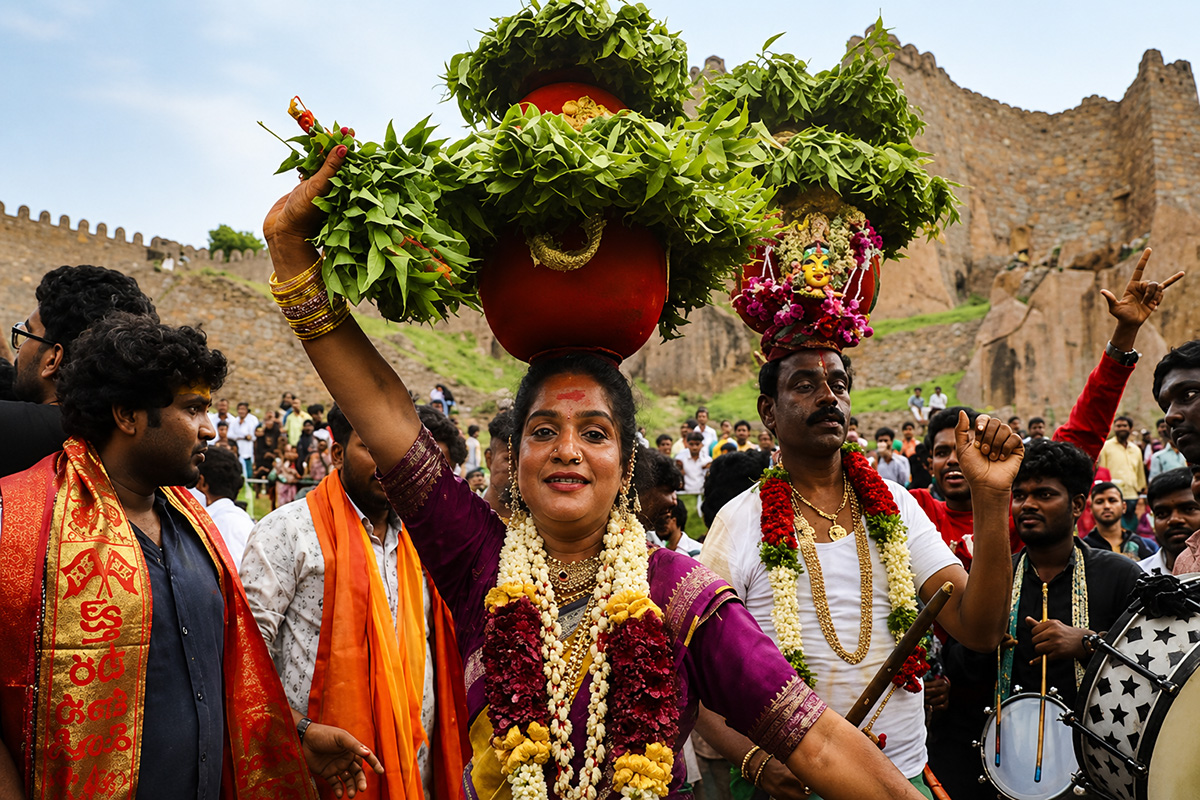
The inverted pot in the Bonalu dance represents instability, while the goddess speaking through the oracle represents restoring order and guidance.

Bonalu is one of Telangana’s most important folk festivals, celebrated primarily in Hyderabad, Secunderabad, and other parts of the state during the Hindu month of Ashada (roughly July–August, during the monsoon season).
Here’s a detailed look at its origins and traditions.
The most widely-cited origin story dates to 1869. Hyderabad and Secunderabad were hit by a devastating outbreak of plague/cholera. Soldiers of the Musarambagh battalion, stationed in Secunderabad, prayed to Goddess Mahakali at the Ujjaini Mahakali Temple, believing the epidemic was caused by the goddess’s anger and that she needed to be appeased.
When the epidemic subsided, the soldiers credited the goddess and began an annual tradition of offering thanks—carrying pots of food (rice cooked with milk and jaggery) to her, along with turmeric, vermilion, and bangles, as tokens of gratitude and respect. This ritual offering became known as “Bonam” (from the Telugu/Sanskrit word for meal or feast), and the festival came to be called Bonalu.
Beyond this specific 19th-century episode, Bonalu is rooted in much older Dravidian and folk traditions of worshipping village and mother goddesses (Gramadevatas)—deities like Mahakali, Pochamma, Yellamma, Maisamma, Peddamma, and Dokkalamma—who are believed to protect villages from disease, especially during the monsoon when infections like cholera and smallpox historically spread. The festival reflects an agrarian society’s way of seeking protection and blessings for health, prosperity, and rainfall as the farming season begins.
Women are the central participants. They prepare “Bonam”—rice cooked with milk and jaggery—in a clay or brass pot, which is then decorated with neem leaves, turmeric, vermilion (kumkum), and sometimes a small lamp on top. Dressed in traditional attire, women carry these pots on their heads and walk, often in processions accompanied by drum beats (dappu) and folk music, to the temple of the goddess.
• The pot is offered to the goddess along with sarees, bangles, and other items as a form of respect. This is akin to gifting a new bride.
• Turmeric and vermilion are smeared on the temple and idol.
• A priest or oracle (called a Pujari or the possessed figure known as Matamma/Poshamma) may go into a trance, believed to be possessed by the goddess, and offer blessings or predictions to devotees.
One of the most visually striking elements is the Rangam or Ghatam procession — a decorated brass pot (Ghatam), representing the goddess, is carried atop the head of a priest or a woman dressed as a devadasi, often accompanied by dance, drumming, and elaborate rituals through the streets.
On the morning after the main Bonalu day, a ritual called Rangam takes place, where a woman (believed to be possessed by the goddess) stands on an inverted clay pot and delivers oracles/predictions about the year ahead—for the city, region, or state—which are taken seriously by many devotees.
The festivities often conclude with the immersion of the Ghatam in a water body. A male figure called Potharaju, considered the brother of the goddess, leads the processions—bare-chested, wearing a dhoti with bells tied to the ankles, wielding a whip, and smeared in turmeric—symbolising protection and strength.
• Golconda Fort’s Jagadamba Mahakali Temple typically kicks off the festival season.
• Ujjaini Mahakali Temple in Secunderabad hosts one of the grandest celebrations, drawing massive crowds.
• Simhavahini Wagamma Temple in Lal Darwaza (Hyderabad Old City) is another major centre, famous for the closing procession.
• The festival spans several weeks across different neighbourhoods, with each locality’s temple observing Bonalu on a designated day within Ashada month.
• The festival typically concludes with a grand procession immersing the Ghatams, often called the Lashkar Bonalu in Secunderabad, marking the finale.
Bonalu is recognised as a state festival in Telangana, and the Telangana government declared it an official state festival after the state’s formation in 2014, organising it with state support alongside Bathukamma. It’s deeply tied to Telangana’s identity — reflecting its folk (Janapada) culture, the centrality of mother-goddess worship, and community bonds, especially among women. UNESCO has also recognised Bonalu (along with Bathukamma) as part of India’s intangible cultural heritage nominations, underscoring its cultural importance.
Rangam (also called Chatti/Ghatam Rangam) is a unique divination ceremony that takes place on the second day of Bonalu, right after the main pot-offering rituals of day one. It usually happens in the morning, before the main goddess processions begin.
How it unfolds:
• A woman, often from a specific traditional family associated with the temple, is chosen to be the oracle. She’s believed to be possessed by the goddess (Mahakali or the local Gramadevata) for the duration of the ritual.
• She stands barefoot on an upturned clay pot (sometimes on a decorated matka), which itself is a precarious, symbolic position, balancing on an unstable object while in a trance-like state.
• In this possessed state, she trembles, sways, and speaks. Her utterances are interpreted as prophecies or oracles (bhavishyavani) from the goddess herself.
• These predictions can cover a wide range: the well-being of the city or state, warnings about calamities, agricultural forecasts (rainfall, harvests), political events, or general guidance for the community in the coming year.
• Priests and temple authorities interpret and relay her words to the assembled devotees, who often wait for hours to hear the oracle.
• The ritual is taken seriously by many — in Hyderabad/Secunderabad, the Rangam predictions from the Ujjaini Mahakali Temple are followed closely and even get media coverage, similar to how some cultures treat New Year predictions from designated seers.
The inverted pot represents instability/chaos, while the goddess speaking through the oracle represents restoring order and guidance — tying back to the festival’s core theme of protection from disease, disaster, and misfortune.
Ujjaini Mahakali Temple, Secunderabad
• The most prominent Bonalu site, directly linked to the 1869 plague origin story.
• Hosts the grandest celebrations, drawing hundreds of thousands of devotees and massive processions.
• The temple’s Rangam predictions are widely watched.
• Celebrations here are sometimes referred to as the “Lashkar Bonalu” (Lashkar being the old name for the cantonment area of Secunderabad).
Jagadamba Mahakali Temple, Golconda Fort
• Traditionally the first temple to celebrate Bonalu each year, marking the ceremonial start of the festival season across the twin cities.
• Its historic setting inside the fort adds significance — it’s linked to the Qutb Shahi and Asaf Jahi era patronage of the goddess.
• The Telangana state government’s official Bonalu celebrations often begin here, with ministers and officials participating.
Simhavahini Sri Wagamma Devi Temple, Lal Darwaza (Old City, Hyderabad)
• Known for hosting one of the most spectacular closing processions of the festival.
• The final day features an especially elaborate procession with the Ghatam, folk dancers, Potharaju performers, and huge crowds — this is often the visual highlight covered in media.
Other notable temples
• Sri Akkanna Madanna Temple (Old City) — linked to two historical Telugu brothers/ministers in the Golconda court, with its own distinct Bonalu traditions.
• Mahankali Temple, Bansilalpet (Secunderabad)
• Numerous neighbourhood Pochamma, Maisamma, Peddamma, and Yellamma temples across Hyderabad, Warangal, Nizamabad, Khammam, and other Telangana towns, each observing Bonalu on a locally designated day within Ashada month — meaning the festival isn’t a single-day event but unfolds across several weeks as different localities take their turn.
Both are major Telangana festivals, often seen as complementary — Bonalu is monsoon-season goddess worship focused on protection from disease, while Bathukamma is an autumn floral festival celebrating womanhood and nature.
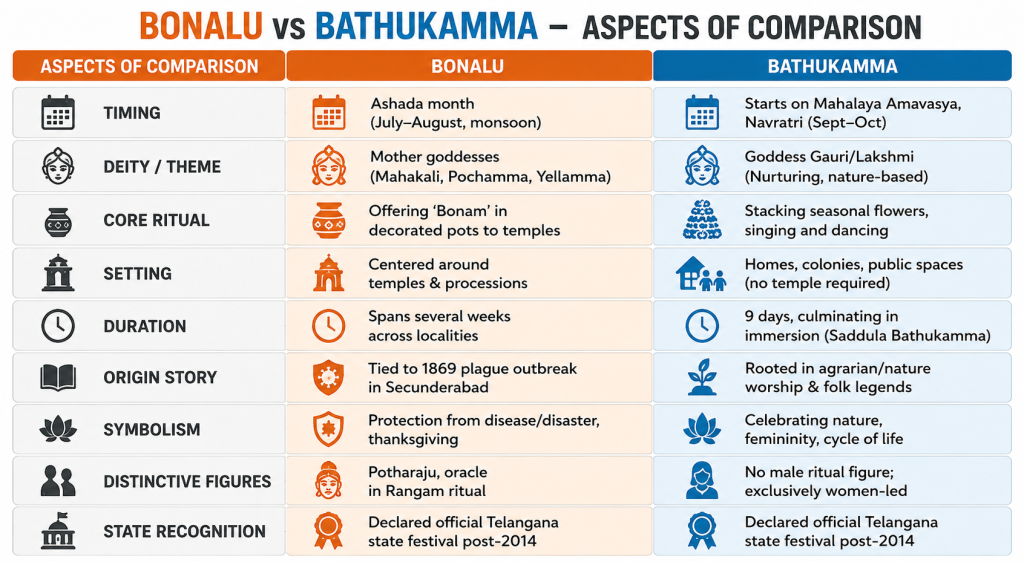
Bonalu is about appeasing and honouring a protective, sometimes fierce mother goddess during the vulnerable monsoon season (when disease historically spread), expressed through temple processions and pot offerings.
Bathukamma, celebrated a couple of months later, is a gentler, nature-centred festival where women create and circle floral arrangements to celebrate femininity, fertility, and gratitude to nature—with no fierce/protective undertone.
Together, the two festivals are often described as bookending Telangana’s festive calendar and reflecting two different faces of goddess worship—one protective and urgent, the other joyous and aesthetic.
From our archives:
Panguni Uthiram, an age-old festival of Tamil Nadu marking the marriage of celestial couples



