

Published Jul 20, 2026 | 3:49 PM ⚊ Updated Jul 20, 2026 | 3:49 PM

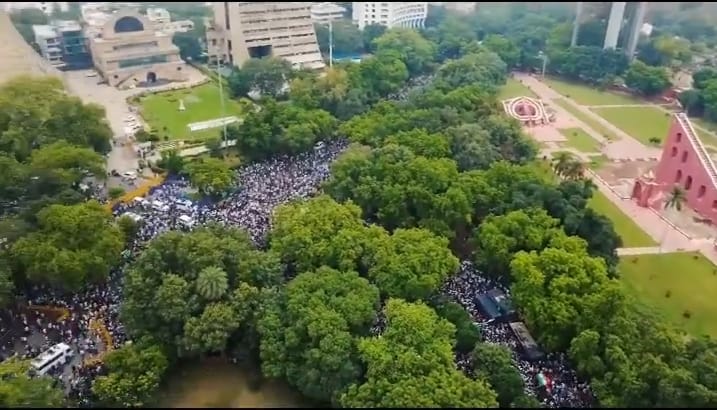
Various estimates suggested that nearly one lakh people gathered at Jantar Mantar and its nearby areas.(Screengrab)

Synopsis: Parliament witnessed continuous disruptions as Opposition MPs raised the CJP protest. CJP founder Abhijeet Dipke took out the march, which was joined by several Opposition leaders and MPs. Police resorted to a baton charge to disperse thousands of protesters — mostly youth — who reached Jantar Mantar, heeding Dipke’s call.
Issues raised by the Cockroach Janata Party (CJP) reverberated loudly in the Lok Sabha on the first day of the Monsoon Session on Monday, 20 July, even as protesters defied prohibitory orders and marched towards Sansad Bhavan — the Parliament House.
Heavy sloganeering by the Opposition and chaos forced the adjournment of both Houses. The Lok Sabha adjourned six times as Opposition MPs — some of them holding up posters — raised the vexed issue of question paper leak and CJP’s demand for Education Minister Dharmendra Pradhan’s resignation.
They also raised the Ayodhya Ram Temple donation fund theft issue.
The Lok Sabha was scheduled to reconvene at 3 pm. The Rajya Sabha will meet on Tuesday, 21 July.
Speaking in the Rajya Sabha, Congress leader Mallikarjun Kharge raised the CJP-led protest march and said, “Our youth is protesting on the streets for NEET paper leaks, but the government is trying to suppress their voice and lathi-charging the protestors.”
Meanwhile, in his customary remarks ahead of the Monsoon session earlier today, Prime Minister Narendra Modi refused to address the protests while taking a veiled jibe at Leader of Opposition in Lok Sabha Rahul Gandhi, stating that the youth of the country is “28 years old, not 56-year-old.
Also Read: Authorities planning ‘something heinous,’ says CJP’s Dipke
Despite heavy security cover and a prohibitory order promulgated under Section 163 of the BNS, over 10,000 CJP workers and supporters took out the planned Chalo Sansad — or the Parliament march. CJP founder Abhijeet Dipke and educator Gitanjali J Angmo — wife of climate activist Sonam Wangchuk — led the protesters.
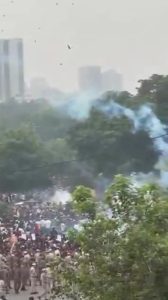
Security forces fired teargas shells to disperse the protesters. (Screengrab)
Several Opposition leaders, including All India Trinamool Congress MP Mahua Moitra, Aam Aadmi Party’s Manish Sisodia, Sanjay Singh and Atishi, also joined the march.
The Delhi Police, Rapid Action Force and the Central Reserve Police Force resorted to baton charge and fired teargas shells to disperse the protesters at several major points leading to the Parliament complex.
Meanwhile, the CJP said Union Minister JP Nadda reached out to the leaders, marking the government’s first attempt to reach out to the protesters almost a month after the protests were launched.
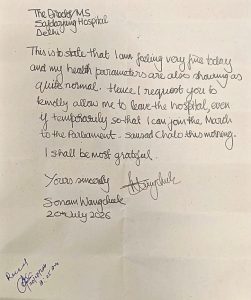
Sonam Wangchuk sought a discharge from the hospital to attend the march.
The CJP had earlier rejected a suggestion conveyed through the police — to hold talks with the District Magistrate, a senior Union Government Secretary, or a Minister of State. They insisted on meeting a senior Union Minister.
Earlier, Dipke ended his indefinite hunger strike at Jantar Mantar at the request of Wangchuk and the father of NEET student Riya Thapa, who had died by suicide. He began the fast after Wangchuk was forcefully shifted to the Safadarjung Hospital on Saturday, 18 July.
Dipke began the Parliament march after breaking the fast with a glass of water around 11.45 am. Around the same time, CJP’s Saurav Das and Ashutosh Ranka left to meet Nadda.
Wangchuk, meanwhile, demanded a discharge from the hospital so that he could participate in the march.



