

Published Jul 23, 2026 | 11:50 AM ⚊ Updated Jul 23, 2026 | 11:50 AM

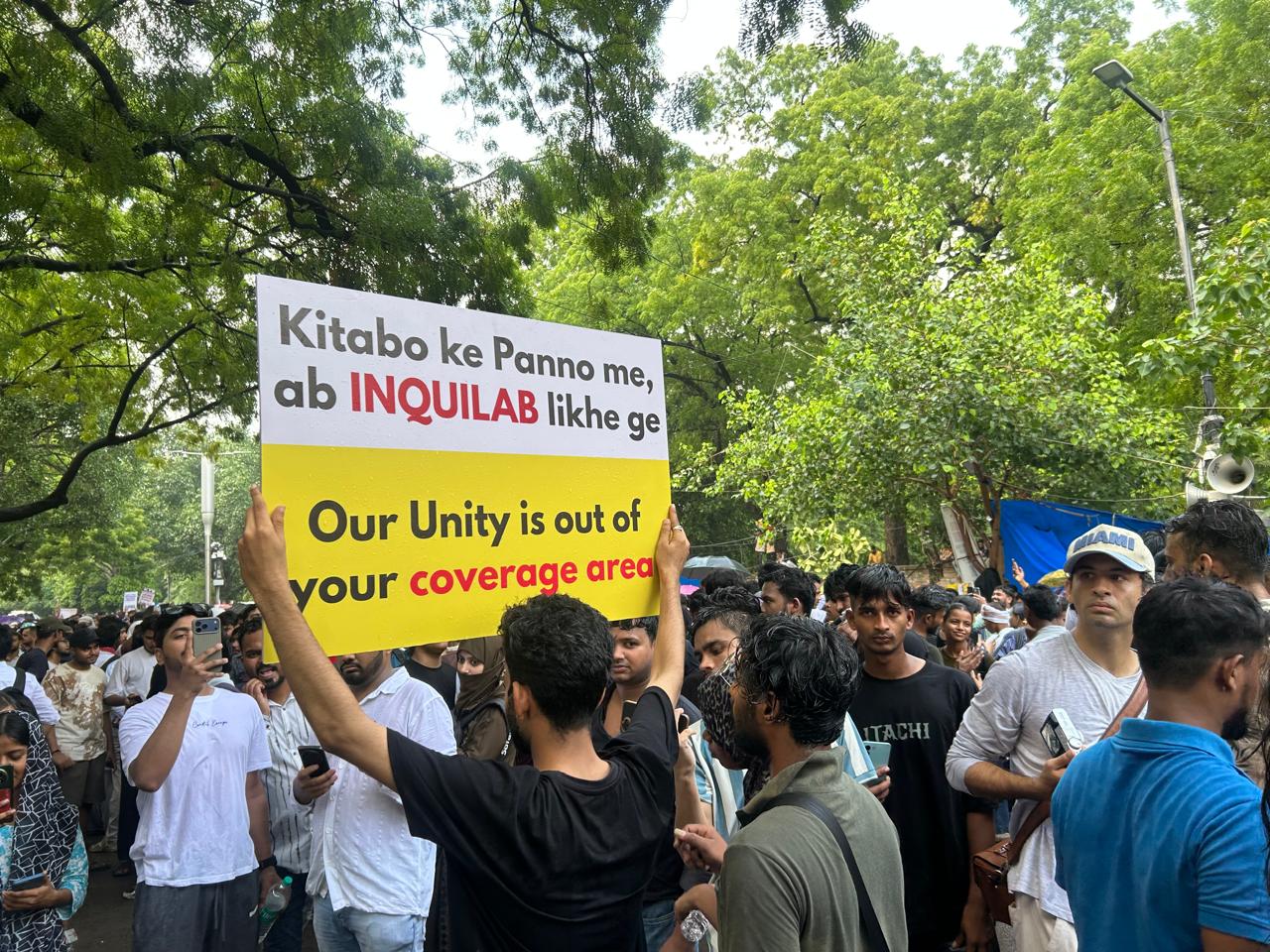
Students remain firm on their demand for accountability. (Sourced)

Synopsis: Students remain firm on their demands, seeking accountability and the resignation of Dharmendra Pradhan. More people are supporting the ongoing peaceful agitation. CJP’s Abhijeet Dipke says the BJP has inserted goons to foment violence.
A night after fresh tensions erupted during the ongoing protest led by the Cockroach Janata Party (CJP) in New Delhi, the morning of Thursday, 23 July, saw beefed-up security at Jantar Mantar, the protest site.
The Delhi Metro Rail Corporation closed 16 metro stations from 7.30 am until further notice to prevent protesters from reaching Jantar Mantar, even as the crowd at the protest site swelled and support poured in from across the country.
“Lok Kalyan Marg, Rajiv Chowk, Patel Chowk, Ramakrishna Ashram Marg, Barakhamba Road, Supreme Court, Seva Teerth, Janpath, Mandi House, Central Secretariat, ITO, Delhi Gate, Indraprastha, Khan Market, Jor Bagh and Shivaji Stadium metro stations have been closed till further instructions,” the DMRC said in a post on X.
Voluntary doctors have set up a makeshift clinic, providing basic medical support and supplies to protesters, including girls. Gig workers associated with food delivery platforms delivered food packets to the agitators, based on orders placed by unidentified supporters located as far as in Kerala.
CJP convener Abhijeet Dipke, meanwhile, urged the police and paramilitary personnel not to “obey illegal orders that ask you to beat up innocent protesters”.
Wednesday night witnessed friction between the protesters and security personnel on Tolstoy Marg. The tension was soon defused.
Dipke alleged that BJP-linked people from outside were being sent to Jantar Mantar to disrupt the protest. “Goons are being sent from outside by the BJP to deliberately incite people. These are the people from the BJP who are pelting stones. The police bring trucks of stones here. BJP goons come, they pelt stones and then defame the people of CJP,” he told reporters on Wednesday.
The agitation, spearheaded by students and youngsters, has taken on a pan-Indian character, with people of all ages, genders, religions, and languages voluntarily throwing in their weight, forcing the Union government to reach out to the leaders.
The protesters demanded the resignation of Union Education Minister Dharmendra Pradhan for the inept handling of competitive, life-defining examinations, including NEET (UG), 2026, and accountability in the Indian education and examination processes, among others.
Also Read: When young India found its voice at Jantar Mantar
NEET 2026 had to be scrapped following an alleged question leak. Students had been preparing for the entrance test to medical colleges for years, and several students died by suicide following the cancellation.
The examination was later re-conducted under military-grade security. Students, protesting against the NEET fiasco and seeking accountability, are now facing armed police and paramilitary forces in Delhi.
Beyond Delhi, tensions were reported in several parts of the country. In Bihar’s Patna, police tear-gassed CJP supporters, who took out a rally to the Lok Bhavan.
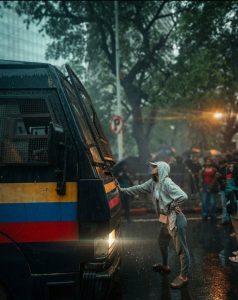
A woman, 27-year-old model Rhiya Ahir, preventing a police van from taking away protesters at Mumbai’s Shivaji Park. (SudhirSuryawanshi/X)
The Mumbai police have registered 13 FIRs between 18 and 22 July against 400 people. Authorities said demonstrations were staged in Shivaji Park, Chaityabhoomi, Chembur, Shiv Sena Bhavan and other places without the required permission.
Marine Drive in Kerala’s Kochi reverberated with chants of “Azadi” — or freedom — as the night progressed on Wednesday.
Also Read: When books clashed with police batons
Meanwhile, a Delhi High Court Bench of Chief Justice DK Upadhayaya and Justice Tejas Karia rejected the Delhi police’s contention that aggrieved protesters must individually pursue action against alleged brutalities and excessive use of force during the 20 July protest rally.
“Is it a case of some isolated individual incidents? Perhaps no,” Chief Justice Upadhyaya observed.
If it was an unlawful assembly as per the police claim, there is a law to deal with it. “There is a Supreme Court judgment (that prescribes circumstances and extent of use of force by police). If these issues are being raised in this PIL, how can you say every individual should go and lodge an FIR? If it is an isolated incident, you would have been correct in (saying), approach the magistrate and police station or lodge a private complaint, but this is not such an incident as is being asserted. We are not saying they (petitioners) are correct,” the Chief Justice added.
The Bench further asked the police to file responses within four weeks and to stick to the Standard Operating Procedure. The court has also asked the Centre to file its response to the police actions against students.
Several social media users alleged that certain police officers misbehaved with girls and women who took part in the 20 July rally.
Also Read: Annamalai, Ravi Shankar express support for students
Meanwhile, educator and climate activist Sonam Wangchuk, who has been on a hunger strike, said on Wednesday that he would end his fast and ask the students to “halt the movement for now” and enter into dialogue with the government if the Centre accepted his conditions.
The conditions included no legal action against the protesters, adequate compensation for the families of students who had committed suicide following the NEET question leak, and a meaningful discussion in Parliament to ensure accountability, including consideration of the resignation.
Wangchuck raised the condition in a letter to Union minister JP Nadda and Jitendra Singh. Incidentally, he mentioned “consideration of the resignation” instead of explicitly demanding Pradhan’s ouster from the Union Cabinet.
Also Read: Centre ready for Parliament debate on paper leaks
On Wednesday, police allegedly stopped a delegation of the opposition MPs from meeting Wangchuk at Medanta Hospital.
“This protest was going on for 22 days before the [Parliament] session began. Where was the Delhi government at that time?… Today, we went to meet Sonam Wangchuk. Why weren’t we allowed to meet him? We were stopped at the gate. His wife told us that there is no court order prohibiting anyone from meeting him…,” Mahua Majhi of the Jharkhand Mukti Morcha told reporters.



