

Published Nov 10, 2026 | 3:28 PM ⚊ Updated Nov 10, 2026 | 3:39 PM

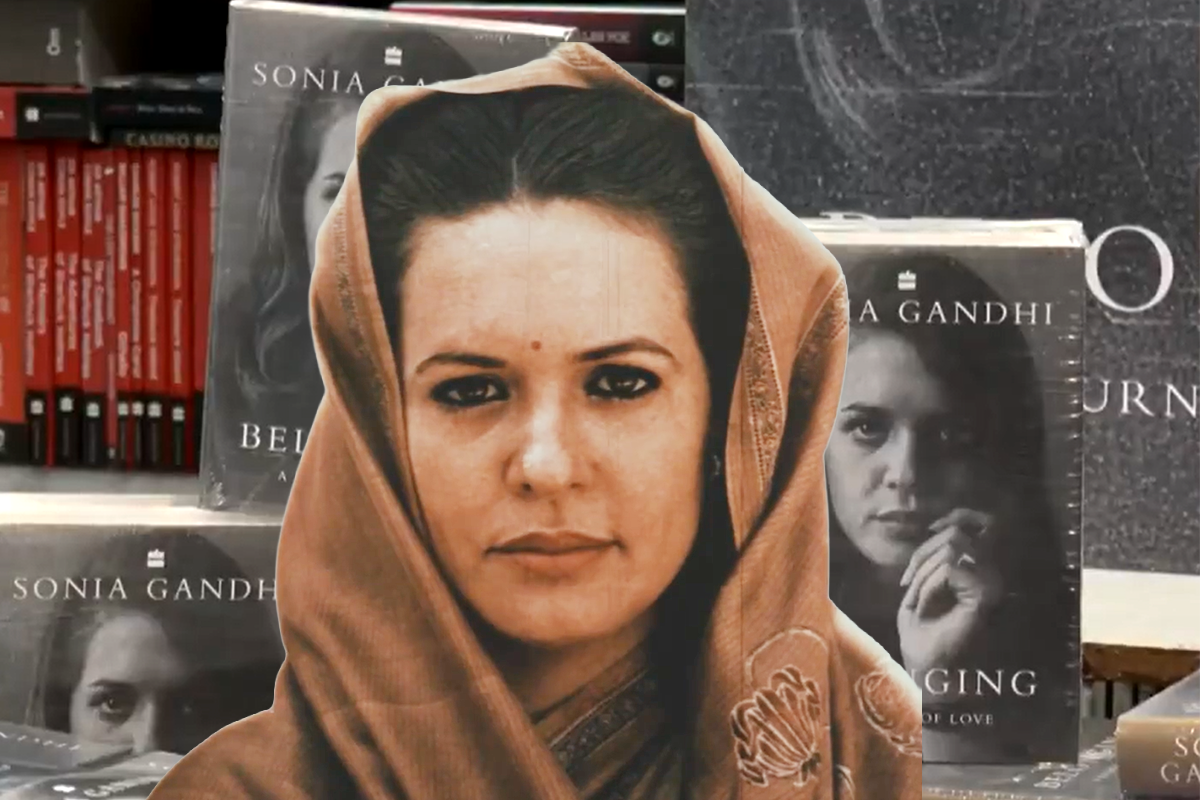
In Belonging: A Journey Of Love, Sonia Gandhi discusses her personal and political life spanning decades.

Congress leader Sonia Gandhi’s long-anticipated memoir is finally here. As expected, the 544-page book, published by HarperCollins India, delivers intriguing details: firsthand accounts of living within India’s most prominent political family, along with a front-row history of Indian politics.
In Belonging: A Journey Of Love, Sonia Gandhi discusses her personal and political life spanning decades, from her first impression of her mother-in-law and former prime minister Indira Gandhi to her life with Rajiv Gandhi and her interactions, or lack thereof, with Prime Minister Narendra Modi. She also shares anecdotes from meeting different world leaders, including former US president Bill Clinton.
Describing her interactions with PM Modi, which she says were very rare, Sonia Gandhi claims that the BJP leader avoids eye contact and tends to look away when they face each other.
“Narendra Damodardas Modi has been the prime minister of India for more than twelve years as of this writing and is now in his third term in office. To this day, I’ve had practically no real contact with him,” she writes.
“We meet at semi-official gatherings — for instance, at the end of every Parliament session, when leaders of the major parties customarily gather at the Speaker’s chamber. It’s a very small room, and usually many people are present, but when he comes face-to-face with me, we greet each other with a formal namaste. This is different from the past, when leaders across party divides would treat one another with cordiality. He tends to look away, avoiding eye contact,” Gandhi writes.
She, however, recalls an instance when Modi inquired about her health when she returned after a brief hospitalisation.
“Apart from such brief exchanges, we have never really conversed, though we’ve exchanged formal birthday and New Year greetings over the years,” the Rajya Sabha MP writes.
She also stresses her ideological differences with Modi, stating that her idea of India is drastically different from the BJP leader’s “fundamentalist” idea, which was inculcated in him by RSS ideologues.
“All I learnt about India was assimilated from the members of my family, their lives of service, and their faith in a nation that encompassed a host of races and cultures, languages and faiths, based on principles of liberty and equality for all. Narendra Modi’s idea of India was constructed by the ideologues of the RSS and the experience of his own growing up. It affirmed a fundamentalism in which his faith and culture superseded all others,” she writes.
“He was fighting for his vision of India, and I for mine: an India against hegemony, an India that stands for inclusiveness, secularism, and social justice. It wasn’t personal,” she says.
She, however, mentions that some of the elements of Modi’s “discomfort with the ruling elite” were something she could resonate with.
“But there were elements of his discomfort with the ruling elite of our times that I too had come to understand well. I often found myself ill at ease in a drawing room in Delhi in the midst of a political discussion — feeling that the opinions expressed were very far removed from the reality of India. The suffering, the struggle to survive, that I had witnessed in my constituency and seen in my travels through the country were to this privileged group unimaginable,” she says.
She talks about the prime minister’s speeches in Parliament, which she describes as similar to his addresses at public rallies and his “tirades” against former prime minister Jawaharlal Nehru. She discusses the BJP’s stated aim of a “Congress-free India” too.
“I tend to believe that this antipathy stems from the conditioning of the prime minister by the RSS. It has inculcated in its cadre a commitment to an exclusionary, hardened version of Hinduism that has been crafted into a political agenda,” she writes.
In her book, Sonia Gandhi gives a rare glimpse into former prime minister Indira Gandhi’s personality in the initial years of her marriage to Rajiv Gandhi.
“What I found most alarming was my mother-in-law’s occasional explosions of temper. They could freeze the staff into numbness. On one occasion, a member of the staff who had forgotten to remind her of an important appointment, and not for the first time, was made to stand in a corner of the room while others hurriedly passed by, all feeling rather embarrassed,” she writes.
Gandhi also remembers noticing a “kurta-dhoti-clad individual standing immobile in the corner, staring at the wall” in another instance.
“I was not yet familiar with who was who in the political pantheon, but the fact that he was within our private space signalled that he must have been a Congress Party senior. I was with Amie Aunty for a good half an hour, and when I walked back, the man in white was still stuck to the wall as ordered by my mother-in-law, I learnt later,” she says.
She also recalls that the former prime minister would occasionally “flare up” at mealtimes, when in Parliament there had been “a particularly unpleasant exchange with the opposition.”
She remembers one such occasion when Indira Gandhi pushed her thali to the other side of the long dining table in a “fit of anger.”
“Such outbursts would unsettle me, reminding me of my father’s explosions. While I’d feel perturbed and shaken, Rajiv and Sanjay would wait silently for the unpleasant moment to be over,” she writes, adding that her husband would reassure her, “Don’t let yourself get so scared. She’ll be all right in no time.”
“But until I got to know her well, I’d quake in my seat. She normally repented her outburst and, in her own way, communicated her regret to whoever had annoyed her. But if a colleague had betrayed her trust, she didn’t relent; she’d distance herself and not ever deal with that person again,” Gandhi writes.
In an interesting anecdote on the India visit of former US president Bill Clinton in 2000, Sonia Gandhi writes, “The Monica Lewinsky scandal had subsided a little by then, but old habits die hard; at the reception held by Prime Minister Vajpayee in his honour, I noticed him now and then surreptitiously sizing up the more striking women present.”
She also writes about how Clinton was keen to express his own views regarding Kashmir while not having ears for what the Indian leaders had to say.
“President Bill Clinton was staying at the Sheraton hotel with his daughter, Chelsea, and his delegation in 2000 when I called on him with our foreign minister. Friendly, informal, and exuding confidence, he appeared more keen to give us his own views and predictions about Kashmir — ‘a nuclear flashpoint’, in his words, ‘one of the most dangerous places on earth’ — than to pay attention to our point of view,” she writes.
Also Read:
Sonia Gandhi’s memoir: When publishers start censoring ideas
(Compiled and edited by Fayisa CA.)



