

Published Oct 15, 2026 | 2:00 PM ⚊ Updated Oct 15, 2026 | 2:00 PM

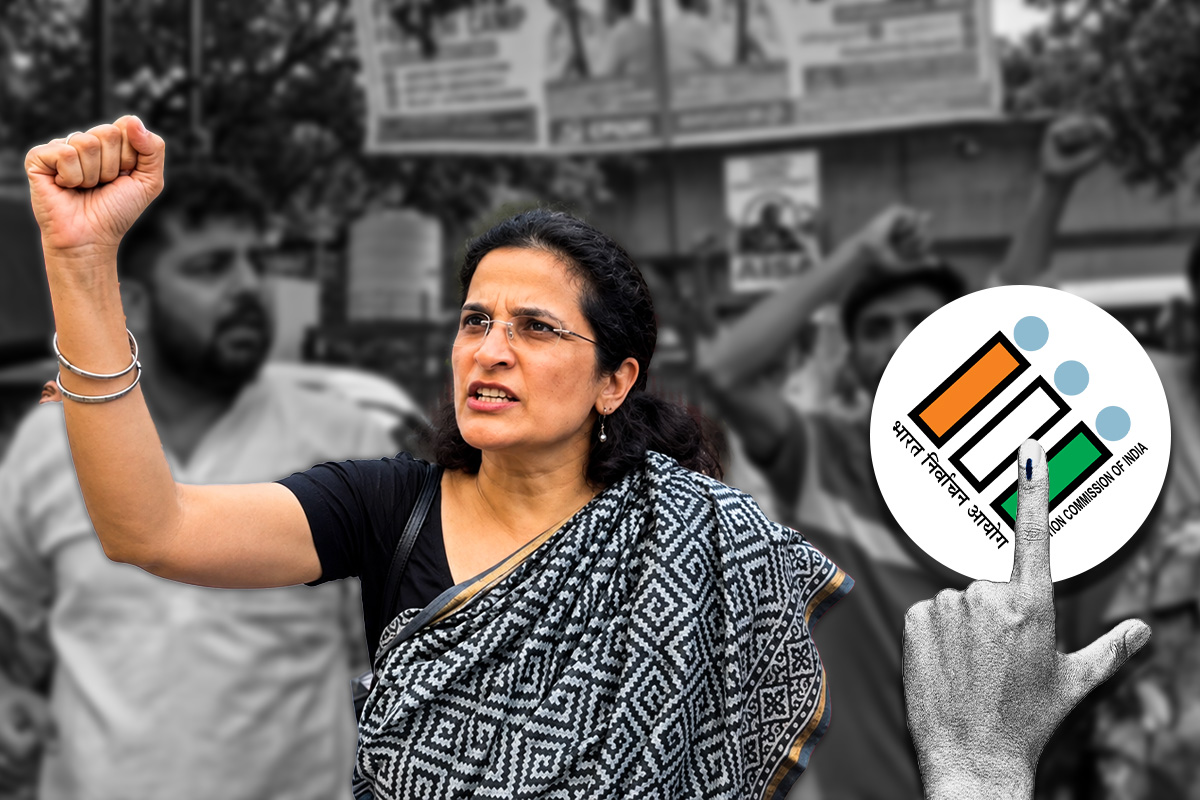
Anjali Bhardwaj highlights the problems with the ECI’s response to her RTI query and broader concerns over citizens’ right to information.

Synopsis: RTI activist Anjali Bharadwaj says the ECI’s failure to provide records explaining the basis for the SIR of electoral rolls and who took the decision to conduct it raises serious questions about the poll body’s independence. In a conversation with South First, she discusses how the RTI Act has been gradually stripped of its effectiveness and how the Lokpal has become a completely lacklustre body.
In 2025, when the Election Commission of India (ECI) was conducting the Special Intensive Revision (SIR) of electoral rolls in Bihar, ahead of the Assembly elections, Right To Information (RTI) activist Anjali Bharadwaj sought to know who took the decision to carry out the exercise. The answer was baffling.
The ECI said it had not taken the decision and had no other information. That was just the beginning of several questions regarding the constitutionality, legality, credibility and transparency of the SIR process.
In conversation with South First, Anjali Bhardwaj highlights the problems with the ECI’s response to her RTI query and broader concerns over citizens’ right to information as the RTI Act marks 21 years. She also discusses how institutions such as the Lokpal, established under the Congress-led UPA regime following a popular movement for accountability, have been rendered toothless under the BJP-led NDA government.
Edited excerpts follow.
Q: In 2025, you sought to know who ordered the SIR process. The answer you got from the ECI was quite shocking. Clearly, we still have no answers on whose idea this was. Can you take us through the query? What did you ask, and what is the response you received?
Bharadwaj: In a democracy, one major fundamental right that we have is the right to information. When the ECI announced that they are going to start the SIR exercise from Bihar and take it across the country, they did not give any information to the people.
They did not consult with the people and offer an explanation as to why they were undertaking the exercise, which was very baffling. After all, this is an exercise which involved around one billion voters across the country. It required them to produce documents and establish their eligibility for inclusion in the electoral rolls. Yet, the Commission did not explain why it wanted to conduct the exercise.
In an affidavit filed in the Supreme Court, the ECI said the SIR was being undertaken “on the basis of an independent appraisal.” So, I filed RTI requests to the Commission, in which, I asked for two things.
One, I asked for the copy of the independent appraisal on the basis of which the ECI decided to undertake the SIR exercise. To this, the ECI responded “that no material exists on this, so no information can be provided,” which was really shocking.
Second, I sought a copy of all the files linked to the decision to undertake SIR. The Commission responded by saying that “information does not exist in material form,” which again was baffling. The ECI was saying that it did not have any files related to the decision it had taken.
Following this, I filed a first appeal, to which Principal Secretary of the Election Commission, Mr TC Kom, gave me a written response. Kom’s response read, “we want to inform you that no such decision to take up an intensive revision exercise across the country has been taken by the Election Commission of India.”
This raises serious questions on the constitutionality of the SIR exercise.
Under Article 324 of the Constitution, only the ECI has the right to make and revise voter lists. If the ECI is saying in writing that they did not take the decision, then who did? Was it taken by the political executive? Maybe by Amit Shah or the PMO? This strikes at the heart of the question of whether the SIR was indeed a constitutional exercise or not.
It also raises very, very serious questions about the independence of the referee, the ECI. If the referee is not independent, then how do we trust the voter lists? And then how do we trust the electoral process and the electoral outcomes?
Also Read: ‘SIR is a bloodless political genocide to exterminate citizenship’: Dr Parakala Prabhakar
Q: How does one view such a response from the ECI? Is it lack of information or the unwillingness to share it?
Bharadwaj: This is not a question of them denying information. TC Kom made a categorical statement that the ECI did not have any files related to the decision to conduct the SIR.
It is not about lack of transparency. It is a categorical admission that the ECI did not take the decision. It shows that the ECI is then doing somebody else’s bidding. It indicates that the ECI was asked to conduct the SIR. The files, therefore, must lie somewhere else. Now where that is, only time will tell.
One of the things the opposition parties have done is that they have used the information obtained by me and filed a petition in the Supreme Court. They have sought the files and records to be submitted by the ECI to the court. Now the apex court has to summon all records related to the SIR and satisfy itself and the people of the country that the ECI was indeed working independently, if it was.
Today, people’s faith is shaken, and rightly so. The faith of opposition parties is shaken, and rightly so, because the ECI has admitted that the SIR was an unconstitutional act.
An exercise of this nature, it cannot be done without prior planning and consultation. When I filed the RTI query, I was actually trying to understand who the ECI had consulted before taking this decision. Who were they in touch with? Because we know that there were no public consultations, which is actually very concerning in itself. The opposition parties were also not consulted.
So my question to the Commission was, what was the process? Did they write to any ministries? How did they take the decision? Who did they consult with? Even in my wildest dreams, I had never thought that the ECI would say, ‘we didn’t take the decision’.
Q: Is this symptomatic of the state of RTI in the country over the last few years? As somebody who’s been engaging with information transparency for more than two decades now, perhaps you’re the best person to tell us, where does RTI stand today, 21 years after it was given to the people as a tool for accountability?
Bharadwaj: Right to information is a fundamental right. The Supreme Court has said it for more than five decades. It flows from Article 19(1)(a) of the Constitution, which is freedom of speech and expression. If we don’t have information, we cannot express ourselves freely. We need information for meaningful, informed speech and expression.
Unfortunately, there was no law governing the exercise of people’s right to information. For a long time, a sustained movement involving people across the country demanded that such a law be enacted. Finally, in 2005, the Right to Information Act was introduced at the national level.
It was considered to be a progressive law because it came from a strong people’s movement. The law has been used by common people to access their basic rights including ration, pension, education and healthcare. It has also been used by people to hold the highest offices of the country accountable.
I cannot think of any major scam or corruption scandal that has come to light over the past 20 years in which the RTI has not played an important role. Whether it was the Adarsh scam or Vyapam scam, or even the electoral bonds scam, RTI has been used to access information, expose wrongdoing and corruption, and hold those in power accountable.
So clearly, no government likes the RTI as no government likes transparency. And yet, we have seen that the law was not amended until about 7 years ago. The last 8 to 10 years, we have seen a systematic pushback and restriction of people’s fundamental right to information.
The BJP government has pushed through two amendments to the law, including a provision that stripped information commissioners, who serve as the final appellate authority under the Act, of their powers by empowering the central government to determine their salaries, tenure and pensions.
A second amendment was brought in citing data protection and restrictions were placed on seeking ‘personal information’. The danger of this is that imagine people asking for the names of contractors who built bridges that collapsed. In Bihar, we’ve had 19 or 20 bridges collapse in one year. Under the amended law, people are being told, ‘sorry, this involves personal information’. So how will people use the law to hold anybody accountable?
Under this regime, there has also been a systematic denial of information. Restrictions were placed on access to information about electoral bonds and PM CARES under the RTI Act, even though such information is critical for the public to know. And here we are seeing that the ECI also seems to be now working in exactly the same spirit.
There is no place for this kind of secrecy, lack of transparency in a democracy, certainly no space for something like this in an exercise like SIR. There is some information which can be exempt under the right to information law, something that deals with a fiduciary relationship or violates the privacy of individuals.
But things like the functioning of the ECI, the decisions taken by the poll body, on what basis are people being removed from the voter list – all of this is basic information.
Look what happened with Form 6. The Chief Election Commissioner went ahead and made changes to Form 6. When this was challenged as illegal, the ECI claimed that the Supreme Court had permitted it to do so. The Supreme Court then came out and said it did not approve it.
All of this is happening behind a veil of secrecy, the ECI seems to be getting away with illegalities and unconstitutional acts. This is what happens when institutions work in secrecy, it becomes dangerous for democracy. Imagine if all of this was in the public domain. People would have prevented the ECI from doing illegal acts.
Q: You spoke about privacy and exemptions under the RTI. In Delhi, under the garb of maintaining law and order, the police did not think twice before using surveillance equipment, including smart glasses, during the recent protests. When there is use of technology for mass surveillance, the government thinks it is alright to say, ‘I have no information, and whatever information I may have, I’m not compelled to share it’ with activists or citizens.
What explains this phenomenon? Do you believe it is the lack of intent to be more transparent or accountable? Or is there malice?
Bharadwaj: The Supreme Court has recognised both the right to privacy and the right to information as fundamental rights. Unfortunately, the current government is trying to play with it.
When people ask the government for information, for example regarding assets and liabilities of public servants or the travel details of the Chief Election Commissioner, they are being told no on the grounds that it is personal information. But when it comes to surveilling citizens, as in the case of the protesters you mentioned, the government does not seem concerned about privacy.
The government needs to understand that people are able to see through this. We are aware of our constitutional, fundamental rights as citizens. We must be able to obtain information that can be used to hold the government and public functionaries accountable. At the same time, our privacy as citizens must also be protected. So it is very, very important that these two fundamental rights be balanced very carefully.
And framing all protests and acts of dissent as a law and order situation is dangerous. People raising their voice against injustice and illegality cannot be just termed as a law and order problem.
Look at the Jantar Mantar issue. What has the government designated instead of Jantar Mantar? CBD, Burari grounds, Ramlila grounds — we have not even heard of these places. This is a clear clampdown on people’s right to protest. Send them away from the Parliament, from the city so that people can’t see them.
This is not how democracies function. Look at what is happening in Paris, Washington, New York, London and other democracies when people fill the streets in protest. Nobody calls it a law and order situation. The police have training in crowd management. Training is not using force.
You say this is a law and order problem. Let’s drive everybody away from the streets. That’s not what you’re supposed to do in a democracy. What you are supposed to do is to make sure that people can peacefully protest.
Also Read: Jantar Mantar denotified: When democracy is asked to move away
Q: The last time there was a mass people’s movement in Ramlila, the government in Delhi changed. Right now the government has designated Ramlila Maidan as an option for people to protest. The protest that we did see previously in Ramlila was focused on transparency, on accountability, on Lokpal. Can you help us understand what has become of the Lokpal after this mass movement?
Bharadwaj: Many of us were involved in that movement demanding an independent and empowered anti-corruption Ombudsman. We know that corruption is a serious problem in our country. It runs from the highest to the lowest levels. It can involve powerful individuals, even the prime minister. We needed a body that was independent of the government and empowered to act against corruption committed by the most powerful people in the country.
It was a very strong people’s movement which finally paved the way for the current government. However, it is an absolute shame that the Lokpal Act, which was brought in after such a strong people’s campaign, has been rendered toothless today.
The Lokpal Act was passed in 2014, but for five years, not a single Lokpal was appointed by the BJP government, which came to power riding on the back of the anti-corruption movement. It was not until 2019 that the Lokpal was appointed for the first time. So you can imagine the political will of the current regime, rather the lack thereof, as far as anti-corruption is concerned.
Under the law, the Lokpal had to be appointed by a selection committee which included the Leader of Opposition. The selection committee set up by the BJP-led government did not have an LoP as no opposition party had the required seats to claim the post.
The government could have included the leader of the single largest opposition party in the committee, but that was not done, which meant that the government had a majority in the selection of the Lokpal. The resultant Lokpal did not have the trust of the people, because they were essentially seen as close to the government in power.
We have seen how the Lokpal has been a completely lacklustre body. There have been numerous allegations of corruption. The electoral bonds revelations exposed instances of alleged quid pro quo and regulatory inaction. The Lokpal should have intervened and taken up these matters, but it has done little in several cases, including those involving the Rafale deal and electoral bonds. Instead, it has largely pursued allegations against opposition leaders, among others.
It is really unfortunate that a law like this was passed after so much agitation, only for its autonomy to be compromised. It has been rendered absolutely ineffective and useless in today’s environment.
(Edited by Fayisa CA)



