
Published Nov 02, 2026 | 2:09 PM ⚊ Updated Nov 02, 2026 | 2:09 PM

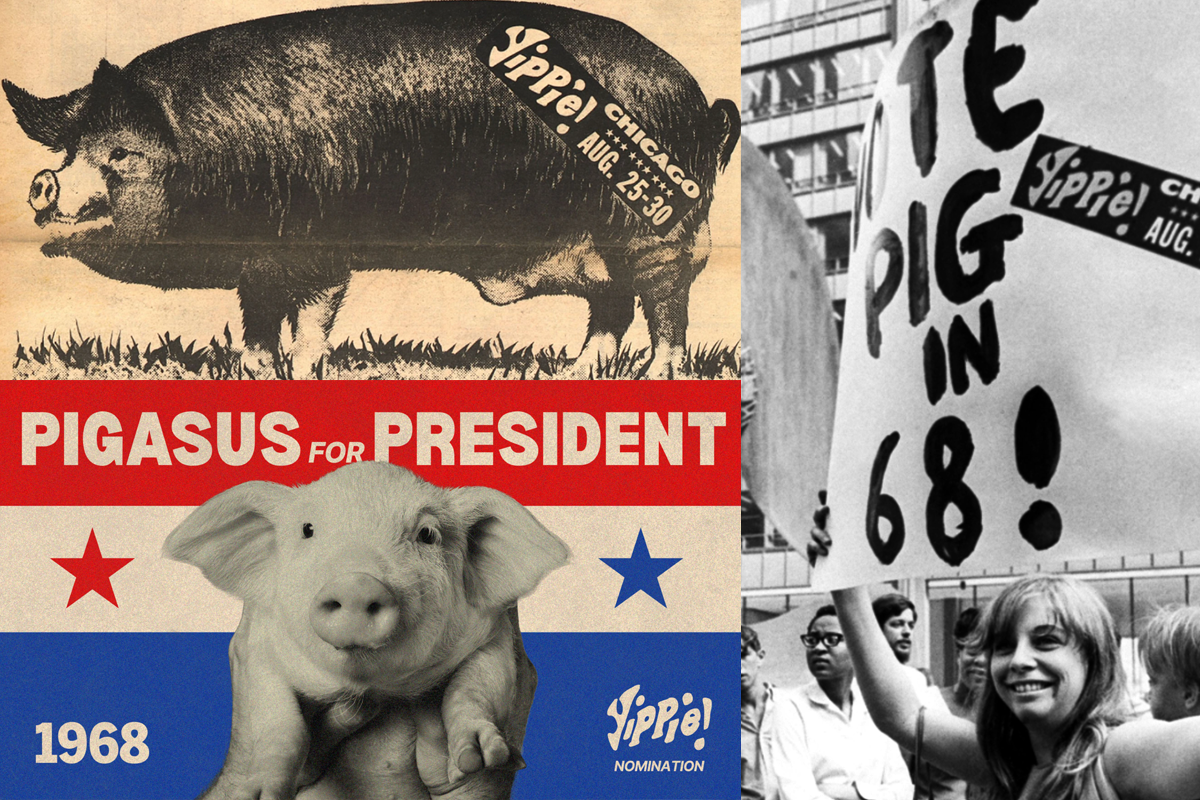
An illustration of Pigasus from the Berkeley Barb in 1968.Berkeley Barb. (Photo | chicago.suntimes.com)

It is the Age of the Young again. From Europe to India, the youth are shaking and stirring the establishment. Well-entrenched leaders like Viktor Orbán and Aleksandar Vučić have already had to bow down in their wake.
India might not have seen the old order give way to the new yet. But an infectious fearlessness is marching on the streets, and it’s the 12-year-old government at the Centre that is seemingly out of step and scrambling for answers. What a fall, in particular, for Prime Minister Narendra Modi — the world’s most followed leader on social media — who was reduced to posting “uncle selfies”.
As we all know, the twist in that tale came with a “What if all cockroaches unite” call from a then-unknown Master’s student in Boston on social media at 0911 am IST on May 16. Two and a half hours later, at 1142 am to be precise, Abhijit Dipke shared a Google Form inviting the “Unemployed, lazy and chronically online” folk with an ability to rant professionally. In three days, the CJP Instagram account would boast more followers than the BJP. Just a little over two months later, a protest movement kickstarted by the Cockroach Janta Party would go on to gain the scalp of Dharmendra Pradhan, the Union Education Minister who announced his resignation on X.
The roaches had done it in gloriously unpredictable fashion and at a speed in keeping with the social media age. “Subah ho gayi mamu,” Dipke declared, borrowing a famous line from the film Munna Bhai MBBS after dropping to his knees and banging his fists in joy.
The Cockroaches are now an integral part of the campaign to oust Gyanesh Kumar and restore democracy. And all of India, home to almost 400 million under-29s, is waiting to see where all this leads.
For 81-year-old Abe Peck, watching it all unfold from Santa Barbara in California, the rise of the Cockroach Janta Party brings back memories of when he and his fellow conspirators slipped a pig into the 1968 US presidential race.
New Jersey pig farmer Henry J Krajewski had made three unsuccessful runs previously in the 1952, 1956 and 1960 US presidential elections. A friend, Joe McKay, had been quoted by the New Jersey Monthly as remembering that Henry, who died at the age of 54, believed in the “two-party system — one on Friday nights and one on Saturday nights.”
Krajewski, who arrived proclaiming that “The Democrats have been hogging the administration in Washington for 20 years, and it’s about time the people began to squeal”, had his best showing in 1952 when he won 4,203 votes.
Sixteen years after the pig farmer arrived on the scene, a pig went on to have a brief tilt at running for president.
First, the beginnings. Abe recounted how “at the dawn of 1968, a group of New York-based activists coined the idea of the Youth International Party. The idea was to channel increasingly widespread counter-cultural (“hippie”, “freak”) dropout/alternate society energy toward political engagement.” Echoes of the CJP, anyone?
1968 in the US was a year of tumult. There were also massive student protests in France, West Germany, Italy, Poland, and Mexico. Echoes of 2026, anyone?
The “Crack the sky, shake the earth” Tet Offensive that 85,000 North Vietnamese troops launched on January 31, 1968, cost the US 500 soldiers a week in the initial phase. It laid bare then-US President Lyndon Johnson’s lie that the war in Vietnam was ending and triggered massive anti-war agitations across the United States.
Such was the anger that there was rioting at the 1968 Democratic National Convention held from August 26 to August 29, 1968, in Chicago.
Abe, then a 23-year-old hippie and the editor of the underground newspaper Chicago Seed, was around. He was also a Yippie, a member of the Youth International Party. Time estimated that the Yippies’ following could have reached 250,000, describing their outlook as “basically satirical”.
“The 1968 Democratic Convention in Chicago was a target for an array of groups from civil rights to anti-war (the Republicans were seen as irredeemable). The Yippies had Movement experience, but really didn’t know anyone in the Chicago community, and I became a co-conspirator for organising imaginative demonstrations,” Abe remembered.
He went on to explain what inspired the Yippies to nominate a 66-kg pig to run as the presidential candidate.
“The idea of the pig was that mainstream political leaders were at the trough of corporate greed and complicit with the Vietnam War. This surreal approach appealed to a collective, drop-out culture of young people,” Abe said.
“Some of what was being endorsed was piggish, so why not run a real pig?” he had said on another occasion.
The pig that would become the emblem of Yippie angst and restlessness emerged from a debate.
Some of them wanted a cute, Porky Pig-style candidate, while the others preferred a fierce wild boar. Eventually they settled on the black pig with white spots, whom they found at a pig farm with “mud on her face” and “a torn ear”. She would cost the Yippies $20. Having earned the right to name her, they anointed her Pigasus the Immortal.
Pigasus was presented to an enthusiastic crowd during an impromptu press conference at the Richard J. Daley Centre. But the event was soon cut short by the Chicago police, who had little patience for “porcine politics”, and the Anti-Cruelty Squad took Pigasus away.
Abe, while reflecting on whether the moment of political theatre worked, said, “Yes and no. Pigasus resonated as a clever idea for “freaks,” bringing recruits and attention to the planned demonstrations. But a small group’s dependence on mainstream media for attention led to putting forth increasingly outrageous claims that, while often entertaining, somewhat freaked out the Mayor’s office and the Chicago police, who increasingly sought to suppress any opposition to the showcase Democratic Convention.”
Abe had another part to play in the story, tasked as he was by the Yippies with retrieving Pigasus along with his friend Steve Mrvos, who looked like “Jimi Hendrix with a stovepipe”. The duo failed in their mission, and for many years since, the Yippies and Abe lived in the belief that Pigasus had been “roasted and eaten at a Chicago Cops barbecue”, as they told the BBC.
A Chicago Sun-Times hunt in 2025, though, found evidence that she might have been “rehomed to a farm in Grayslake”.
Abe reflected that “both Pigasus and Cockroach Janta Party hold a similar appeal to the young, alienated people who perceive corruption and envision a better, less hierarchical way for humans to interact in society.”
He went on to observe how “co-opting the Chief Justice of India’s comparison of demonstrators to cockroaches has tapped into discrimination around class and ageism and mobilised thousands. The protests have triggered official and police over-reaction, which in turn can expose abuses of power but also alienate folks in the middle if too outrageous.”
Abe also said that the Cockroach Janta Party “will need to decide how their goals align with mainstream party considerations, or risk becoming like those they set out to challenge. As The Who sang back in my day, ‘Meet the new boss, same as the old boss‘.”
And then there is social media, which the Yippies could not put to use.
“Of course, we didn’t have that. The underground media, fliers and use of discounted youth airfares helped spread our word, but now ideas spread (better or worse) at warp speed,” the one-time associate editor of Rolling Stone added.
The Indian government sure would agree.
From our archives:
Lest we forget, India resisted Modi and his men long before the Gen-Z agitation
Withdrawing consent: Gene Sharp and the Cockroach uprising
(Acknowlegments to Rob Peck, who lit the spark and got his dad to go down memory lane.)



