

Published Jul 26, 2026 | 11:41 AM ⚊ Updated Jul 26, 2026 | 1:07 PM

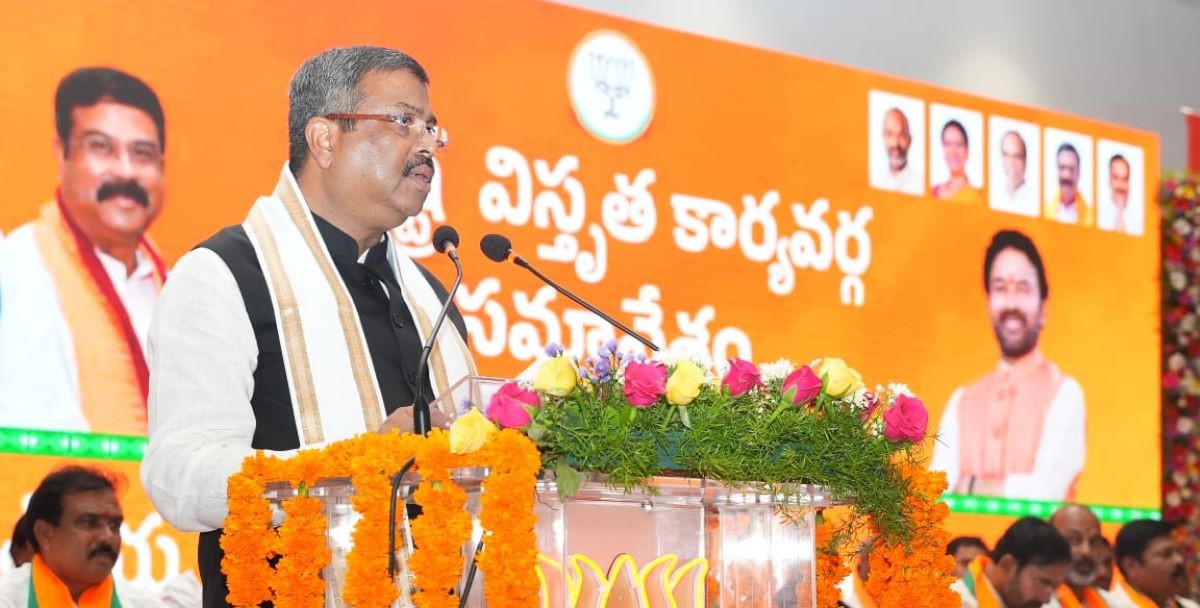
Dharmendra Pradhan addressing Telangana BJP. (Supplied)

Synopsis: The BJP-led Union Government’s 12 year tenure has seen four education ministers with their own controversies. Dharmendra Pradhan, who is the only minister to last five year in office was however the first to tender a resignation. While Pradhan’s tenure was marked by paper leak controversies, others came under fire over multiple issues including police crackdown on student activists and the National Education Policy (NEP).
Union Education Minister Dharmendra Pradhan resigned on Saturday 25 July, marking the very first instance where a senior minister in the the Prime Minister Narendra Modi-led government bowed out owing to public pressure. The NDA government’s 12 year tenure has seen a total of four education ministers and multiple controversies from Rohit Vemula suicide to NEET-UG paper leak. Pradhan is the only one to last five years in office. Here is a look at the four education ministers and their tenure:
Smriti Irani was appointed the Minister of Human Resource Development (HRD), after the Narendra Modi-led government assumed power for the first time in 2014.
A highlight of her tenure was the roll back of Delhi University’s Four-Year Undergraduate Programme (FYUP). She oversaw the implementation of several digital initiatives in school and other institutes. She launched the National Institutional Ranking Framework (NIRF) to rank higher education institutions and also initiated the drafting of the controversial National Education Policy (NEP).
In 2016, two years after she assumed office, Rohit Vemula, a Dalit PhD scholar at the University of Hyderabad died by suicide allegedly due to caste discrimination by the administration, sparking widespread student-led protests. Students and family described Vemula’s death as an “institutional murder” and accused Irani of abetment through political interference leading to disciplinary action against him, which allegedly prompted the tragedy. Her statements in Parliament defending the administration’s action against Vemula also sparked widespread criticism. In the same year, Smriti Irani also came under fire for the arrest of student activists including Kanhaiya Kumar and Umar Khalid in a sedition case and her subsequent defence of the police action in the Parliament.
Amid the controversies, Irani was moved to the Textiles Ministry in the Modi government’s first Cabinet reshuffle in July 2016. After the 2019 Lok Sabha elections, Irani was given the charge of Ministry of Women and Child Development and the Ministry of Minority Affairs. She lost the elections in 2024 polls.
Also Read: At Jantar Mantar, a generation that stopped being afraid
Prakash Javadekar took over as the HRD minister in July 2016 after Smriti Irani’s removal. It was under his watch that the controversial National Testing Agency (NTA) was created to conduct major examinations including the NEET. The Indian Institutes of Management (IIM) Act which declared IIMs as ‘Institutions of National Importance’ was passed during his tenure. Javadekar’s term also saw the Right to Education Act being amended to scrap the ‘No-Detention Policy’ that had prohibited failing children in classes 5 and 8.
The ministry came under fire in 2018 after the CBSE board exam papers for Class 10 Mathematics and Class 12 Economics leaked ahead of the examinations. The agency conducted a retest for the Class 12 paper while claiming that the Class 10 paper leak was limited and did not warrant a re-examination. Javedkar remained the minister until the end of the first Modi government’s tenure and returned to take charge of the Environment and Information & Broadcasting ministries. Ahead of a cabinet reshuffle in 2021, Javadekar resigned from the Union cabinet.
Also Read: ‘Foul on democracy, red card for brutality’: How students beat the BJP at their own game
Ramesh Pokhriyal was appointed the HRD minister after the BJP returned to power in 2019. The NEP was announced the next year and the HRD ministry was renamed to the Ministry of Education. However, the implementation process was slow during his term. Pokhriyal oversaw online classes, board examinations and other digital initiatives during the COVID-pandemic era. He was tested positive for Covid and later resigned citing health reasons during the 2021 Cabinet reshuffle.
Also Read: Modi blinks as Dharmendra Pradhan resigns; Ex-Education Minister addresses youth on X
Dharmendra Pradhan replaced Pokhriyal as the education minister in July 2021. His tenure saw the proper implementation of the NEP, amid mounting criticism from opposition parties and student groups. Pradhan’s tenure was marred by repeated paper leak allegations involving the NEET-UG and UGC-NET examinations intensifying scrutiny on the NTA and finally leading to the student-led movement and his subsequent resignation.
The student-protests led by the Cockroach Janta Party have been successful in pushing the Modi-government to make an unprecedented move but Pradhan is unlikely to fade into oblivion and remains an important leader for the BJP. This was reflected in Union Home Minister Amit Shah and other senior leaders visiting Pradhan immediately after he announced his resignation.
Meanwhile, long time RSS-associate and senior BJP leader Pralhad Venkatesh Joshi has taken over as the education minister. It remains to be seen whether Joshi is able to meet the demands raised by the students.
(Compiled by Fayisa CA)



